119. JOURNAL OF THE SOCIETY OF COSMETIC CHEMISTS rors have serious consequences when one is appraising efficacy in a small panel of "dandruff" subjects. Quite recently, another disease, atopic dermatitis, has impressed us by its ability to mimic dandruff. We became aware of this source of error when puzzling over why "dandruff" patients failed to respond to highly effective antidandruff preparations. It turned out that these subjects had atopic derma- titis, often with a background of infantile eczema in association with a family and personal history of respiratory allergies. Since atopics are notoriously unable to tolerate anionic soaps and surfactants, failure to respond to anti- dandruff shampoos should immediately arouse the suspicion that the subject does not have dandruff. When we find that all but 1 of 10 subjects improve, we immediately review the case. Our belief is that dandruff is never com- pletely resistant to such potent drugs as selenium sulfide (SeS) and zinc pyridinethione (ZPT). II. PRUVALU•CE For the most part, statements concerning the proportion of pcrsons who have dandruff are merely "guesstimates." Systematic epidemiologic surveys are expensive and laborious dandruff is, after all, not a health-threatening disorder. To be meaningful, a large unselected rigorously defined population would have to be examined. The frequency with which physicians encounter dandruff patients in their clinics or practices is no measure of prevalence. Neither is the size of the market for antidandruff products. It is easy enough to describe dandruff as excessive scaling. Tension arises over the qualifying adjective: How much is excessive? Lacking objective measurements, we are driven to subjective estimates. The amount of scaling that will be regarded as bothersome will largely depend on social status, the rule being that concern increases directly with height up the ladder. What the ghetto resident would not notice might be a severe embarrassment to a bank president. A few flakes would mar the dignity of a funeral director while a blizzard of scales would likely be ignored by construction workers. The rich are more reactive than the poor to factors influencing self-image, the beautiful more than the plain, the sexy more than the neutral, etc. We appraise dandruff by recourse to the ancient and honorable institu- tion of the professional expert, best exemplified by the wine tasters. The pow- ers of these artists exceed that of gas chromatography when it comes to idcntifying the type, year, and province where the wine was produced. There are virtually no disagreements among the gentleman of this admirable craft. With dandruff, too, an individual with inborn sensitivity and meticulous habits can develop a high degree of reliability. Expert status is not conferred upon the novitiate until he has assessed many hundreds of scalps, preferably thousands. Competency can be objectively validated. The candidate grades

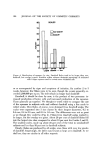
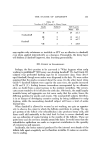
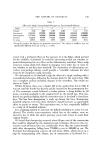
THE NATURE OF DANDRUFF 113 50 scalps, the face and body being concealed. The subjects are then scrambled and graded again. Concordance should be achieved in at least 45 of the 50 pairs. More than a keen eye and conscientiousness are required. Strict rules must be followed if serious error is to be avoided. Scalp cleanliness is a compulsive concern of increasing numbers of people. Daily washing will banish all signs of scaling. Moreover, many persons regularly use antidandruff shampoos. The suppressive effects of the more potent ones last for a month or more. Hence, we make certain that active agents have been avoided for at least that period. Then, too, grading must be done at a fixed interval after last bland sham- poo we use 4 days, since this is the approximate "restoration time" in subjects with appreciable dandruff (see below). We use a 0 to 10 grading scale (1). This is, of course, quite arbitrary and requires some explanation, since we virtually never assign grades greater than 7 or less than 1. The justification for this seemingly stretched out scale is to allow for the entire range of possibilities. For example, if dandruff sub- ieets wear bathing caps and are prevented from washing, the grades will as- cent to 9 or 10 within two weeks. Conversely, potent agents may be so effec- tive that the grade falls to 0. The descriptive equivalents of the various grades are as follows: Grade IV equals mild dandruff, Grade V equals moderate dandruff, and Grade VI equals severe dandruff. Grade III is slight sealing, not enough to warrant corrective efforts. Grade I and II are shady areas where scaling is miniscular and very difllcult to judge. Here, we would emphasize that all scalps show some sealing even though this may be very slight. Using this scoring system, we surveyed a prison population of 1,033 un- selected young adult males, mainly in the 9•5 to 35 age group. About 18 per cent fell into grade IV (mild dandruff), while another 13 per cent were grade V (moderate dandruff). Grades VI and VII accounted for less than 5 per cent. Another 18 per cent were classified as Grade I. Grades II and III were the commonest, about 93 per cent each. Bourne and Jacobs surveyed what might be regarded as a comparable group (79•g0 soldiers) and judged that only 9•.5 per cent had "gross" dan- druff (9•). If the latter description conforms to our grade VI, there then exists good agreement that severe dandruff is uncommon. In our survey, less than one in 5 young adults had moderate dandruff (Grade V). Clearly, it is not easy to recruit good panels for antidandruff assays unless one is willing to settle for mild Grade IV dandruff. Cohen looked at 500 young women, and he thought that about 15 per cent had moderate dandruff, a figure close to ours (3). Van Abbe and Dean also emphasized that good dandruff subjects are hard to find (4). The subjective element in self-assessment is brought to light when we put out a call for dandruff subjects to participate in therapeau- tie studies. Few respondents have Grade V dandruff. Most are Grade III.
Purchased for the exclusive use of nofirst nolast (unknown)
From: SCC Media Library & Resource Center (library.scconline.org)