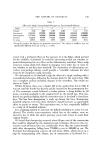
114 JOURNAL OF THE SOCIETY OF COSMETIC CHEMISTS Scaling is over-rated in our population. Women seem to have as much dandruff as men. Prevalence seems to be no different in blacks and whites. However, nothing is known about the fre- quency of dandruff among the various races of mankind nor of the influence of geography and climate. Similarly, we are quite ignorant about genetic in- fluences. Heredity can certainly not be ruled out. Although we have not conducted a formal survey of how dandruff varies throughout man's lifespan, we have formed some rather firm impressions. Young infants commonly experience a conspicious episode of scalp scaling. Large flakes are shed over a period of weeks followed by subsidence. "Cradle cap," as this condition is called, has been even less studied than dandruff. Nothing is known about it. We see no reason to call it dandruff or imply any relationship whatever. Our speculation is that it represents a wave of exfoliation of the thickened horny layer which protected the fetus in its watery intrauterine existence. Cradle cap disappears without "active" treat- ment. Dandruff is decidely rare in children. Our maxim is that excessive scaling is a prepuberal child is atopic dermatitis until proved otherwise. Seborrheic ,dermatitis, on the other hand, can be very severe in infants. It is fortunately uncommon. It resembles the adult disease, but is not necessarily the same. Dandruff begins to emerge at puberty and may be thought of as another cutaneous event that marks the onset of sexual maturation. The pubertal display includes expansion of the sebaceous glands (oiliness), appearance of public and axillary hair, apocrine sweating (axillary odor), deepened pig- mentation (melanization), thickened skin, and other signs. All these changes reflect increased cutaneous activity. Presumably, this same enhancement ap- plies to the physiologic function of desquamation the production and shed- ding of cornified cells is accelerated. Starting quietly at puberty, dandruff intensifies gradually over the next few years, probably peaking in the late teens and early twenties. It is a common belief that bad acne and severe dandruff go hand in hand, but no one has performed a comparative study that would validate such a view. The correlation, in any case, is not a strict one. The most one can say is that acne and dandruff are both quite common in late adolescence. An association between the two might be purely coincidental. We think that dan- druff levels off in young adults, gradually declining toward middle age. It can be categorically stated that dandruff falls off sharply as old age is approached. We have had intensive experience in an institution for the aged and know with certainty that after 60, Grade V subjects are about one-third as common as in young adults. After 75, dandruff is very rare, while after 85, it practically vanishes altogether. This decremental age trend contrasts sharply with sebor- rheic dermatitis which increases after middle age and indeed becomes qui.te

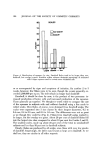
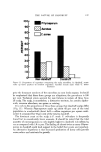
THE NATURE OF DANDRUFF 115 common in the elderly, especially among males. Many of these are misdiag- nosed as dandruff, a mistake we made for many years (see below). Fortunate- ly, seborrheic dermatitis responds to the same agents that are effective in dandruff. III. SEASONAL VARIATIONS One widely held belief, which has been sustained by formal epidemiologic investigation, is that dandruff declines in the summer months. The decrease actually begins in the late spring and bottoms out in the summer (1). The seasonal rhythm is easily perceived by comparing very low and high grades. In late spring, for example, Grade I accounts for about 25 per cent in a young, unselected population, while the comparative figure for winter is 10 per cent. Conversely, Grade VIs are more common in early winter than at any other time. These seasonal changes are not artifacts of altered visibility, which might occur from say increased sweating in summer time. Objective measurements of horny cell production also bear out the validity of the seasonal changes. Sales of antidandruff products are another indicator these fall off in summer. While biologists are keenly aware of circadian (daily) rhythms, too little attention has been paid to seasonal ones. Molting patterns are well-known in many vertebrates. In man, Orentreich has obtained evidence that physio- logic shedding of telogen (club) hairs increases in the fall, causing unneces- sary concern in women (5). We venture to say that these annual rhythms are innate and are not responses to exogenous events such as temperature changes. In any event, the summer downturn in dandruff should be taken into ac- count in therapeutic assays. The most rigorous time for testing is in the fall and winter. Weaker agents will tend to be over-rated when the trial begins in springtime. IV. RELATIONSHIP TO OILINESS (SEBORRHEA) Earlier writers created a distinction between an oily and a dry type of dan- druff, respectively called pityriasis olesa and pityricis in the pedantic jargon of the day. It takes only a moments reflection to discern the absurdity of such designations. Scalps, of course, are either oily or not oily, regardless of the presence or absence of dandruff, whether their owners are blondes or brunettes, saints or scoundrels, etc. One is reminded of a charming saying among the Pennsylvania Dutch: "When the cock crows on the dung heap, the weather will either change or it will stay the same." The real question is whether there is a statistical association between oiliness and dandruff. We undertook to settle the matter. The production of sebum was measured by having each subject dip his entire scalp for 2 rain in a liter of ethyl ether 24 hours after defatting the scalp by a similar immersion. After filtering and
Purchased for the exclusive use of nofirst nolast (unknown)
From: SCC Media Library & Resource Center (library.scconline.org)