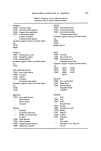
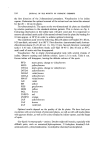
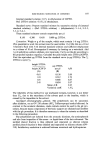
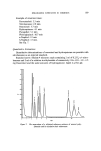
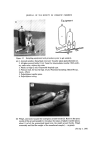
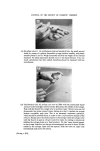
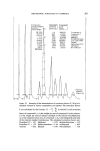
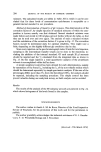
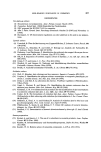
164 JOURNAL OF THE SOCIETY OF COSMETIC CHEMISTS much was known about the actual use of these materials. It was decided to start analytical market surveys of several classes of cosmetics in order to contribute to the establishment of a well-balanced legislation in Holland. The work will continue for several years, but it was thought valuable to make the analytical experiences available to those who are interested in the field of analytical cosmetic chemistry. EYE MAKE-UP COLOURS Identification Application of colours in the area of the eye should be carried out with the utmost care and with the best non-toxic colours available, in order to minimize the hazard of damage to this vital organ. In contrast to lipstick colours no practical data are available on the kinds of pigments that are in actual use in today's eye cosmetics. At the beginning of 1972 an analytical survey of these colours was started. As no analytical methods were available such a system was developed. To get an idea what kind of colours might be used an inventory was compiled which is tabulated in Table I (1-5). Many are inorganic insoluble pigments. From this point of view instrumental analysis of the metal elements would give much information. Emission spectro- scopy, X-ray fluorescence and X-ray diffraction methods are the methods of choice. On the other hand it should also be possible to make an analysis along classical chemical lines. A 'non-instrumental' methodology has been used but excluding the identification of the whites (except for TiO2). This can only be done satisfactorily by instrumental analysis. Apparatus and reagents Apparatus for thin-layer chromatography Polyamide powder MN-SC6 or similar Microburner Lead acetate/cotton plugs Platinum needle Sodium Peroxide granules (Merck Platinum disk 6563 for instance) Homogenizer (for instance Ultra Turrax: TP 18/2, Janke & Kunkel. W. Germany) Kjeldahl flasks (25 ml) Microscope Vitreosol or quartz crucibles (ca 20 ml) Centrifuge

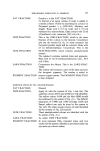
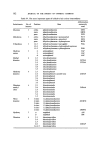
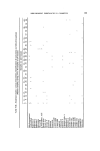
RISK-BEARING SUBSTANCES IN COSMETICS 165 Table I. Inventory of eye make-up colours (numbers refer to colour index numbers) GREEN 77288 Chromic oxide 77289 Chromic oxide hydrate 75810 Copper chlorophyllene 77013 Ultramarine green -- Copper versenate -- Titanated mica (green) Synthetic organic colours and their lakes. e.g. 42170 44090 BLUE 77007 Ultramarine blue 77346 Cobalt aluminate 75510 Ferricferrocyanide -- Titanated mica (blue) Synthetic organic colours and their lakes. e.g. 42735 42090 Sudan blue II VIOLET 77007 Ultramarine violet 77745 Mna(PO4)a.7HaO 77742 Mn(NH4)PaO7 Synthetic organic colours and their lakes. e.g. 73385 YELLOW-ORANGE 77489 Iron oxide yellow 75300 Turmeric 75120 Anatto 75130 Carotene -- Titanated mica (gold) Synthetic organic colours and their lakes. e.g. 11920 19140 RED 75470 Carmine 77491 Iron oxide red 77007 Ultramarine red -- Titanated mica (red) Synthetic organic colours and their lakes. e.g. 12120 15850 45430 12150 15865 45170 12085 15880 45425 15630 BLACK 77499 Iron oxide black 77267 Bone black 77266 Carbon black -- Vegetable black -- Graphite BROWN 77492 Iron oxide brown -- Burnt sienna -- Burnt umber -- Caramel PEARL -- Guanine -- Titanated micas/talc -- BLOC1, or precipitated on mica 77480 Gold powder 77820 Silver powder 77400 Copper/bronze powder 77000 Aluminium powder WHITE -- Talc 77891 TiO 77947 ZnOa -- Zn carbonate 77005 Kaolin 77002 Aluminum oxide 77120 BaSOa 77713 MgCOa 77220 CaCO3 77231 Gypsum -- SiOa -- Tin oxide -- Stearates of Li, Mg, Ca, A1, Zn
Purchased for the exclusive use of nofirst nolast (unknown)
From: SCC Media Library & Resource Center (library.scconline.org)