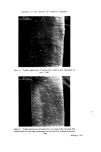
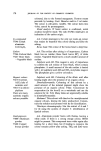
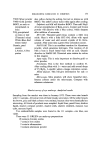
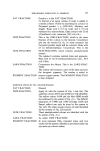
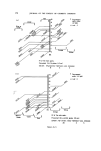
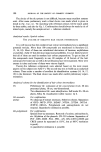
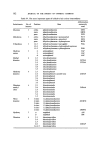
A STUDY OF DAMAGED HAIR 157 attempts were made to ascertain what caused the observed changes by reproducing the damage in controlled laboratory experiments. The study was divided into two sections: the examination of virgin hair, that is, hair that had not been dyed, bleached, permed or otherwise treated, and cosmetically altered hair, hair that had received one or more of these types of treatments. RESULTS Virgin hair In common with the findings of Wall and Hunter (5) this study has shown that there was very little difference in fibre appearance between fibres from different people. The great variation detected was along fibres from root to tip and this variation was similar for all the fibres studied. This variation is reported below. Fig. 1 shows a micrograph of a hair fibre, taken near the root, indicating the natural appearance of hair that is free from externally promoted defects (1). A few millimetres from the root the scale edges became jagged. For most of the fibres examined this jagged scale edge appearance, Fig. 2, represents the typical appearance of most of the fibre length. Previous researchers (1, 2) have concluded that some of this change is due to the mechanical damage caused by brushing, combing and handling, and that some contribution to this deterioration may be due to weathering by exposure to rain, sunlight and dirt. Some of the fibres examined in this study had been shampooed and towel-dried three or four times per week, given minimal combing, approximately five comb strokes per day, were hardly ever exposed to sun or rain and had never been brushed. This abrasion of the scale edges still occurred in this hair, see Fig. 2. It seems probable that this deterioration of scale edge appearance was, in this case, due almost entirely to the wet abrasion associated with sham- pooing and towel drying. To check the effect of wet abrasion on the cuticle, two experiments were per- formed. In one study, a child's hair was lightly shampooed, approximately once every week to minimize wet abrasion, and given minimal brushing and combing. The majority of the fibres examined from this child displayed a fibre appearance similar to that shown in Fig. 1. In the second experiment, a group of fibres from the above study were wet and rubbed vigorously between the hands to simulate shampooing and towel-drying. It was found that this action produced deteriora- tion similar to that displayed in Fig. 2. From these observations it was concluded that the wet abrasion associated with shampooing and towel-drying was a dominant factor in the deterioration of scale edge appearance, at least amongst the persons studied.

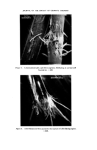
158 JOURNAL OF THE SOCIETY OF COSMETIC CHEMISTS With the exception of hair that had only been lightly shampooed, all other hair studied always displayed this deterioration of scale edges. However, some hair fibres displayed damage beyond that shown above. As reported by Swift and Brown (1), the next stages of fibre damage that were observed were partial, followed by complete scale removal, see Fig. 3. Again, by rubbing wet hair fibres in a manner that simulated shampooing, it was found that it was possible to remove completely the scale structure from the fibres. Similar rubbing of dry fibres did not produce the same degree of scale damage. Thus it seems probable that shampooing is a contributing factor to complete scale removal. At this stage no assessment has been made of the role of hair brushing and combing in the damage to and removal of scales, although it seems probable (2) that these actions could also produce deterioration in the cuticle. Amongst the hair fibres studied, it was found that complete scale removal only occurred in the last few centimetres. Once complete scale removal had occurred splitting of the fibre end into two, three or more longitudinal sections usually occ•trred, see Fig. 4. Attempts were made to reproduce this type of damage. It was found that brushing a group of fibres that had been subjected to simulated shampooing caused the ends of some of the fibres to split, indicating that shampooing and brushing alone is sufficient to cause the ends of hair fibres to split. At this stage, no attempt has been made to ascertain which of these two actions is most responsible for the production of splitting, or what other procedures can cause splitting. It was noted during the brushing trials that when a fibre had split longi- tudinally, it was common for the individual splits to fibrillate, see Fig. 5. Continued brushing caused these fibrillated regions to break, Fig. 6, thus producing a fibrillated end fibre. The appearance of split ends could vary quite considerably from the simplified breakdown pattern shown in Figs 4, 5 and 6. Some of these variations have been shown by Swift and Brown (1) and DiBianca (6). There is a shortening of fibres associated with the rupture of these fibrillated ends and this shortening appears to keep this type of damage restricted to the last few centimetres of a fibre shaft. These observations have illustrated that shampooing and brushing alone are sufficient to transform the hair from its natural state, Fig. 1, to split ends, Figs. 5 and 6. It seems probable that these grooming treatments of shampooing and brushing are the dominant factors in the physical deterioration of virgin hair. Weathering and exposure to sunlight would appear to be minor effects. If a sample of hair is just stored for hundreds of years, this type of damage does not occur (1), indicating that the deterioration is not an ageing process.
Purchased for the exclusive use of nofirst nolast (unknown)
From: SCC Media Library & Resource Center (library.scconline.org)