156 JOURNAL OF THE SOCIETY OF COSMETIC CHEMISTS variations are due to combing of the hair and concluded that some may be due to natural weathering processes. They have also briefly mentioned some of the changes introduced into hair by perming and bleaching treatments. In a series of dynamic in situ experiments in a scanning electron microscope, Brown and Swift (2) have further demonstrated the deleterious effects of combing out tangles in hair. Such combing can cause cuticle cell lifting in tightly-looped fibres, as well as snapping fibres transversely or through the initial formation of a longitudinal fracture, when excess tension is applied during the combing. In a study of the structure and properties of normal adult hair, Wall and Hunter (5) have similarly illustrated the production of jagged edges in the cuticle, and have shown features on the cuticle that they have attributed to sun and atmosphere exposure. DiBianca (6) has demonstrated many different types of damaged hair ends, but has not studied how these different types of damage occurred. Robbins and Kelly (7) have analysed the amino acid content of cos- metically-altered hair. They found that bleached and permanent-waved hair contained less cysfine than unaltered hair, and correspondingly more cysteic acid residues. Bleached hair also contained slightly less tyrosine and methionine than unbleached hair. Miyazawa, Nozaki and Tamura (8) have made a similar study of the amino acid composition of hair damaged by treatment with cold-waving and hair bleaching lotions. They have also observed a reduction in the cysfine content of human hair, with one bleaching condition reducing the cystinc content from the normal of 13.9•o to 5.0•o, corresponding to an approximately 64•o reduction in the disulphide bond cross-linking of the protein molecules. These studies have illustrated the extent of chemical changes and the mag- nitude of physical changes introduced to hair, but have not yet confirmed how these observed physical changes were introduced. There is a need to understand how and why these deleterious physical changes to hair fibres occur in order to be able to prevent the damage. Some of this information is presented in this study. EXPERIMENTAL Samples of Caucasian hair were used in this study. This hair included many fibres displaying various degrees of splitting and hair damage, and samples that displayed no damage visible to the unaided eye. No attempt was made to differen- tiate between hair of different texture or condition. The fibres were mounted on stubs so that the tip, root and portions of the mid shaft of each fibre could be examined in a scanning electron microscope (JSM2). The mounted fibres were coated with approximately 500 3, of gold prior to examination. They were examined for variation of scale structure along and between fibres, extent of scale damage and removal and degree of splitting of ends. The findings were correlated with the known history of the hair, and

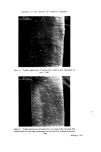
A STUDY OF DAMAGED HAIR 157 attempts were made to ascertain what caused the observed changes by reproducing the damage in controlled laboratory experiments. The study was divided into two sections: the examination of virgin hair, that is, hair that had not been dyed, bleached, permed or otherwise treated, and cosmetically altered hair, hair that had received one or more of these types of treatments. RESULTS Virgin hair In common with the findings of Wall and Hunter (5) this study has shown that there was very little difference in fibre appearance between fibres from different people. The great variation detected was along fibres from root to tip and this variation was similar for all the fibres studied. This variation is reported below. Fig. 1 shows a micrograph of a hair fibre, taken near the root, indicating the natural appearance of hair that is free from externally promoted defects (1). A few millimetres from the root the scale edges became jagged. For most of the fibres examined this jagged scale edge appearance, Fig. 2, represents the typical appearance of most of the fibre length. Previous researchers (1, 2) have concluded that some of this change is due to the mechanical damage caused by brushing, combing and handling, and that some contribution to this deterioration may be due to weathering by exposure to rain, sunlight and dirt. Some of the fibres examined in this study had been shampooed and towel-dried three or four times per week, given minimal combing, approximately five comb strokes per day, were hardly ever exposed to sun or rain and had never been brushed. This abrasion of the scale edges still occurred in this hair, see Fig. 2. It seems probable that this deterioration of scale edge appearance was, in this case, due almost entirely to the wet abrasion associated with sham- pooing and towel drying. To check the effect of wet abrasion on the cuticle, two experiments were per- formed. In one study, a child's hair was lightly shampooed, approximately once every week to minimize wet abrasion, and given minimal brushing and combing. The majority of the fibres examined from this child displayed a fibre appearance similar to that shown in Fig. 1. In the second experiment, a group of fibres from the above study were wet and rubbed vigorously between the hands to simulate shampooing and towel-drying. It was found that this action produced deteriora- tion similar to that displayed in Fig. 2. From these observations it was concluded that the wet abrasion associated with shampooing and towel-drying was a dominant factor in the deterioration of scale edge appearance, at least amongst the persons studied.
Purchased for the exclusive use of nofirst nolast (unknown)
From: SCC Media Library & Resource Center (library.scconline.org)