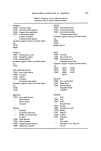
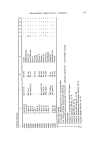
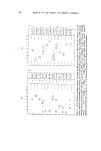
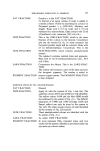
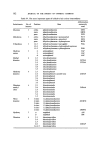
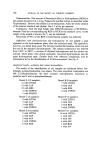
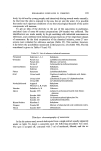
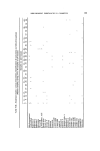
RISK-BEARING SUBSTANCES IN COSMETICS 183 Table V. List of reference compounds: oxidative hair colour intermediates OFD o. Phenylenediamine 2AF 2.aminophenol PCT pyrocatechol MFD m. Phenylenediamine 3AF 3.aminophenol RES resorcinol PFD p.Phenylenediamine 4AF 4.aminophenol HCH hydroquinone 24TDA 2.4.tolylenediamine M4AF 4.methylaminophenol PHL phloroglucine 25TDA 2.5.tolylenediamine (metol base) PGL pyrogallol 24DAF 2.4.diaminophenol 2NPFD 2.nitro.p.phenylene- AN naphthol ct (amidol base) diamine BN naphthol I• 24DAA 2.4.diaminoanisole 4NOFD 4.nitro.o.phenylene- CRES chlororesorcinol 26DAP 2.6.diaminopyridine diamine 2CPFD 2.chloro.p.phenylene- diamine There is one important factor that is worth mentioning. The silica support must be carefully considered to obtain good resolution and good shapes of the spots. We did not have satisfaction with several kinds of precoated supports, including self-coated silica with gypsum binder. The purest kind of silica (without binder) (for instance Silica HR, Merck) gave the best results. Colouring of the iodine vapour of the spots on these self-made plates will also give much more beautiful colours (in particular the starting colours), which aids the identification procedure. Precoated plates will only give brownish colours with iodine vapour for all the components. Procedure. The solvent for extract or reference solutions is always methanol: ethylacetate = 1:4 vol. Extracts and reference solutions should always be preserved with several crystals of sodium-metabisulphite. Reference solutions: Make 0.1• standard solutions of the substances of Table V in the above solvent mixture. Standard mixture: A mixture of 0.1 • each of PFD, 2AF, 3AF, 4AF, RES, AN. Extraction: Mix I g of the product and 4 ml of the solvent. Heat a little on a waterbath. Add ca 250 mg sodium-metabisulphite and ca 500 mg sodium-sulphate exsicc. Shake the mixture vigorously. Use the clear liquid for tic. This extract can only be kept for ONE day. Optimal spotting is very important. For 20 x 20 cm plates 5 pg is the optimal amount for these tic plates (except for 2NPFD •- pg for 3AF.4NOFD.HCH. AN.BN. 10 lag, and PGL 15 I-tg). For small plates (10 cm) half of these amounts. Mixed spots of extracts and reference solutions can be used for confirmation. Preliminary tlc. The purpose of preliminary tlc on precoated tlc plates (10 cm) is the estimation of the concentration level in the product, in order to permit optimal spotting in the main identification procedure. It is made with the following spots of the extracts: 1-2-5-20 I-tl of the extract and a reference mixture spot of 2 lag of 25TDA-3AF-RES. Solvent same as in

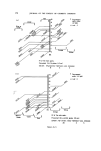
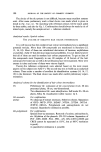
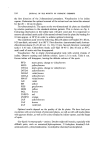
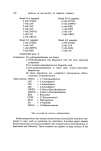
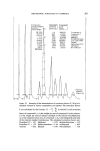
184 JOURNAL OF THE SOCIETY OF COSMETIC CHEMISTS the first direction of the 2-dimensional procedure. Visualization is by iodine vapour. Determine the optimal amount of the extract and use twice this amount for the 20 x 20 cm tlc plates. Two-dimensional tlc. The spots on the two-dimensional tlc plate are identified by relative positions to the standard-mixture pattern. This is shown on Fig. 4. Colouring observation in the iodine tank will give some aid. It is important to remove all residual acetic acid of the second solvent from the plate (by heating for 10 min approx. at 50øC) in order to achieve optimal colouring. The conditions used were the following. Silica H plates (self-made) 20 x 20 cm, 0.25 mm thick, activated 1 h at 105øC. First direction: (unsaturated tank)Acetone- chloroform-toluene 35-25-40 vol. 1 h. Dry 15 min. Second direction: (saturated tank) 1 h 45 min. Chloroform Acetic acid-H20 50-45-5. Dry 10 min at 50øC, until smell of acetic acid has disappeared. Visualization: Put in empty chromatographic tank with several crystals of iodine. Observe starting and definite colours. Leave « h in tank. Take it out. Excess iodine will disappear, leaving the definite colours of the spots. PFD starts green, change to violet/brown MFD yellow/brown 25TDA starts green, change to violet/brown 24TDA yellow/brown 24DAF violet/brown 24DAA yellow/brown M4AF violet/brown AN violet BN yellow RES grey/brown HCH yellow PGL brown 2NPFD red 4NOFD orange 2AF yellow/brown 3AF brown 4AF violet/red. Optimal results depend on the quality of the tlc plates. We have had poor resolution with several kinds of precoated plates, as well as with self-made plates with gypsum binder, as well as for colour display by iodine vapour, and the shape of spots. Gas-liquid chromatography--amines. Doubts might still remain, especially with difficult pairs, such as resorcinol/hydroquinone, 2.5.toluylene diamine/2.4.di- aminoanisol/m. phenylenediamine, 2.4.toluylene diamine/4.aminophenol.
Purchased for the exclusive use of nofirst nolast (unknown)
From: SCC Media Library & Resource Center (library.scconline.org)