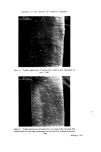
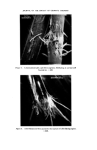
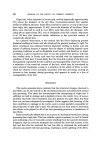
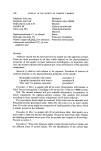
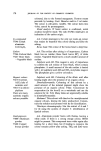
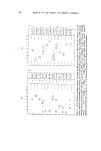
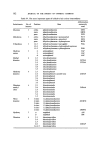
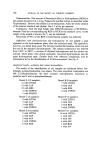
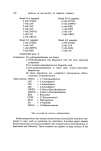
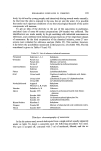
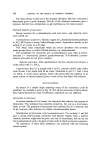
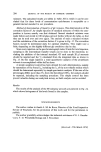
JOURNAL OF THE SOCIETY OF COSMETIC CHEMISTS Figure 7. Fibre splitting in permanently-waved hair. X 640. Figure 8. Shaft damage in permanently-waved hair. This damage was detected about 10 cm from the end of the fibre. X 400.

A STUDY OF DAMAGED HAIR 159 Cosmetically-altered hair Cosmetically-altered hair had an appearance very similar to virgin hair, when no split ends were detected. The hair appearance shown in Figs 1-6 for virgin hair, can also be seen in cosmetically-altered hair. However, there are also other types of breakdown associated only with cosmetically-altered hair. Fig. 7 shows a split end from hair that has had one permanent-wave applica- tion. Unlike virgin hair, where splitting was only observed after almost all of the cuticle was removed, hair that had been permed or bleached was often observed to split whilst the cuticle was still clearly visible. It was observed that splits and general shaft damage could also occur well away from the end. Fig. 8 shows shaft damage detected about 10 cm from the end of a fibre that had been permed once and the perm did not 'take'. The third important factor of cosmetically-altered hair was the extent of splitting. Virgin hair less than 15 cm long was hardly ever observed to split, whilst cosmetically-altered hair less than 15 cm long was often observed to split. This was detected as most likely to occur when a perm 'went wrong' or did not 'take', and on some bleached hair. Also, the splits and shaft damage associated with hair that had been permed or bleached, was generally observed to be far more severe than for virgin hair. That is, cosmetically-altered hair was observed to contain far more of the hair categorized as fly-away fibre (6) than virgin hair, for hair fibres of the same length. The reason for this additional deterioration associated with cosmetically- altered hair is not immediately apparent. Swift and Brown (1) have shown that very minor changes in the surface structure of hair occur immediately after perming and bleaching, but these are not likely to be directly responsible for the observed additional damage. It is probable that these processes have chemically altered and weakened the hair and then during subsequent physical treatments, the altered hair is unable to withstand the abrasion normally associated with hair grooming to the same extent as can the virgin hair, and a greater degree of fibre splitting results. Robbins and Kelly (7) and Miyazawa et al. (8) have found a reduction in the cystine content of bleached and permanent-waved hair. It is primarily the cystine content of keratin fibres, through the cross-linking associated with the disulphide bonds, that gives these protein fibres their high mechanical stability. It seems probable that the reduced fibre cross-link content associated with these treatments is responsible for loss of physical strength associated with these fibres. Feughelman and Chapman (9) have shown that the relative cross-link density of keratin fibres can be ascertained by a determination of the diametral swelling of the fibres in 98• formic acid. This provides a convenient method for the determination of a relationship between fibre cross-link and splitting caused by the mechanical abrasion associated with hair grooming.
Purchased for the exclusive use of nofirst nolast (unknown)
From: SCC Media Library & Resource Center (library.scconline.org)