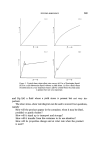
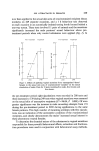
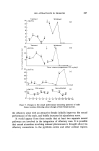
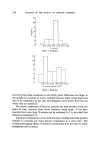
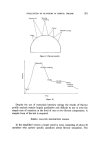
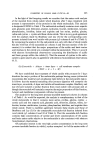
SEX ATTRACTANTS IN PRIMATES 261 o 2o io • Pre-treatment • cF68,71 ? -- -L_. I ..• 0 4 8 12 cFII5,71 ? -- -cF41,71 ? 4 - 0- I I I I 0 2 4 6 Figure 2. Sexual stimulation of male rhesus monkeys during treatment of their female partners with a synthetic mixture of aliphatic acids applied to their sexual skin area. ¸, test without ejaculation ß E, one ejaculation in the test. ß 2E, two ejaculations in the test. and 41, acids and vaginal secretions were equally effective and this was also the case with females 71, 78 and 74, although with female 74 they were equally ineffective (Fig. 4). With male 67 and 68, the synthetic acid mixture was approximately half as effective as the fresh secretion. This was due to these males being paired for some of their tests with female 76 where, although secretions have stimulated sexual activity in 52•o of tests, the acid mixture has always been ineffective. Thus it can be seen that the male's response to olfactory attractants varies between individuals and is also, in part, dependent on the female parmer with which they are paired. Whereas some females readily evoke a sexual response from the male, others when treated in the same manner fail to do so. Hence, the response to pheromones in these highly-evolved social primates is not stereotyped. Furthermore, it can be seen that for cer- tain pairs, the synthetic acid mixture is not as effective in stimulating the

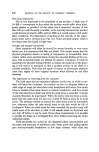
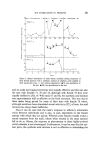
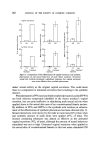
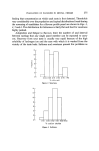
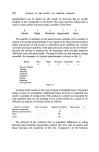
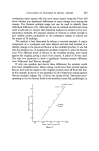
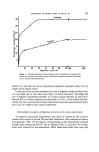
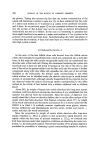
262 JOURNAL OF THE SOCIETY OF COSMETIC CHEMISTS Vaginal secretions 60 40 .• zo '• o I'--I • A/ 69 62 ._ ._u_ Synthetic mixture I 40 N 77 69 0.6 0'4 • 0.2 '5 0 (. , .•, .• 0.6- õ 0.4 0.2 7 69 62 c ø' 69 62 ._ 77 69 77 69 Pre- Treatment Pre- Treatment Pre- Treatment treatment treatment treatment Figure $. Comparison of the effectiveness of vaginal secretions and synthetic pheromones on the sexual behaviour of male rhesus monkeys. Treatment using both methods produced a significant response, but vaginal secretions were more effective than synthetic pheromone. males' sexual activity as the original vaginal secretions. This could mean there is a component in untreated secretions that is lacking in the synthetic mixture. Phenylpropanoic (PPA) and parahydroxyphenylpropanoic acids (HPPA) are both odorous compounds identified in the rhesus monkey's vaginal secretion, but are quite ineffective in stimulating male sexual activity when applied alone to the sexual skin area of an ovariectomized female partner. By addition of PPA and HPPA to the synthetic acid mixture an enhance- ment of the effectiveness of synthetic pheromone has been obtained (Fig. 5). Sexual interactions were shown by the male in more tests (65•o) than when just synthetic mixture of acids alone were applied (37•o of tests). The mixture containing enhancers was almost as effective as the untreated vaginal secretions (70•o of tests), although the amount of sexual behaviour stimulated was not so high. Untreated vaginal secretions when applied to the sexual skin of ovariectomized females in this test series stimulated 252
Purchased for the exclusive use of nofirst nolast (unknown)
From: SCC Media Library & Resource Center (library.scconline.org)