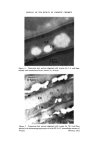
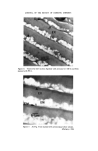
298 JOURNAL OF THE SOCIETY OF COSMETIC CHEMISTS It follows from the foregoing proposals about the origin of ENDO A and its subfractions A1 and A2, that ENDO B probably originates from the non-nuclear cytoplasmic debris of the cuticle cell left over after the formation of the exocuticle, A- and inner-layers. (f) Consideration on the properties and nature of the cuticle cell membrane complex It has been known for some time that single cuticle and cortical cells are apparently liberated into suspension when keratin fibres are treated with solutions of various proteolytic enzymes and it has been generally assumed that this is because the cell membrane complex separating the cells has been degraded (cf. review by Bradbury (9)). From our critical electron microscope examinations of hair sections, treated not only with pronase and trypsin but also with papain/di- thiothreitol (2), we can find no evidence whatsoever for the dissolution of the cuticle cell membrane complex. Even despite extensive enzyme treatments, the full structural integrity and pattern of heavy metal staining of the intercellular membrane glue (5-band) is retained. We therefore believe that the liberation of cuticle cell-like units in the proteolytic enzyme treatment of bulk mammalian keratin fibres is due to digestion along the endocuticle sheet rather than splitting of the cell membrane complex. Further evidence for believing that this is so is that mild mechanical agitation is always necessary to release the cell-like units pre- sumably by rupturing the retaining cell membrane which now only loosely holds the remaining exocuticular segment. A similar situation may also exist in relation to the liberation of cortical cells by proteolytic enzymes with digestion occurring in the intermacrofibrillar matrix, and particularly in that matrix immediately adjacent to the cortical cell membranes, as a necessary prerequisite for subsequent mild mechanical agitation to release cell-like units. The chemical composition of the intercellular membrane cement of the cuticle (5-band) is puzzling. Electron histochemical observations using not only phosphotungstic acid as a stain but also silver/N-acetyl homocysteine thiolactone (10) indicate that this component is rich in free amino groups. If these amino groups were either those of the lysyl groups or the end groups of proteins it is surprising that proteolytic enzymes had no effect on the 5-band. One possibility is that the protein content of the 5-band is small and that the major component is a polysaccharide rich in amino-containing sugar residues. Polysaccharides con- taining vic-diol groupings are certainly present in the cell coat around hair follicle matrix cells and in the intercellular desmosomal plaques between adjacent follicle cells (17). It is not unreasonable to suppose that the polysaccharide coat of the hair follicle cells is retained throughout the keratinization process and, in the case of the cuticle, becomes organized into the layer later identified as the 5-band. Some support for this idea also comes from the fact that we have tentatively identified

CHEMISTRY OF HUMAN HAIR CUTICLE--Ill 299 amino sugars and pentoses in a cuticle cell membrane fraction, rich in fi-band, obtained by our papain/dithiothreitol procedures (2). Also this fraction had a very low protein content. (g) Consideration of the properties of the cuticle in the light of the composition of the cuticle subcomponents The hair cuticle is divided into two main subcomponents whose chemical compositions are quite different and which can be expected to behave differently under the influence of various cosmetic treatments. The exocuticle and A-layer laminae are oriented within each cuticle cell sheet towards the outside of the hair. Since they are highly cross-linked by cystine they will be extremely tough and resilient and fitting in their role for protecting the surface of the hair shaft from environmental exposure. On the other hand these components are likely to be relatively inelastic and susceptible to brittle fracture on bending. An indication of this brittleness to bending is that we have never observed with the scanning electron microscope cuticle scale edges bent back on themselves at the surface of virgin hair. Indeed where the edge of a cuticle cell is not adhering immediately to the underlying cell, it is usually tilted upwards by only a few degrees. Despite extensive combing either with or against the natural scale overlap the scale edges tend to break off in small pieces rather than be bent back (12). If, on the other hand, the cystine disulphide crosslinks are destroyed by oxidation (as occurs in weathered hair or to some extent on bleach- ing with hydrogen peroxide) or by reduction (as in thioglycollate perming) the exocuticle and A-layer become much more pliable. This is indicated by the fact that we sometimes see cuticle edges bent back through quite large angles when weathered, bleached or reduced hairs have been combed. It is also noteworthy that Makinson (13) believes that the oxidative softening of the wool cuticle is important in the anti-felting treatments of wool fabrics and it is this which elimi- nates the directional dependance of the coefficient of friction of the fibres. In contrast to the exocuticle, the proteins of the endocuticle contain very little cystine but relatively high concentrations of acidic and basic amino acid residues. Electron histochemical experiments indicate the existence of fairly high concen- trations of free carboxyl and amino groups in the endocuticle, but it is not possible to determine from these experiments alone what proportions of the groups are the side chains of the acidic or basic amino acid residues or the end groups of the protein chains, though we would expect the latter to be quite a small proportion. It is possible that some of the acidic and basic amino acid residues are involved in intermolecular isopeptide cross-linking (14). On the other hand since the pres- ence of isopeptide links in proteins such as hair medulla tends to confer trypsin insolubility (15, 16) we must presume that the amount of isopeptide link present in our trypsin-soluble ENDO A components of the cuticle is quite small. The exocuticle and endocuticle can be expected to behave quite differently in
Purchased for the exclusive use of nofirst nolast (unknown)
From: SCC Media Library & Resource Center (library.scconline.org)