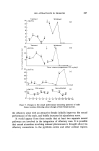
PSYCHO-RHEOLOGY 255 samples is described in (2). Types of test and their usefulness are summarized below. The triangle test Subjects are given three coded samples, one of which is different from the other two. They have to select the odd one out. This type of test is useful to establish a panel's sensitivity, or thresholds, and to define a range of physically measurable differences in a product which cannot be per- ceived by the panel. Scoring methods Several different ways exist for scoring, or ranking samples for a particular property, e.g. Scoring several samples together on a subdivided scale, with standard samples provided for reference. As a ratio of two samples, a trial sample against a reference standard. By 'paired comparison' tests, establishing which of a pair is greater in any chosen property, but not assigning any magnitude to the difference. Scoring directly on a familiar scale without reference to standards except from time to time. This may be useful for a well-trained panel only. Whichever methods are used, it is always necessary to analyse the results statistically. Analysis of variance (3) establishes whether there are significant differences either between the products or between the panellists, and how great the significance is. Scaling methods have been used very extensively by Szczesniak (4) to establish correlations between food textural propertibs and instrumental measurements. Some good correlations have been re- ported. Other people have carried out similar work (5). The techniques which have been applied to foods are equally applicable to cosmetics. Only the rheological properties of importance will be changed. CONCLUSIONS Cosmetics show complicated rheological properties, but their textures can be described, in the various usage situations, by the the correct choice of a few important properties. These properties, as measured instrumentally,

256 JOURNAL OF THE SOCIETY OF COSMETIC CHEMISTS can be correlated with sensory evaluation of the same properties, thus enabling optimum properties to be specified along with acceptable depar- tures from the optimum. Having established these quantities, an invariable standard is then available for use in new product design and as a quality control tool. (Received: loth February 1975) REFERENCES (1) The art ofperfurnery. G. V. Septimus Piesse (1879). (2) Principles of sensory evaluation of food, chapter 6. Amerine, Pangborn and Roessler (1965) (Academic Press, New York). (3) Facts from figures, chapter 19. M. J. Moroney (1951) (Penguin Books, London). (4) Szczesniak, A. L. Correlations between objective and sensory texture measurements. Food Technol. 22 981 (1968). (5) Henry, W. F. et al. Texture of semi-solid foods: sensory and physical correlates. J. Food Sci. 36 155 (1971).
Purchased for the exclusive use of nofirst nolast (unknown)
From: SCC Media Library & Resource Center (library.scconline.org)