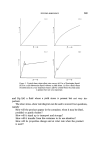
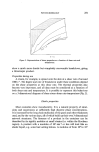
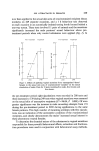
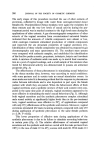
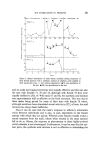
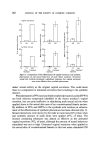
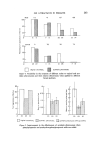
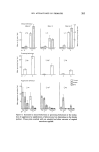
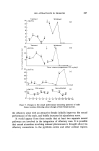
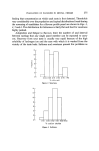
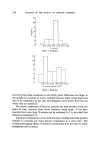
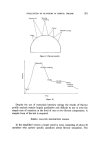
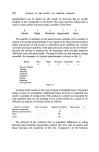
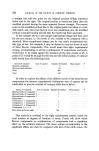
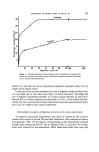
276 JOURNAL OF THE SOCIETY OF COSMETIC CHEMISTS 0.1:5 0.25 0.50 1.00 2.00 •,'00 % sucrose Figure 5. Sweetness. 12- I0- 8- 6- 4 2 0 0.156 0.313 0'625 I.:50 :'500 5.000 % quinine sulphate (xlO -3} Figure 6. Bitterness. recovery from these sensations is also fairly quick. Bitterness can linger in the mouth for a minute or more, probably because bitter compounds tend also to be substantive to the skin and disappear more slowly from the site where they are tasted (6). The odour component of flavours presents the least problem from this point of view, recovery from odour sensation being quick. It has been reported that more than 70 odours can be evaluated in 1 h, provided that interest is maintained (7). Tactile and temperature, not to mention pain, stimuli present the greatest obstacle to carrying out many flavour evaluations in a short time. The cooling and tingling effects of menthol considerably slow the rates at which toothpastes can be tasted.

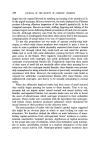
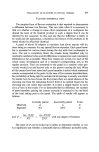
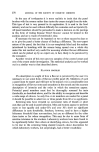
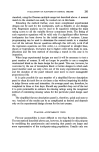
EVALUATION OF FLAVOURS IN DENTAL CREAMS 277 FLAVOUR DIFFERENCE TESTS The simplest form of flavour evaluation is that required to demonstrate a difference between two flavours. This can arise when it is necessary to find out whether a change in some other component of a toothpaste has altered the taste of the finished product to such a degree that it can be detected by the consumer. In this case any flavour difference is likely to be small and the appearance, consistency and texture of the products to be tested should be effectively identical. A panel of about 30 subjects is recruited. Just about anyone will do, there being no necessity for any special flavour expertise. Each panel mem- ber is presented at various times during the day with four toothpastes to taste. The test is completely blind, the creams being identified only by randomly numbered tubes and all differences in appearance and consistency eliminated as far as possible. These four creams are, in fact, two each of the cream under investigation and of a standard corresponding, say, to the regular product. They are presented to the panel in a random order pre- viously worked out and known only to the person running the test. When all the creams have been tested each panel member is asked which numbered creams corresponded to the pairs. In the case of four creams described here, his probability of being right by accident in his pairings is exactly one-third. No matter how he has chosen the first cream there are equal chances of his choosing one from the remaining three if there is no special reason for his choosing any one rather than another. It is then a simple matter to carry out a g ø' test on the results. For no detectable flavour difference the number of panel members pairing the creams correctly is expected to be one-third of the total taking part in the panel. The table of results will appear as follows: Correctly paired Incorrectly paired Total Observed m n N Expected N/3 2N/3 N (m--N/3) ø' (n--2N/3) ø' and z•'= + with one degree of freedom. The value of Z ø' can be looked up in tables to determine whether or not it is significant and whether a detectable flavour difference probably exists.
Purchased for the exclusive use of nofirst nolast (unknown)
From: SCC Media Library & Resource Center (library.scconline.org)