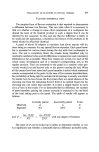
EVALUATION OF FLAVOURS IN DENTAL CREAMS 277 FLAVOUR DIFFERENCE TESTS The simplest form of flavour evaluation is that required to demonstrate a difference between two flavours. This can arise when it is necessary to find out whether a change in some other component of a toothpaste has altered the taste of the finished product to such a degree that it can be detected by the consumer. In this case any flavour difference is likely to be small and the appearance, consistency and texture of the products to be tested should be effectively identical. A panel of about 30 subjects is recruited. Just about anyone will do, there being no necessity for any special flavour expertise. Each panel mem- ber is presented at various times during the day with four toothpastes to taste. The test is completely blind, the creams being identified only by randomly numbered tubes and all differences in appearance and consistency eliminated as far as possible. These four creams are, in fact, two each of the cream under investigation and of a standard corresponding, say, to the regular product. They are presented to the panel in a random order pre- viously worked out and known only to the person running the test. When all the creams have been tested each panel member is asked which numbered creams corresponded to the pairs. In the case of four creams described here, his probability of being right by accident in his pairings is exactly one-third. No matter how he has chosen the first cream there are equal chances of his choosing one from the remaining three if there is no special reason for his choosing any one rather than another. It is then a simple matter to carry out a g ø' test on the results. For no detectable flavour difference the number of panel members pairing the creams correctly is expected to be one-third of the total taking part in the panel. The table of results will appear as follows: Correctly paired Incorrectly paired Total Observed m n N Expected N/3 2N/3 N (m--N/3) ø' (n--2N/3) ø' and z•'= + with one degree of freedom. The value of Z ø' can be looked up in tables to determine whether or not it is significant and whether a detectable flavour difference probably exists.

278 JOURNAL OF THE SOCIETY OF COSMETIC CHEMISTS In the case of toothpastes it is more realistic to insist that the panel brushes with the creams rather than tastes the cream straight from the tube. This type of test is very general in its application. It is used in the food industry and can be used without difficulty for cosmetics such as lipstick (8). All panel members should be persuaded to make a decision on the pairings in this form of testing because 'Don't Knows' cannot be treated in the analysis and are a waste of everybody's time. If necessary the test can be repeated on two or three successive days so as to give the panel a better chance of finding a difference. The non-expert nature of the panel, the fact that it is run completely blind and the realism introduced by brushing with the creams being spread over a whole day make this test method very useful for assessing whether flavour differences which can be picked up by an expert are, in fact, likely to be perceived by the consumer. Another version of this test uses two samples of the control cream and one of the cream under investigation. The statistical analysis can be worked out in a similar way to that described above. FLAVOUR PROFILES If a description is sought of how a flavour is perceived by the user it is necessary to use some form of flavour profile panel (9). Members of such a panel must be expert and will have to be trained over a considerable time in recognition of flavour notes and sensations in the mouth and the accurate description of intensity and the order in which the sensations appear. Potential panel members must first be thoroughly screened for taste thresholds, as described above, and for the ability to recognize and describe a wide range of odours. As only five or six members are needed for a panel it should be possible to select two or three panels from 60 or so applicants. Screening tests have revealed no convenient rules of thumb or short cuts that can be used in panel selection. Men and women appear to perform more or less equally and under-30's and over 30's show no significant differences in taste thresholds. Smokers, however, tend to have a higher bitterness threshold than non-smokers, but are no different for the other three tastes or for odour recognition. This may be due to some form of nicotine tolerance in the smokers. Laboratory workers have been found to be significantly better than others at identifying odours, but this appeared to be due to the screening being slanted towards odour description for which laboratory workers, not surprisingly, had a better vocabulary.
Purchased for the exclusive use of nofirst nolast (unknown)
From: SCC Media Library & Resource Center (library.scconline.org)