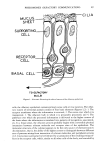
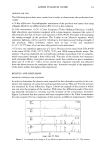
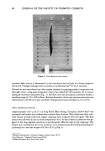
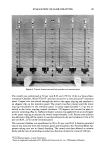
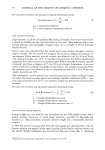
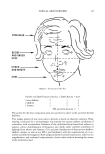
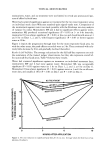
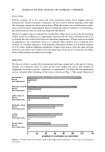
80 JOURNAL OF THE SOCIETY OF COSMETIC CHEMISTS one can readily imagine that increased consumer awareness of cosmetic effectiveness will result in greater emphasis on it by those firms able to demonstrate the action of their products. For that, it will be necessary to have available a range of scientifically valid, controlled investigatory procedures for cosmetics, as well as toiletries, comparable in its way to that range of procedures developed previously for drug products. For cosmetics and toiletties, the problem is complicated by the fact that we usually are dealing with short- term actions, meaningful to the extent that they are perceived by the user, and yet sub- ject to the user's expectations. Among the approaches developed to define these actions are evaluation of changes in skin condition by an expert observer (3,4) and by use of instrumental means (5-7) after the application of lotions or moisturizers. In a concurrent article (8), we describe utilization of consumers who have not been trained as cosmetic evaluators to assess perceived overall effect of topical facial moisturizers on a separate group of subjects, and to do so within the format of the controlled study. In this article, we describe a controlled trial of a different technique by which two trained judges under the supervision of a clinical researcher (by visual assessment) can quantify in detail the effect of topical moisturizers on superficial facial lines (SFL's). EXPERIMENTAL TECHNIQUE The method was developed as a reproducible scoring system for the assessment of vi- sually perceived changes in the kind of lines (superficial facial lines) that temporarily respond to treatment with effective topical moisturizers, as contrasted to the deeper lines and more pronounced wrinkles that do not respond. Each half of the face was divided into its four component areas (forehead, beside and under the eyes, cheek and 'mouth, chin--see Fig. 1) to increase the accuracy of scoring and to define responses by individual area. To determine the SFL score in each area, two judges were trained as noted below. Each judge, working separately, assigns a descriptive rating (very shallow, shallow, and deeper) for each SFL in an area, groups the SFL's by descriptive rating, and then multi- plies, according to the numerical scales below, the frequency rating times the depth rat- ing for each type of SFL. The values for all SFL's in an area are then summed. SFL score per area = Frequency Rating times 0 (no SFL's) ! (1 or 2 SFL's) 2 (3 or 4 SFL's) 3 (5 or 6 SFL's) 4 (more than 6 SFL's) Depth Rating 1 (very shallow) 2 (shallow) 3 (deeper) Use of this five-point (0-4) frequency rating sca. le prevents changes in a large number of very trivial lines from producing a skewed positive effect. For example, if a component area had 4 very shallow, 2 shallow, and 1 deeper SFL's, the SFL score for that area would be:

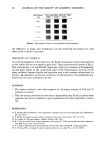
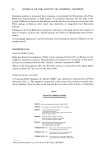
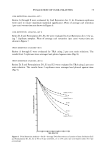
TOPICAL MOISTURIZERS 81 FOREHEAD -••( AND UNDER "• '• .... k, ....... CHEEK • • AND MOUTH CHIN Figure 1. Scoring areas of the face Number and depth Frequency Rating x Depth Rating = Score 4 very shallow 2 1 2 2 shallow 1 2 2 1 deeper 1 3 3 -- SFL score for the area = 7 The scores for the four component areas are summed to arrive at the score for the full half-face. Two judges instead of one were used to provide a check on observer variation. Their training, conducted by a dermatologist, was intended to ensure uniform conditions of evaluation, such as equivalent definition of the individual facial areas from subject to subject, correct determination of frequency and depth under uniform conditions of lighting (from above) and distance (2 ft), accurate classification of lines as very shallow, shallow, deeper, or else as not SFL's, and familiarity with the requirements of a con- trolled scientific investigation. Both judges possessed normal visual acuity, relied on no magnification, and evaluated independently of each other without knowing the nature of the treatments used.
Purchased for the exclusive use of nofirst nolast (unknown)
From: SCC Media Library & Resource Center (library.scconline.org)