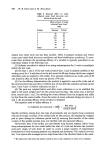
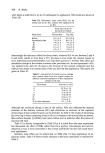
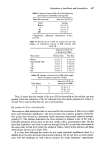
412 D. C. Cullum experimental conditions, will yield different results in terms of percentage reduction in sweat weight. All would seem to be equally valid they are simply different kinds of information. All hot-room methods serve to rank products in order, under their own particular experimental conditions, and all involve the tacit assumption that the ranking order in real use will be substantially the same. ACKNOWLEDGMENTS The author wishes to thank Mrs D. M. Minton and Miss L. Taylor for carrying out the hot-room tests, and various members of the Computing and Statistics Section, Unilever Research Laboratory, Isleworth, for much help and advice as well as routine analysis of results. REFERENCES 1 Tentative Findings of the OTC Antiperspirant Panel: Information Copy, Draft Report ep. 130 (see particularly pp. 168 and 168B). 2 Fredell, W. G. and Read, R. R., Proc. Sci. Sect., Toilet Goods. Ass. No. 15, 23 (1951). 3 Fredell, W. G. and Longfellow, J. Report on evaluating antiperspirant and deodorant products. J. Soc. Cosmet. Chern. 9 108 (1958). 4 Majors, P. A. and Wild, J. E. The evaluation of antiperspirant efficacy: influence of certain variables. J. Soc. Cosmet. Chem. 25 139 (1974). 5 Wooding, W. M. and Finkelstein, O. A critical comparison of two procedures for antiperspirant evaluation. J. Soc. Cosmet. Chem. 26 255 (1975). 6 Tentative findings of the OTC Antiperspirant Panel: Information Copy, Draft Report, p. 144. 7 Wooding, W. M. Interpretation of gravimetric axillar antiperspirant data. Proc. Joint Conf. Cosmet. $ci. 91 (1968).

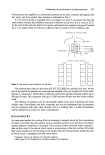
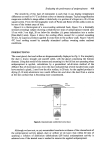
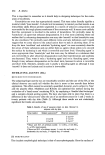
J. $oc. Cosmet. Chem. 29 413--422 (1978) Evaluating the performance of antiperspirants W. B. DAVIS and A.M. REES-JONES Beecham Products Research Department, Leatherhead, Surrey, England Presented at the Symposium on 'Product Evaluation' 18 April 1978, at Eastbourne Synopsis Particular attention is paid to two methods of performance evaluation (thermography and hygrometry) that allow antiperspirant activity measurements to be made under controlled conditions that do not interfere with the normal operation of the glands or the cooling caused by the evaporation of sweat at, or near, the skin surface. Thermography involves imaging the axillary vault region from the long-wave radiations emitted by the warm skin surface and uses the cooling effect of evaporation to map out areas where water is evaporating from the surface. Hygrometry involves relative humidity measurements of ambient air passing over the skin surface: sweat evaporating increases the relative humidity of the current of air. The results obtained from these methods are compared with those derived from conventional gravimetric tests on the back and the axillae in which sweat is collected in occluded absorbent pads. INTRODUCTION Therma-regulation in man is a complex efficient system in which the thermal energy released as a result of the chemical and physical activities within the body is used, in conjunction with local and central temperature control systems, to maintain the body and blood temperature near 37øC (Fig. 1). Heat gain Heat loss Muscular activity Metabolism External heat supply Conduction Radiation Sweat evaporation Figure 1. The thermal balance. Heat is gained from within the body as a result of metabolic activities. Sources such as the heart and liver are relatively constant whereas heat generated by skeletal muscular activity produces a variable contribution. Heat production under resting conditions is approximately 4.2 kJ/kg of body weight per hour (1 kcal/kg/h). During physical activities this heat production rate increases ten-fold. Heat is gained from the environment by radiation and conduction. Heat is lost by conduction and evaporation in the lungs and by radiation, conduction and evaporation at the skin surface. In a temperate climate a resting, clothed person loses approximately half of his heat by radiation and conduction and half by evaporation. 0037-9832/78/0700-0413 $02.00 ¸ 1978 Society of Cosmetic Chemists of Great Britain 413
Purchased for the exclusive use of nofirst nolast (unknown)
From: SCC Media Library & Resource Center (library.scconline.org)