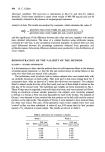
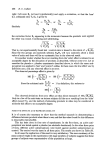
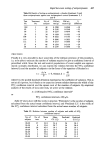
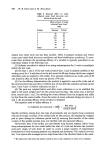
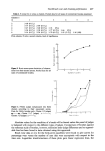
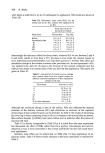
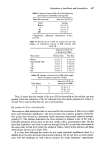
416 W. B. Davis and A.M. Rees-Jones Table I. Seasonal effect on sweat collected under fixed hot-room con- ditions from the back Mean amount of sweat collected from 4 cm a (mg) Subject Summer Winter 1 46 15 2 172 82 3 113 11 4 63 26 5 94 18 6 76 10 Mean 94 27 subject may sweat more one day than another. Table I compares summer and winter sweat rates under fixed hot-room conditions and fixed stabilisation conditions. To over- come these problems the percentage efficacy of a product is typically quantified on an individual subject in the following way. (1) Subjects are asked to refrain from using antiperspirants for 2 weeks immediately before the test week. (2) On days 1 and 2 of the test week (control days 1 and 2) subjects stabilise in the waiting room for 1 h and then sit in the hot-room for 80 min during which time weighed absorbent pads are applied to the axillae. Two separate collections are made, each of 20 min duration after an initial warm-up period of 40 min. (3) For the efficacy determinations the product is applied to one axilla at the end of the second control day and then 1 h before and 15 min after the collection periods on test days 3 and 4 and 1 h before collection on day 5. (4) The pads are weighed before and after sweat collections so as to establish the right to left sweat weight ratio* for the control and test days. The sweat ratio is derived from control days 1 and 2 by dividing the sweat collected from the assigned test axilla by that from the control axilla. From the ratios of sweat collected during test days 3, 4 and 5, the percentage efficacy of the product is obtained. The equation used to define efficacy is •o reduction in sweat rate= 100(1 - test ratio ] control ratio] Specific problems arising from this type of gravimetric test are mainly those concerned with (a) thorough coverage of the treated area by the product, (b) keeping the weighed pad in place during the collection period and (c) ensuring that transfer of the solids content of the applied product does not interfere with the measured efficacy. Gravimetric tests in the axillae are unavoidably long because subjects refrain from using antiperspirants for two weeks before the start of a trial and between the essential cross-over stages of such trials. In order to screen a larger number of experimental formulations a back-screening method was adopted and developed. This method involves ten, 2 cm square sites arranged as two strips from below the shoulder blade to the waist. * By using sweat rate ratios the scatter caused by day to day variations in sweat rate is reduced.

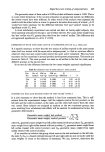
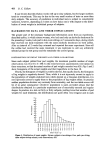
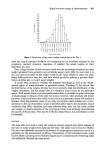
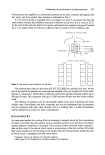
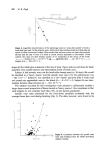
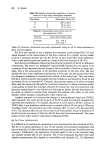
Evaluating the performance of antiperspirants 417 Test products are applied in a randomised pattern on six sites, constant throughout the test week, and four control sites situated as indicated in Fig. 2. 0.1 ml of test product is applied from a syringe to an area 3 cm square (so that the area treated overlaps the collection area) and is allowed to dry for 1 h in a room at 23øC. At the end of this period a dried 2 cm square pad made from surgical pad gauze* backed by a 5 cm square sheet of occlusive, adhesive taper is fixed over the collection site. Arrangement of collechng system •k,• Spine lectoutsitescutbetweencmcm2_cm sit 2_.5
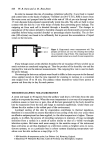
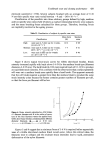
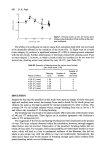
Oo, 2_ x 7'5 Figure 2. Gravimetric sweat collection on the back Position of control sites (C) Group ] Group 2 The subjects then enter the hot-room (38'5øC 35 % RH) for a period of 45 min. At the end of ths period the patches are removed and weighed. They are weighed 24 h later after drying in a desiccator. Under these conditions control site patches typically collect up to 200 mg of sweat. This compares with up to 2,500 mg over 40 rain over the whole axillary vault. The efficacy of products can be numerically higher from back screening tests than axillary tests. Nevertheless the back screening test has the advantage that six products can be compared with each other directly and it is unlikely that a usable formulation will be rejected as a result of a back screening test. HYGROMETRY As mentioned earlier the cooling effect of sweating is brought about by the evaporation of water at or below the skin surface, thus as ambient air flows over the skin its moisture content (relative humidity) is increased. The product of (the increased water content) x (the air flow rate) is the rate at which sweat is evaporating at the skin surface. Provided that sweat droplets are not forming on the surface the rate of evaporation equals the rate at which sweat is emerging from the sweat ducts. * Surgipad, Johnson & Johnson Ltd, Slough, England. •- Sleek tape, S & N Southalls Ltd, Welwyn Garden City England
Purchased for the exclusive use of nofirst nolast (unknown)
From: SCC Media Library & Resource Center (library.scconline.org)