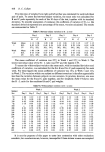
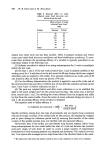
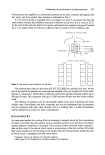
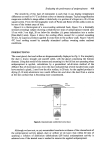
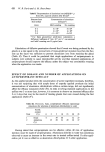
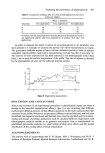
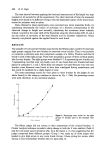
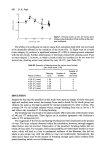
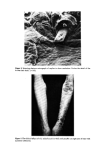
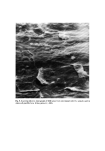
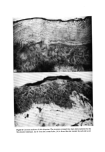
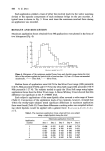
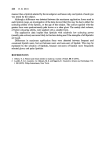
43O B. R. Pugh I..5 25 50 75 I00 Percenfoge weor Figure 7. Cleaning scores in vitro for various worn brushes using Pepsodent (Elida Gibbs) as the refer- ence toothpaste. The ability of a toothpaste to remove stains from extracted, dyed teeth was not found to be drastically affected by the condition of the brush (Fig. 7). Slight wear of a brush (wear category 4) produced a significant increase (P=0.05) in cleaning scores compared with the new brush. Further deterioration of the brush reduced the cleaning score. Even at wear category 7, however, at which a brush would be considered to be too worn for normal use, cleaning scores were reduced by only 10-15•o (see Table III). Table III. Summary of cleaning scores for various worn brushes (new brush score, 1'00) Number of Cleaning Number of mosiacs Brush condition score brushes per brush 3 (24.4% wear) 1.03 2 6 4 (36-3•o wear) 1.28 2 6 5 (52.6% wear) 1' 10 2 6 6 (75.5% wear) O. 86 4 6 7 (95.6% wear) O' 89 4 6 __ DISCUSSION Despite the fact that the panellists in this study were made up largely of those who gave high and medium wear scores, the average force used to brush for the whole group was virtually the same as the figures quoted for normal populations by other workers. This average (7.4 N) did include subjects whose average brushing force was as low as 3 N and others who exceeded 17 N during brushing. The brushing rate was found to be approximately 260 strokes/min with extreme values of 340 and 177 strokes/min. These figures are in excellent agreement with Robinson's value of 275 strokes/min (11). The magnitude of the forces used during brushing have been implicated in the process of wear. The large variance observed within the correlation, however, strongly suggests other factors may be involved. Observation of the panellists' brushing habits did not reveal obvious clues For example, while some panellists pre-wetted their brushes in warm water, which will lead to a loss in mechanical resilience of the filaments, this did not relate in any simple way with the ability to wear out toothbrushes. Speculatively, the other major factor may be the manner of brushing, though again direct evidence from actual brushing habits was not forthcoming.

Toothbrush wear and cleaning performance 431 The condition of the brush does not drastically affect the ability of a toothpaste to remove cosmetic stains from extracted teeth. Some deterioration was observed for severely worn brushes. Our experience of evaluating the cleaning performances of tooth- pastes in vivo (3, 10) strongly suggests that this effect would not lead to any serious increase in the severity of stains on the teeth for the great majority of a population. The function of a toothbrush is to remove dental plaque and food particles as well as help remove cosmetic stains and it does not follow that while the condition of the brush does not unduly influence the ability of a dentrifrice to keep teeth free from stains, that similar relationships hold for dental plaque and other soft deposits. This may be parti- cularly true for dental plaque retained in the spaces between the teeth. Filaments of a badly worn brush may well be unable to penetrate into these regions, with important consequences in terms of gingival health. REFERENCES 1 Manly, R. S. A structureless recurrent deposit on teeth. J. Dent. Res. 22 479 (1943). 2 Kitchin, P. C. and Robinson, H. B. G. How abrasive need a toothpaste be? J. Dent Res. 27 501 (1948) 3 Bull, W. H., Callender, R. M., Pugh, B. R. and Wood, G. D. The abrasion and cleaning properties of dentifrices. Br. Dent. J. 125 331 (1968). 4 World Workshop in Periodontics (1966) The University of Michigan Press, Ann Arbor. 5 Frandsen, A. (ed.) Oral Hygiene (1972) Aalborg Stiftsbogtrykkeri, Denmark. 6 A survey into the state of the nation's toothbrushes: A British Dental Health Foundation Survey. (1975) British Dental Health Foundation, London. 7 McKendrick, A. J. W., McHugh, W. D. and Barbenel, L. M. H. Toothbrush age and wear. An analysis. Br. Dent. J. 130 66 (1971). 8 Bergstrom, J. Wear and hygiene status of toothbrushes in relation to some social background factors. $ven. Tandlak, Tidskr. 66 383 (1973). 9 Heath, J. R. and Wilson, H. J. Forces and rates observed during in vivo toothbrushing. BiomedEng. 9 61 (1974). 10 Wilkinson, J. B. and Pugh, B. R. Toothpastes: cleaning and abrasion. J. $oc. Cosmet. Chern. 21 595 (1970). 11 Robinson, H. B. G. Toothbrushing habits of 405 persons. J. Am. Dent. Ass.33 1112 (1946).
Purchased for the exclusive use of nofirst nolast (unknown)
From: SCC Media Library & Resource Center (library.scconline.org)