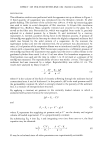
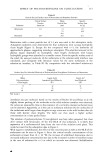
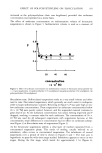
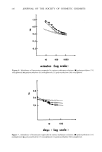
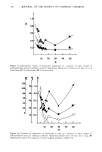
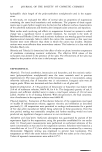
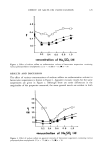
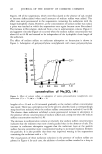
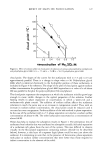
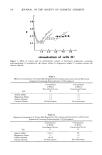
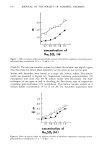
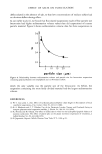
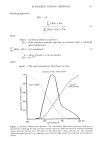
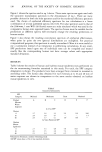
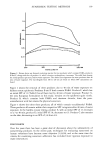
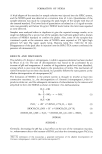
EFFECT OF POLYOXYETHYLENE ON FLOCCULATION 119 suspensions that contain thickening agents. Our suspensions contained no added polymers and had relatively nonviscous media. '['he networks that exist in flocculated sediments result in a more open structure than is found with deflocculated systems. The latter tend to pack rather tightly. As a result, filtration or refiltration through a flocculated sediment tends to be much more rapid than through a deflocculated bed. This is reflected in the value of K, the permeability coefficient, which is used to characterize our refiltration results. Higher values of K reflect the porous structure of a flocculated system, whereas smaller values result from permeation through the compact structure of a deflocculated sediment. As shown in Figure 10, the three techniques used, sedimentation volume, viscosity and refiltration, generally correlate well with each other. An exception occurs in the case of surfactants with n _ 9 where viscosity and F decrease with increasing polyoxyethylene length, whereas K increases over the same range. An explanation for this discrepancy will be provided below. The effect of polyoxyethylene chain length on fiocculation sDte is complex and involves several factors. Particle-particle repulsion and attraction, the strength and reversibility of interparticulate bonds and the packing of particles and aggregates all play a role in determining the structural properties of a suspension. It is often difficult to separate these factors, but various physical-chemical measurements provide insight into the mechanism of flocculation or deflocculation. Suspensions containing polyoxyethylene (5) nonylphenol were fiocculated as shown by measurements of viscosity and F (Figures 8-10). As noted earlier, the supernatant of these suspensions was clear although solutions of this surfactant are hazy. This fact, together with the results of our adsorption study, suggest that incipient phase separation of the surfactant occurs in benzocaine suspensions. The surfactant-rich layer acted as liquid bridges that joined the particles into a fiocculated network. With an increase in polyoxyethylene chain length, HLB of the surfactants increased and the tendency for phase separation was reduced. Also the adsorbed surfactant layer contained longer polyoxyethylene units, promoting repulsion of the particles. As a consequence, sedimentation volume (Figures 8-10) and viscosity (Figure 10) decreased with a lengthening of the surfactant polar group, up to n = 10. The low value of K from refiltration measurements with very short chain length surfactants is attributed to the surfactant-rich layer which not only was responsible for flocculation, but, on the other hand, occupied space between the particles and, provided smaller capillaries for the passage of the supernatant. For very long chain surfactants, such as polyoxyethylene (50) nonylphenol, the surface tension of an aqueous solution is much higher than the critical surface tension and wetting may not be complete. Agitation offsets, to some extent, the effect of too high a surface tension, but it is possible some air is entrapped in the suspensions. Tiny air bubbles on particle surfaces can serve as foci for interparticulate attachment because of the absence of a repulsive surfactant covering in those regions. This mechanism could account for the increased flocculation observed in suspensions containing polyoxyethylene (50) nonylphenol. In suspensions containing surfactants whose polyoxyethylene chain length ranges from n = 10 to n = 30, wetting appears to be complete and the medium exists as a homogeneous single phase. All three methods of evaluating suspension structure give

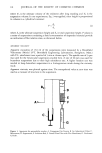
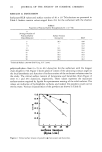
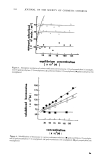
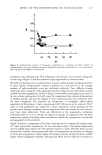
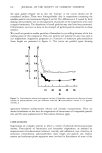
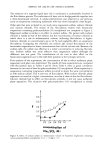
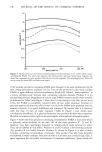
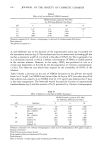
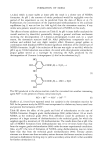
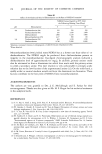
120 JOURNAL OF THE SOCIETY OF COSMETIC CHEMISTS the same pattern (Figure 10) so that the "bumps" in the curves should not be considered artifacts. These were distinguishable only in suspensions containing the smallest particle size benzocaine (Figure 8 and 9). The differences in F caused by daily shaking were probably due to rearrangement of particles in the suspensions into more compact formations. The dissolution of small particles may also have been promoted. Unfortunately, we have no data on the strength of particle-particle attraction in these systems. We could not produce smaller particles of butamben by jet milling because of the low melting point of this compound. Only one particle size material (23/am) was used in our suspensions. Suspension properties as a function of surfactant polyoxyethylene chain length are presented in Figure 11. The curves are parallel, again showing q 10 20 30 40 50 Figure 11. Sedimentation volume and apparent viscosity of butamben suspensions as a function of mean number of polyoxyethylene units per surfactant molecule. (©) sedimentation volume, F (o) apparent viscosity, r/. agreement between sedimentation volume and viscosity measurements. There are marked similarities to the data for suspensions of benzocaine of comparable particle size, and the same explanations for flocculation behavior apply. CONCLUSIONS Suspensions are complex systems in which a variety of physical-chemical processes interact. Flocculation of benzocaine and butamben suspensions, as assessed by measurements of sedimentation behavior, viscosity and refiltration, was a function of surfactant concentration, polyoxyethylene chain length and particle size. Surface tension and surfactant phase separation were involved in flocculation of some of the
Purchased for the exclusive use of nofirst nolast (unknown)
From: SCC Media Library & Resource Center (library.scconline.org)