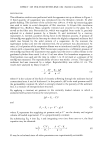
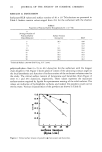
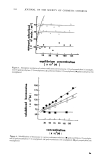
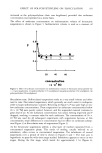
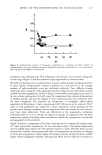
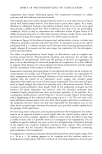
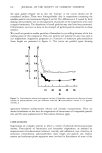
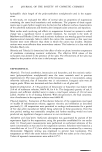
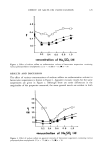
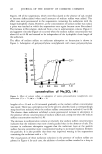
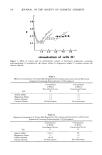
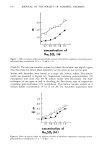
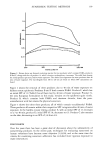
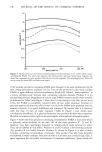
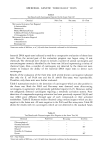
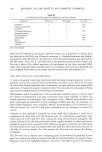
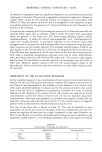
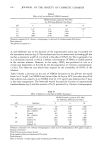
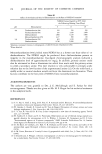
130 JOURNAL OF THE SOCIETY OF COSMETIC CHEMISTS 30 K 20 10 I i • I I 0.2 0.4 0.6 0.8 1.0 concentration o! Na 2 SO 4 (lvl) Figure 7. Effect of sodium sulfate on permeability constant of butamben suspensions containing various polyoxyethylene nonylphenols. (El) n = 7.5 (•.) n = 15. (Table II). The salt concentration required to induce fiocculation was slightly higher than that needed to induce phase separation, but the values are not very far apart. Studies with butamben were limited to a single salt, sodium sulfate. Flocculation results are presented in Figures 6-8. Suspensions containing polyoxyethylene (15) nonylphenol with more than 0.6 M sodium sulfate were flocculated. The three techniques do not agree as well in discribing the fiocculation state of suspensions containing polyoxyethylene (7.5) nonylphenol. Flocculation became evident at a sodium sulfate concentration of 0.4 to 0.6 M. The butamben suspensions were 75 6.0 I 1 4.5 (½P) 3.0 1.5 0.2 0.4 0.6 0.8 1.0 concentration o! NoSO Figure 8. Effect of sodium sulfate on apparent viscosity of butamben suspensions containing various polyoxyethylene nonylphenols. (El) n = 7.5 (•.) n = 15.

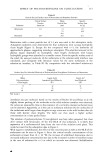
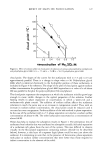
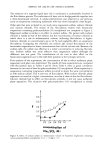
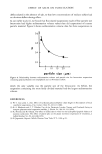
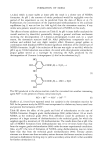
EFFECT OF SALTS ON FLOCCULATION 131 deflocculated in the absence of salt, so that low concentrations of sodium sulfate had no obvious defiocculating effect. In our earlier study (1), we found that flocculated suspensions made of fine particle size benzocaine had higher sedimentation volume values than did suspensions of coarser particle material. Figure 9 shows sedimentation volume data for three suspensions in 0.6 0.5 0.4 0.3 t I i i I 5 10 15 20 particle size (,um) Figure 9. Relationship between sedimentation volume and particle size for benzocaine suspensions containing polyoxyethylene (15) nonylphenol and 1.0 M sodium sulfate. which the only variable was the particle size of the benzocaine. As before, the suspension containing the most finely divided material had the largest sedimentation volume. REFERENCES (1) W. C. Liao and J. L. Zatz. Effect of surfactant polyoxyethylene chain length on flocculation of local anesthetic suspensions,J. Soc. Cosmet. Chem 31,107-121 (1980). (2) B. A. Matthews and C. T. Rhodes, Use of the Derjasuin, Landau, Verwey and Overbeek theory to interpret pharmaceutical suspension stability,J. Pharm. Sci., 59, 521-525 (1970). (3) K. Shinoda and H. Takeda, The effect of added salts in water on the hydrophile-lipophile balance of nonionic surfactants: The effect of added salts on the phase inversion temperature of emulsions, J. Colloid Interface $ci., 32,642-646 (1970). (4) B.Jirgensons, Organic Colloids, Elsevier: New York, N.Y., 1958 p 231.
Purchased for the exclusive use of nofirst nolast (unknown)
From: SCC Media Library & Resource Center (library.scconline.org)