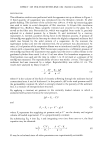
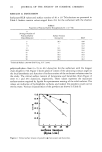
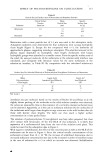
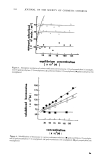
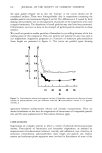
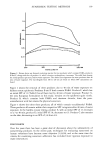
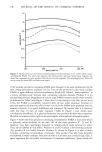
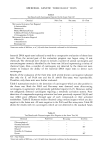
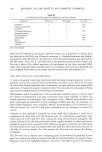
SUNSCREEN TESTING METHODS 141 vehicle containing TiO2 (product B) has remained on the skin after 40 min of water exposure, yet the PABA appears easily removed. While the vehicle obviously is important, it does not appear to hinder the removal of water soluble sunscreen agents. Because of the risk, time and expense involved in clinical trials of sunscreening products, the need for reliable predictive in vitro tests now is much more acute. While other investigators have had the basic predictive tools at hand, they have not had available the human data, expressed in an equivalent manner, which is necessary for meaningful comparison (26-29). They were therefore unable to correlate their proposed procedures with human experience. In the work already published using hairless mouse epidermis as a matrix for studying changes in optical properties produced by application of sunscreening products, the results could be compared directly with human experience (1). This resulted in a basis for extending uses of the test method. Human water-resistance testing is more difficult to perform than are the inherent efficacy tests and are more difficult to control. In the literature, there have not been many reports of products tested for water resistance, using objective methods suitable for in vivo comparisons (20,21,30). Very few in vitro methods of testing substantivity have been attempted (28,30). Those reported to date have been cumbersome, time-consuming, and involved a great deal of analytical equipment or theoretical relationships. The in vitro method described here is straightforward and rapid the results are directly comparable to human data. The data on all six products is consistent for all water exposure periods examined. Products which appear to be easily removed from human skin are easily removed from hairless mouse epidermis. Products which stay on human skin also appear to adhere well to mouse epidermis. The protection level of each product determined by both methods is quite similar. In all cases, the standard deviations fall within the range specified by the FDA guidelines (14). Products which fail to meet FDA requirements for water resistance are shown in this study to be decreased significantly after only 10 min of water exposure, both in the human and in the hairless mouse epidermis methods. This makes screening products by the in vitro method quite rapid. These studies demonstrate that for each SPF category, products can be formulated to effectively resist water removal. Tests such as the one described herein can now be extended to predictions of other product qualities, such as which ones are suitable candidates for •'waterproof" testing in vivo. Another application of this in vitro method could be to compare substantivity in salt water, or in chlorinated water. (Preliminary data shows that sea salt water is no more effective in removing these products than is fresh or chlorinated water.) By controling the temperature, pH, salinity, etc., we can achieve new understanding of the mechanisms of sunscreen retention. Ultimately, in vitro testing should lead to better and more rapid development of sunscreening products to meet changing consumer needs. REFERENCES (1) R. M. Sayre, P. P. Agin, G.J. LeVee and E. Marlowe, A comparison of in vivo and in vitro testing of sunscreening formulas, Photochem• PhotobioL, 29, 559-566, (1979). (2) G. A. Groves, P. P. Agin and R. M. Sayre, In vitro and in vivo methods to define sunscreen protection, Aust. J. Dermatol., 20, 112-119, (1979).

142 JOURNAL OF THE SOCIETY OF COSMETIC CHEMISTS (3) R. M. Sayre, In vitro testing of sunscreens, Proc. Proprietary Assoc., 78-85, (November 1978). (4) D. F. Robertson and G. A. Groves, The selection and use of topical sunscreens, Med. J. Aust., 2, 1445-1451, 41972). (5) G. A. Groves, The selection and evaluation of ultraviolet absorbers, Aust. J. DermatoL, 14, 21-34, 41973). (6) G. A. Groves, Evaluation of solar protective preparations, Aust. Soc. Cosmet. Chem., 90, 36-50, 41975). (7) P. P. Agin, R. M. Sayre and M. R. Chedekel, Photodegradation of phaeomelanin: an in vitro model, Photochem. PhotobioL, 31: 359-362, 41980). (8) K. H. Kaidbey, P. P. Agin, R. M. Sayre and A.M. Kligman, Photoprotection by melanin, a comparison of black and caucasion skin,J. Am. Acad. DermatoL, 1,249-260, 41979). (9) H. S. Black, C. M. Kleinhans, H. T. Hudson, R. M. Sayre and P. P. Agin, Systemic protection by butylated hydroxytoluene to UV-radiation damage, Photobiochem. Photobiophys., In press. 410) H. S. Black, C. M. Kleinhans, H. T. Hudson, R. M. Sayre and P. P. Agin, Studies on the protective effect of butylated hydroxytoluene to UV-irradiation, Am. Soc. Photobiol. Abstracts, 7, 193, 41979). 411) G. DeRios, J. T. Chan, H. S. Black, A. H. Rudolph and J. M. Knox, Systemic protection by antioxidants against UVL-induced erythema,J. Invest. DermatoL, 70, 123-125, 41978). 412) U. Hoppe, H. J. Kopplow and A. Wiskemann, Statistische auswertung des lichtschutzfaktors, Arzneim. Forsch., 25,817-825, 41975). 413) J. C. Van der leun, Ultraviolet erythema, Doctoral dissertation, U. of Utrecht, Netherlands 41966). 414) OTC Review Panel on Topical Analgesics, Food and Drug Administration, Monograph on Sunscreens, Fed. Reg., Part II, 43 (August 25, 1978). 415) I. A. Blank, R. D. Griesmer and E. Gould, Penetration of an anticholinesterase agent into skin, J. Invest. DermatoL, 29, 299-309 41957). 416) R. M. Sayre, R. L. Olson and M. A. Everett, Quantitative studies on erythema,J. Invest. DermatoL, 46, 240-244 41966). 417) R. G. Freeman, D. W. Owens, J. Knox and H. T Hudson, Relative energy requirements for an erythemal response of skin to monochromatic wavelengths of ultraviolet present in the solar spectrum,J. Invest. DermatoL, 47, 586-592, 41966). 418) D.J. Cripps and C. A. Ramsey, Ultraviolet action spectrum with a prism-grating monochromator, Br. J. Dermatol., 82, 584-592, 41970). 419) R. M. Sayre, E. Marlowe, P. P. Agin, G.J. LeVee and E. W. Rosenberg, Performance of six sunscreen formulations on human skin, Arch. DermatoL, 115, 46-49, 41979). (20) K. H. Kaidbey and A.M. Kligman, Laboratory methods for appraising the efficacy of sunscreens,J. $oc. Cosmet. Chem., 29, 641-649 41978). 421) R. S. Berger, J. A. Mezick and C. M. Papa, Design and evaluation of a water-resistant sunscreen preparation,J. Soc. Cosmet. Chem., 29, 641-649 41978). (22) M. A. Pathak, T. B. Fitzpatrick and E. Frenk, Evaluation of topical agents that prevent sunburn-- superiority of para-aminobenzoic acid and its ester in ethyl alcohol, N. Eng. J. Med., 280, 1459-1463 41969). A. Langner and A.M. Kligman, Further studies of aminobenzoic acid, Arch. Derre., 105, 851-855 41972). O.J. Lorenzetti, J. Boltralik, E. Busby and B. Fortenberry, The influence of protein vehicles on the penetrability of sunscreens,J. Soc. Cosmet Chem., 26, 593-609 41975). S. I. Katz, Relative effectiveness of selected sunscreens, Arch. Derre., 101,466-468 41970). S. I. Kreps, Spectrophotometric evaluation of sunscreens, Proc. Sci. Sect. Toilet Goods Assoc., 23, 13-26 41955). S. I. Kreps, Sunburn protection and suntan preparations, Am. Perf Cosmet., 78, 73-76 41963). E. Pines, A new technique to assess sunscreen effectiveness,J. Soc. Cosmet. Chem., 29, 559-564 41978). B. M. Cumpelik, Analytical procedures and evaluation of sunscreens, J. Soc. Cosmet. Chem., 23, 333-345 41972). F. Greiter, P. Bilek, S. Doskoczil, J. Washuttl and F. Wurst, Methods for water resistance testing of sun protection products, Int. J. Cosmet. Sci., 1,147-157 41979). (23) (24) (25) (26) (27) (28) (29) (30)
Purchased for the exclusive use of nofirst nolast (unknown)
From: SCC Media Library & Resource Center (library.scconline.org)