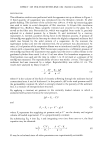
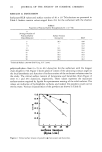
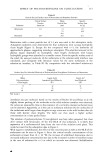
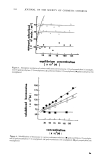
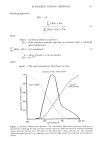
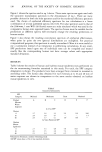
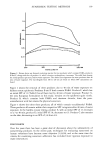
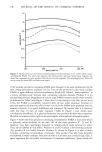
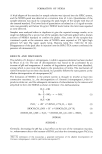
EFFECT OF POLYOXYETHYLENE ON FLOCCULATION 109 CRITICAL SURFACE TENSION Critical surface tension of the local anesthetics was measured on compacts as described previously (6). Solutions of the polyoxyethylene nonylphenols were used as the probe liquids in contact angle measurement. SOLID PARTICLE PREPARATION A portion of the benzocaine powder was broken down into fine particles by a jet mill (Helme Products, Inc. Helmetta, N.J.). The mean particle size of the resulting fractions was monitored by a sub sieve sizer (Fisher Scientific Co., Pittsburgh, Pa.). Surface area of each benzocaine fraction was determined by a single point BET measurement (Quantasorb, Quantichrome Co., Greenvale, N.Y.). PREPARATION OF SUSPENSIONS A 3.50-g portion of drug was weighed into a cylindrical snap-cap vial (Opticlear, 12 dram, Owens-Illinois Inc., Gas City, Ind.) and 35.0 ml of prepared surfactant solution was pipetied in. The capped vials were placed horizontally in a gyratory shaker (Model G-76, New Brunswick Scientific Co., New Brunswick, NJ.) and shaken for 24 hr at 180 RPM. After preparation, suspensions were stored in two ways. One group was allowed to sediment undisturbed. The second group of suspensions was permitted to stand for 24 hr and then shaken vigorously until redispersed. This process was repeated every day. ADSORPTION AND SOLUBILIZATION Adsorption and solubilized drug were determined by analysis of the supernatant liquid after equilibration with the suspended particles. The concentrations of surfactant and benzocaine in solution were determined by spectrophotometric analysis. The absor- bance peak wavelength for the surfactants was 276.5 nm the value for solubilized benzocaine was 286 nm. Absorbance values were obtained at both wavelengths. Simultaneous Beer's Law equations for absorbance based on the assumption of additive contributions by benzocaine and surfactant were solved to yield concentration data for both substances. This technique was verified by studies utilizing known concentrations of the two components. SEDIMENTATION CHARACTERISTICS The sedimentation process was monitored by observing the height of the sediment expressed as a fraction of the total suspension height, with time. When sedimentation is complete (i.e., no further change in sediment height is observed), the sedimentation volume, F, can be defined: F - Vo

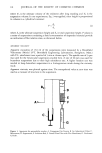
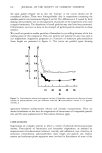
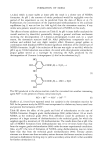
110 JOURNAL OF THE SOCIETY OF COSMETIC CHEMISTS where Vu is the ultimate volume of the sediment after long standing and V o is the suspension volume. In our experiments, Eq. 2 was applied, since height is proportional to volume in a cylindrical container: F - (2) So where hu is the ultimate suspension height and ho is total suspension height. F values in a series of suspensions containing a fixed concentration of suspended material provide an indication of flocculation state, as discussed below. APPARENT VISCOSITY Apparent viscosities of 15.0 ml of the suspensions were measured by a Brookfield Viscometer (Model LVT, Brookfield Engineering Laboratories, Stoughton, Mass.) with U.L. attachment over a period of 3 rain at chosen rpm's. The spindle rate of 3 rpm was used for the benzocaine suspensions studied here. A rate of 30 rpm was used for butamben suspensions due to their high subsidence rate. A higher rotation rate was needed to keep butamben suspensions in a homogeneous mode during the viscosity study. Apparent viscosity was plotted against time. The extrapolated value at zero time was used as a measure of structure in the suspension. B l- Figure 1. Apparatus for permeability studies: A. Compressed Air Source B. Air Adjustment Valve C. Manometer D. Supernatant E. Sediment Bed F. Fritted Glass Filter with Film Membrane G. Graduated Cylinder.
Purchased for the exclusive use of nofirst nolast (unknown)
From: SCC Media Library & Resource Center (library.scconline.org)