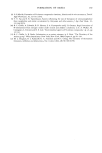
EFFECT OF POLYOXYETHYLENE ON FLOCCULATION 121 suspensions. Structural properties were also influenced by the way in which suspen- sions were treated subsequent to preparation. REFERENCES (1) R. H. Ottewill and T. Walker, The influence of nonionic surface active agents on the stability of polystyrene latex dispersions, Kolloid Z.-Z., Polymere, 227, 108-116 (1%8). (2) P. W. Gerding and G. T. Sperandio, Factors affecting the choice of suspending agents in pharmaceuticals,J. Amer. Pharm. Ass., Pract. Ed., 15,356-359 (1954). (3) R. A. Nash, The pharmaceutical suspensions, part 1, Drug and Cosmet. Ind., 97,939-951 (1%5). (4) E. W. Hiestand, The formulation of coarse suspensions,J. Pharm. Sci., 53, 1-18 (1%4). (5) A. Otsuka, H. Sunada and Y. Yonezawa, Adsorption of nonionic surfactants on sulfathiazole and naphthalene and flocculation-deflocculation behavior of these suspensions,J. Pharm. Sci., 62,751-754 (1973). (6) W. Liao and J. Zatz, Critical surface tensions of pharmaceutical solids, J. Pharm. Sci., 68, 488-494 (1979). (7) R.J. Akers and A. S. Ward, in "Filtration Principles and Practices," C. Orr Ed., Part 1, Marcel Dekker Co.: New York, 1978 pp 169-250. (8) P. Becher, Nonionic surface-active compounds IV. Micelle formation by polyoxyethylene alkanols and alkyl phenols in aqueous solutions,J. Colloid Sci., 16, 49-56 (1%1). (9) L. Hsiao, H. N. Dunning and P. B. Lorenz, Critical micelle concentrations of polyoxyethylated nonionic detergents,J. Phys. Chem., 60,657-660 (1956).

J. Soc. Cosmet. Chem., 31,123-131 (May/June 1980) Effect of added salts on flocculation of local anesthetic suspensions containing nonionic surfactants WEI-CHI LIAO, Present address Schering-Plough Corp., Pharmaceutical Formulation Dept., 86 Orange St., Bloomfield, NJ 07003, and JOEL L. ZATZ, Rutgers College of Pharmacy, Box 789, Piscataway NJ 08854. Received November 5, 1979. Presented at Annual Scientific Meeting, Society of Cosmetic Chemists, December 1979, New York, New York. Synopsis The INFLUENCE of SALTS on SUSPENSIONS of BENZOCAINE and BUTAMBEN stabilized by several polyoxyethylene nonylphenols was studied. Apparent viscosity, refiltration rate and sedimentation studies were used to characterize the FLOCCULATION state of the suspension. The addition of a salt invariably increased the adsorption of SURFACTANT molecules on the particle surface. Sedimentation volume was generally lowered as salt concentration was increased (indicating a reduction in flocculation) until, at a critical salt concentration, there was a sudden increase in sedimentation volume. This phenomenon was related to coacervation of the surfactants as shown by data from adsorption and cloud point measurements. The effectiveness of the salts in promoting flocculation was in the order sodium sulfatemagnesium sulfatesodium chloridecalcium chloride which follows the lyotropic series, indicating that the action of the salts involved dehydration of the hydrophilic chains of the surfactants. ACKNOWLEDGEMENT The support of a Society of Cosmetic Chemists' grant to Wei-Chi Liao is gratefully acknowledged. INTRODUCTION In an earlier study, we investigated the influence of several factors on the flocculation state of suspensions of two local anesthetics, benzocaine and butamben (1). Three techniques related to structural arrangement in suspensions, sedimentation volume, apparent viscosity and refiltration, were employed. Flocculation behavior was influenced by particle size and storage protocol. Flocculation was also a function of 123
Purchased for the exclusive use of nofirst nolast (unknown)
From: SCC Media Library & Resource Center (library.scconline.org)