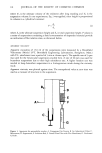
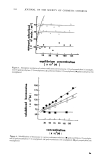
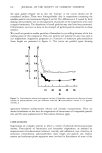
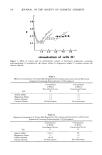
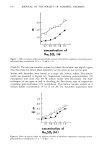
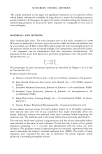
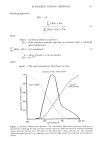
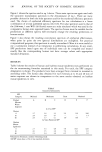
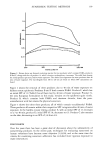
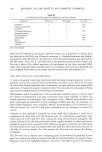
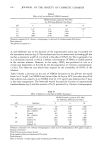
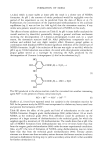
SUNSCREEN TESTING METHODS 139 1.0- 0.8 0.4 w 0.2 m 290 360 3•0 3:•0 NM WAVE LENGTH Figure 2. Shown above are forward scattering spectra for two products which contain PABA, products B and F, along with that of product A, which contains octylmethoxy cinnamate. The solid lines denote the initial product spectrum, before water exposure. The dotted lines represent the same products after 40 min of water exposure. The wavelengths from 290 to 320 nm are those on which SPF calculations are based. Figure 2 shows the removal of three products due to 40 min of water exposure on hairless mouse epidermis. Products B and F both contain PABA. Product F, which has an initial SPF of 12 (Table I) has all been lost by 40 min of water exposure. Product A, the only European formulation in this study, remains on the epidermis quite nicely. Product B, which contains both PABA and titanium dioxide, loses the para- aminobenzoic acid but retains the physical sunscreen. Figure 3 shows the other three products, all of which contain octyldimethyl PABA. These products all remain within their respective SPF categories after 40 min of water exposure. In the hairless mouse testing, product E, with an initial SPF of 13 decreases to a 7 at 40 min product D, initial SPF of 7.8, decreases to 6.5. Product C also remains on the skin, decreasing to an SPF of 3.6 from 4.8. DISCUSSION Over the years there has been a great deal of discussion about the substantivity of sunscreening products. In the recent past, techniques for evaluating sunscreens on human volunteers have become more objective (1,19,20), and at the same time the criteria for examining sunscreen adherence has included more rigorous exposure to water (14,19,20,21).

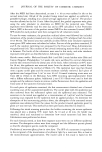
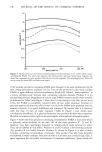
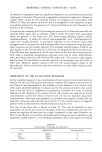
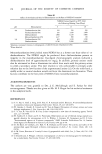
140 JOURNAL OF THE SOCIETY OF COSMETIC CHEMISTS 1.2 1.0 0.8 / uJ "' 0.• 0.4 0.2 i i i 290 300 310 320 NM WAVELENGTH Figure 3. Shown above are the forward scattering spectra for three product C, D, and E, which contain octyldimethyl PABA. The solid lines represent the initial product spectrum before water exposure the dotted line represents the same products after 40 min of water exposure. The wavelengths from 290 to 320 nm are those on which SPF calculations are based. Until recently, products containing PABA were thought to be quite substantive, by the best testing procedures available (22-25). Two of the products in this study contain PABA in quite different vehicle formulations. Product B, labeled •'water-repellent," is a heavy ointment-type formula also containing titanium dioxide Product F is an alcohol-based lotion. Regardless of vehicle type, PABA remains readily water soluble, as indicated in Table i and Figure 3. Even after 15 min drying on the skin (in vivo or in vitro), the PABA is completely removed after 40 min water exposure. Contrary to previous reports, no reservoir effect is seen (22,23). If the PABA does penetrate into the stratum corneum, it is easily solubilized and removed. On human skin it is removed with less than 10 min of water exposure (Table I). Figure 2 also shows quite conclusively the efficacy of a physical sunscreen (see product B) after water exposure. Physical sunscreens scatter light at all wavelengths often without absorption peaks. Figure 3 shows the three products containing octyldimethyl PABA, a sunscreen which is relatively water-insoluble on its own. All of the three products (C, D, and E), however, have been specifically designed in vehicles which resist removal by water. They are all labeled to that effect. Products C and D contain a film-forming polymer (21) product E is a lotion formula. Product A, shown in Figure 2, is also a lotion formula, containing octylmethoxy cinnamate. This product has also been designed and labeled as water-resistant. Selection of both a sunscreen and a vehicle type, then, is quite important for successful achievement of sunscreen adherence. Quite clearly the
Purchased for the exclusive use of nofirst nolast (unknown)
From: SCC Media Library & Resource Center (library.scconline.org)