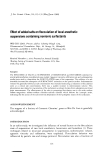
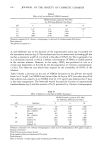
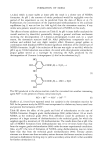
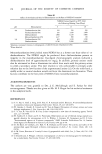
j. Soc. Cosmet. Chem., 31,153-159 (May/June 1980) Some factors affecting the rate of N-nitrosodiethanolamine formation from 2-bromo-2-nitropropane-l,3-diol and ethanolamines JOHN T. H. ONG and BONNIE S. RUTHERFORD Elizabeth Arden Research Center, P.O. Box 2046, Indianapolis, IN 46285. Synopsis The RATE of FORMATION of N-NITROSODIETHANOLAMINE (NDEIA) at 50øC in aqueous SOLUTIONS OF 2-BROMO-2-NITROPROPANE-1,3-DIOL and TRIETHANOLAMINE decreases as the pH is decreased from 6 to 4. No NDE1A is produced at pH 2 after 20 days at 50øC. Citrate buffer catalyzes the reaction, but propyl gallate in combination with disodium EDTA significantly inhibits the reaction. Sorbitol and sorbose have very slight catalytic effect. Technical grade triethanolamine (85%) yields concentrations of NDEIA approximately eight-fold greater than the reagent grade (99%) under the same experimental conditions. This increase could be attributed to the faster nitrosation rate of diethanolamine which is present in substantial amounts in the technical grade triethanolamine. Monoethanolamine (95%) also yielded NDE1A but at a slower rate than either di- or triethanolamine. INTRODUCTION The presence of N-nitrosodiethanolamine (NDE1A) in certain cosmetic products has been reported by Fan et al. (1). We subsequently studied the course of formation of NDE1A in a model system and explored approaches to inhibit NDE1A formation. Lijinsky et al. (2) have shown that either di- or triethanolamine, which are widely used in cosmetics as a part of the emulsifying systems, can be readily nitrosated to form NDE1A. Further, 2-bromo-2-nitropropane-l,3-diol, which is commonly used as a preservative for cosmetics, is able to nitrosate the secondary amine morpholine in an organic solvent (3) it thus seems conceivable that the 2-bromo-2-nitropropane-l,3-diol might also nitrosate di- or triethanolamine. The present study reports 1) the rate of NDEIA formation from various ethanolamines in aqueous solutions at 50øC and 2) some of the factors and compounds affecting that rate. EXPERIMENTAL MATERIALS All materials used were purchased. 2-bromo-2-nitropropane-l,3-diol (Bronopol, Inolex Personal Care Div.), (triethanolamine 85% grade (Ashland Chemical Co.) and organic 153

154 JOURNAL OF THE SOCIETY OF COSMETIC CHEMISTS reagent 99% grade (Mallinckrodt, Inc. OR 1908), diethanolamine (Baker Chemical Co. AR 9227), monoethanolamine 95% (Aldrich Chemical Co., Inc. 11,016-7), citric acid monohydrate (Baker Chemical Co. AR 1-0110), L (--) sorbose (Sigma Chemical Co. S-2001), sorbitol solution 70% (I.C.I. United States, Inc.), and disodium EDTA (J. F. Henry Chemical Co.) were used as received. Propyl gallate was purchased as Tenox S-1 (Eastman Chemical Products, Inc. PM 1771). Deionized water was used as the solvent throughout the study. PROCEDURE Ten ml of aqueous ethanolamine solution (20% w/v) was pipetted into a 150-ml beaker. To the ethanolamine solution was added approximately 35 ml of water and the pH was adjusted to neutrality by the dropwise addition of hydrochloric acid (1.0N or 0.1N). The pH was monitored with a digital pH meter (Corning Model 125). Ten ml of aqueous 2-bromo-2-nitropropane-l,3-diol stock solution (1%) was pipetted into the neutral ethanolamine solution. Other materials were added at this point and the pH was further adjusted to the desired value by the dropwise addition of hydrochloric acid. The solution was quantitatively transferred into a 100-ml volumetric flask and made to volume with water. The volumetric flask was immersed in a constant temperature (50 ø + 0.2øC) waterbath (Magni Whirl, Blue M Electric Co.). At the appropriate intervals aliquots were assayed for NDE1A concentration. ANALYTICAL METHOD Commercial distilled-in-glass solvents (Burdick and Jackson Labs.) and analytical reagent grade anhydrous sodium sulfate were used. The high-pressure liquid chromatography unit consisted of a chromatography pump Model 6000A (Waters Associates), a constant volume injection valve Model 7120 (Rheodyne, Inc.), a precolumn of pellicular silica gel (H. C. Pellosil, Whatman Column Survival Kit) and a silica gel column (25 cm x 4.6 mm i.d., LiChrosorb SI-100, 5/am, Rheodyne, Inc.). This system was connectd to a Thermal Energy Analyzer detector Model 502 (Thermo Electron Corp.) set at a pyrolyzer temperature of 550øC, vacuum of 1.0 mm Hg, oxygen pressure 10 psi. Argon pressure 15 psi and an attenuation factor of 16 or 32. A dry ice-acetone cold trap was used. The mobile phase, acetone-hexane-methanol (50:50:1 v/v), was pumped through the column at a flow rate of 2 ml/min. The temperature was ambient. One to five ml aliquots of the aqueous sample solutions were mixed with 35 ml ethyl acetate and 35 g anhydrous Na2SO 4 and allowed to stand overnight. The supernatant solution was passed through a silica gel column (25 cm x 1.2 cm i.d.) packed with Woelm 100-200/am, activity grade I (ICN Pharmaceuticals). The column was washed with 75 ml ethyl acetate, and the nitrosamine was eluted with 100 ml acetone. The acetone solution was evaporated under vacuum at 40øC, and the residue was dissolved in 1 ml acetone. The external standard was a solution of NDE1A (Columbia Organic Chemicals Co., Inc.) in acetone prepared at a concentration of approximately 1/ag/ml.
Purchased for the exclusive use of nofirst nolast (unknown)
From: SCC Media Library & Resource Center (library.scconline.org)