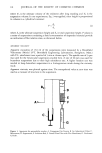
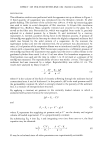
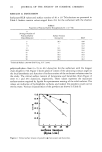
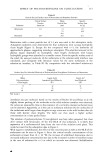
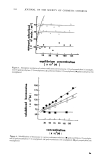
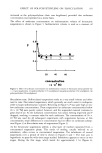
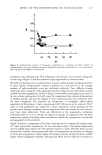
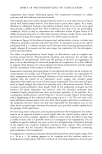
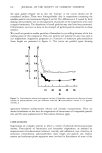
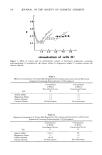
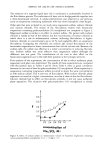
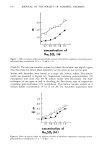
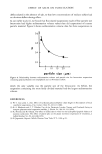
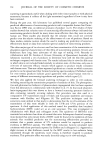
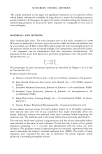
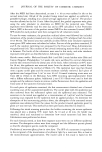
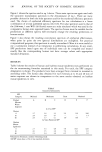
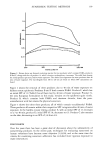
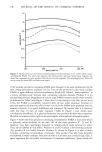
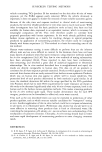
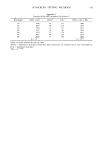
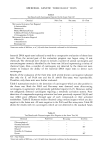
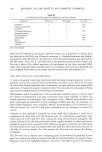
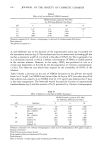
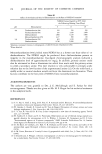
EFFECT OF POLYOXYETHYLENE ON FLOCCULATION Table II Particle Size and Surface Area of Benzocaine and Butamben Powders Substance Critical Surface Mean Specific Tension, Particle Size Surface Area dynes/cm (/xm) (m2/g) Benzocaine 31.1 2.3 1.57 7.6 0.49 20.3 -- Butamben 28.5 23.0 0.12 Benzocaine with a mean particle size of 2.3 /xm was used in the adsorption study. Adsorption isotherms were determined for four surfactants with varying hydrophilic chain length (Figure 3). Except for the compound with n=5, the isotherms all approached a plateau, suggesting monolayer adsorption. The adsorbed amount in the plateau region depended on hydrophilic chain length. Surfactants with longer hydrophilic groups were adsorbed to a smaller extent. From the specific surface area of the solid, the area per molecule of the surfactants at the solution-solid interface was calculated, and compared with literature values for the same surfactants at the solution-air interface, in Table III. By comparison with the calculated solution-air Table .III Surface Area Per Adsorbed Molecule of Polyoxyethylene Nonylphenol Surfactants on Benzocaine n (Mean Liquid-Solid Liquid-Air • Polyoxyethylene Interfacial Area/Molecule Area/Molecule Chain length) (A 2) (A 2) 7.5 42 51 15 55 72 50 166 -- •Ref. 8 and 9. interfacial area per molecule based on the results of Becher (8) and Hsiao et al. (9), slightly denser packing of the molecules at the solid-solution interface was observed the values are reasonably close so the existence of a vertically oriented surfactant layer can be assumed. Apparently, as is the case in surfactant solutions (8), the molecules of the surfactants with longer chain lengths occupy more area at the solid surface than do those with shorter chain lengths. The latter can thus reach a higher surface concentration in a close packed layer. The solution of polyoxyethylene (5) nonylphenol was hazy when prepared, but clear after contact with benzocaine. At the low HLB of this surfactant, it is likely that separation of a surfactant-rich layer from the rest of the solution took place. This would account for the adsorption data in Figure 3. With regard to solubilization, the effect of the concentration as well as the HLB of the surfactants can be seen in Figure 4. Since the critical micelie concentration of the surfactants is lower than 10 x 10 4M, the increase of solubilized benzocaine due to increased surfactant concentraiion was due to the increased number of micelies except in the case of solutions for n=5 in which no increage was observed. Solubilization

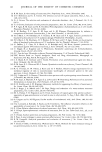
114 JOURNAL OF THE SOCIETY OF COSMETIC CHEMISTS =•" 40 o o o ø ø .,.•o •o •10 ß ß 25 50 75 100 125 equilibrium concentration (x'o4 M ) Figure 3. Adsorption isotherms of various surfactants on benzocaine. ([]) polyoxyethylenenonylph(5) nol (o) polyoxyethylene (7.5) nonylphenol. (A) polyoxyethylene (15) nonylphenol. (©) polyoxyethyl(50) nonylphenol. ' , o u o N 200 175 150 125 100 75 50 30 50 70 90 110 130 concentration ( x 104M ) Figure 4. Solubilization of benzocaine in various surfactant solutions. (.) polyoxyethylene (5) nonylphe nol (o) polyoxyethylene (7.5) nonylphenol. (A) polyoxyethylene (15) nonylphenol- (©) polyoxyethyle(50) nonylphenol. ' ,
Purchased for the exclusive use of nofirst nolast (unknown)
From: SCC Media Library & Resource Center (library.scconline.org)