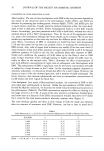
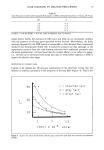
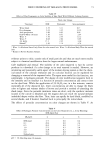
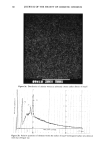
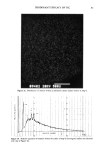
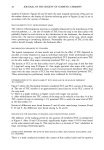
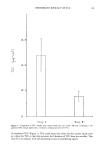
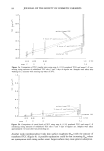
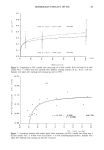
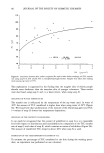
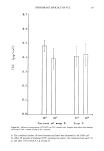
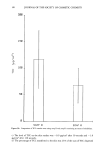
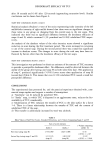
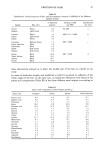
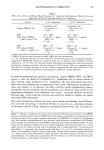
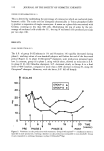
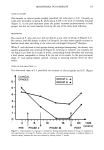
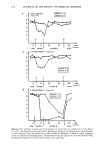
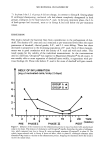
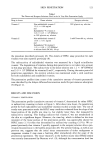
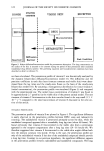
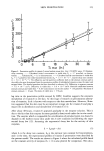
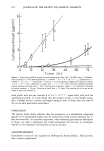
DEODORANT EFFICACY OF TCC 89 after 30 seconds and 6.4% after 120 seconds (approaching saturation level). Similar conclusions can be drawn from Figure 6. SNIFF TEST COMPARING SOAPS A AND D Statistical analysis (Student's t-test) of the ratios representing (odor intensity of the left axilla)/(odor intensity of right axilla) showed that there were no significant changes in these ratios in any group on changing from the control soap to the test soaps. This indicated that there was no significant difference between the deodorant efficacies of soaps A and D, which contained 1.3% powdered and 0.26% solubilized TCC respec- tively. An analysis of the absolute values of the odor intensity scores showed a significant reduction in score during the first treatment period. The scores increased on returning to use of the control soap. During the second period there was a small but significant increase in absolute scores. The changes in score during the trial may have been in- fluenced by factors other than the deodorant efficacy of the test soaps. SNIFF TEST COMPARING SOAPS C AND H This investigation was performed to obtain an estimate of the amount of TCC necessary to provoke a perceptible deodorant effect. No differences could be detected between the axillae of the group after having used soap H on both sides (first day). The application of soap C produced significantly (95%) lower scores than application of soap H (second day) (Table I). This means that even 0.13% solubilized TCC caused a weak but perceptible difference. CONCLUSIONS The experimental data presented for, and the practical experience obtained with, com- mercial soaps explain and support a number of assumptions: a) "Sandiness" can be induced by powdered TCC. b) "Sandy" soap, in which TCC is dispersed in an agglomerate state, reduces the bio- availability of TCC considerably. c) Solubilization of TCC enhances the transfer of TCC to the skin surface by a factor 4. There is a linear relationship between the transfer of TCC and the content of solubilized TCC of the soap. d) This transfer is additionally increased by wool wax alcohols. Table I Mean Values of Sniff Test Scores, Standard Deviations, and t-Values Comparing Soaps C and H Sum of scores (means) t-Values comparing Axilla 1 Axilla 2 axillae 1/2 First day (using soap H) Second day (using soaps C and H) 1.75/0.989 1.625/1.096 0.43 t (95%) = 2.07 3.1/2. 123 3.8/2. 102 2. 122 (soap C) (soap H) t (95%) = 2.046

90 JOURNAL OF THE SOCIETY OF COSMETIC CHEMISTS e) Increasing the content of solubilizer of solvents decreases the amount of TCC trans- ferred. The effects of refattening agents, i.e., wool wax alcohols on the one hand, and solvent, i.e., dimethylpolyglycolether and solubilizer on the other hand, is certainly the consequence of the increased and decreased chemical potential (or "transfer pressure") of TCC respectively. f) The amounts of TCC transferred (% of the soap used) per second of washing period decrease with the duration of the application period and show a saturation level after about one minute of washing. g) Sniff tests show that soaps containing either 0.26% solubilized TCC or 1.3% pow- dered TCC are equivalent deodorants. REFERENCES (1) German patent DBP 31 37 017 US patent 4 547 307. (2) J. J. Kabara et al., Microdetermination of lipid classes after thin-layer chromatography, Anal. Chem., 48, 814-817 (1976). (3) U. Hoppe, Topologie der Hautoberfliiche, J. Soc. Cosmet. Chem., 30, 213-239 (1979).
Purchased for the exclusive use of nofirst nolast (unknown)
From: SCC Media Library & Resource Center (library.scconline.org)