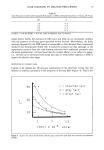
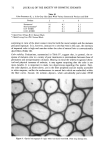
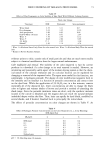
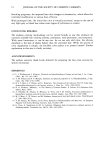
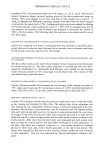
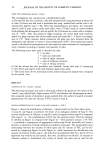
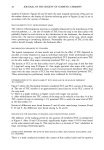
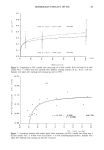
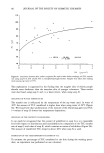
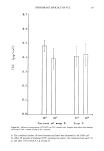
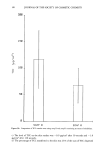
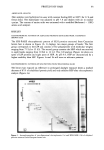
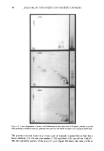
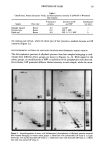
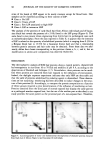
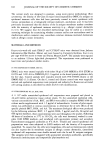
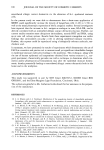
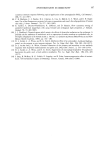
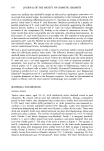
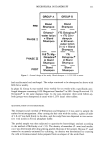
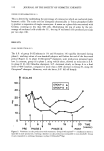
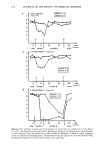
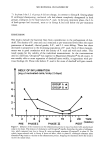
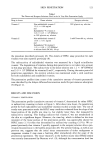
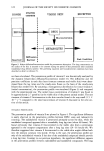
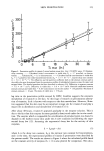
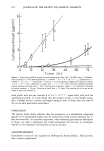
MICROFLORA IN DANDRUFF 113 CLINICAL GRADES The decrease in clinical grades roughly paralleled the reductions in S.P. Virtually no scales were detectable in group B, while group A fell to the level of threshold dandruff (Figure 3). In the post-treatment phase the grades increased proportionately in both groups, but did not reach baseline levels by the end of the three-week followup. MICROFLORA The counts ofP. acnes and cocci did not decline at any time in Group A (Figures 4,5). By contrast, both fell sharply in phase I of Group B, but then rather rapidly returned to baseline levels after switching to the selectively antifungal Octopirox © shampoo. While P. ovale declined in both groups during antifungal shampooing, the density very quickly approached zero in Group B (Figure 6). In Group A, however, the numbers did not begin to go down for a couple of weeks, diminishing slowly thereafter and reaching a level almost comparable to Group B by the end of ten weeks. In the post-treatment phase, P. ovale sprang sharply upward, nearing or attaining baseline levels by three weeks. INDEX OF INFLAMMATION (I.I.) The downward slope of I.I. paralleled the decrease in clinical grades and S.P. (Figure 6 3 CLINICAL GRADES GROUP A ß GROUP B ß ß TIME PRE PHASE I PHASE Tr POST Figure 3. Clinical grades in response to treatments. Scaling diminishes slowly in Group A compared to the rapid decline in Group B. Further, after ten weeks, the latter group showed a complete absence of clinical scaling, whereas this was not achieved by Group A after 17 weeks.

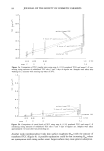
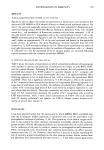
114 JOURNAL OF THE SOCIETY OF COSMETIC CHEMISTS 5 3 2 1- COCCI DENSITY IGROUPA :1 (Iog/½m 2) GROUP B I • ' ' I ' ' • I • ' ' ' I ' • ' ' I 0 •' 2 6 10 15 2 TIME (weeks) PRE PHASE T PHASE Tr POST P, ACNES DENSITY (Iog/cm 2) GROUP A ß] GROUP B ß [ I I I I I I I [ I I [ I I I [ [ [ l 2 6 10 15 20 TIME (weeks) PRE PHASE I PHASE Tr POST õ P. OVALE DENSITY (log/cm 2} 7 5 4 3 2 i [ [ I [ )" 6 TIME (weeks) PRE PHASE I PHASE ]I POST Figures 4, 5,6. Influence of treatments on the densities of, respectively, cocci (Figure 4), P. acnes (Figure 5), and P. ovale (Figure 6) on the scalp surface. The mixture Octopifox and clindamycin is clearly bacterias- tic and fungistatic, while the vehicle has no effect. Antifungal shampoos, in phase II, appear fungistatic and do not influence bacterial population. Octopifox © more quickly supresses P. ovale than Omadine © Mg. Stopping the treatment restores the initial density of the scalp flora.
Purchased for the exclusive use of nofirst nolast (unknown)
From: SCC Media Library & Resource Center (library.scconline.org)