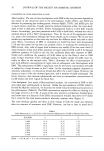
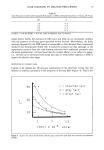
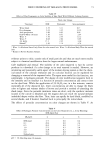
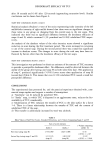
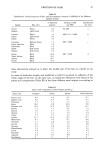
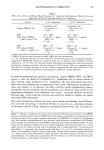
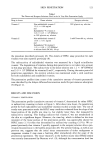
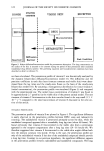
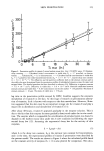
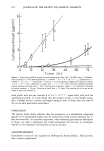
HAIR COLORING BY MELANIN PRECURSORS 73 Table IV Effects of Post-Treatments on Color Stability of Hair Dyed With Different Coloring Systems Total color change Treatment DHI Permanent Semi -permanent Water bleed 3.35 3.11 10.7 Five shampoos 2.63 3.25 13.23 Acid perspiration 5.89 0.95 10.8 Fade-O-Meter 10 hours 3.20 0.41 2.07 Wave 1 a 7.70 2.44 11.12 Wave 2 a 8.08 2.86 9.93 3% H202 17.2 2.25 3.38 Relaxer b 3.26 1.16 4.74 • Wave 1 is Kindness Extra Curly Perm for hair. b Relaxer is Revlon Realistic Relaxer. color-treated hair. Wave 2 is Kindness Body Wave for natural evidence points to this), consist only of small particles and thus are much more readily subject to chemical modification than the larger natural melanosomes. Color modulation and removal. The stability of the color imparted to hair by current products is a drawback if a color change or its total removal is needed. However, an interesting and potentially useful aspect of the melanin dyeing system is that the chem- ical nature of the colorant (melanin) and its cuticular location can be exploited for changing or removal of the imparted color. The agent most useful for this function, not surprisingly, is hydrogen peroxide. The degree of color modification (apparent both in the intensity and its tonality) is a function of peroxide concentration and contact time on the dyed hair. While the application of 3% H202 can, in a few minutes, remove essentially all of the deposited dye, lower concentrations are able to change the black color to lighter and warmer shades of brown and provide a method of extending the shade range. Since the peroxide treatment times are short, only the synthetic melanin located in the cuticle is bleached and the reagent does not reach the natural melanin imbedded deeper within the fiber. Thus, hairs can rapidly be dyed black, modified by several shades, and if desired, bleached back to principally the initial shade. The effects of peroxide concentration on color changes are shown in Table V. As Table V Effect of Hydrogen Peroxide Concentrations on the Color Parameters (L, a, b) by Bleaching DHI-Dyed Hair [H2021% L a b DHI-dyed 17.3 0.0 0.4 0.1 20.6 0.0 2.6 0.5 26.3 0.9 5.5 1.0 27.3 0.5 5.8 3.0 32.8 0.7 7.9 6.0 33.1 0.8 7.8 Undyed grey 33.0 - 0.5 9.1 pH = 10 bleaching time 10 minutes.

74 JOURNAL OF THE SOCIETY OF COSMETIC CHEMISTS bleaching progresses, the imparted hair color changes its chromaticity, which allows for controlled modification to various hues of brown. With prolonged time, the initial hair color is virtually recovered, except in the case of very light grey or blond hair where some degree of yellowness is evident. CONCLUDING REMARKS The melanin coloring methodology can be viewed broadly as one that embraces all currently available hair coloring systems, permanent, semi-permanent, and temporary. With some limitations, it can be any one. As we can only add color, the obvious drawback is the lack of shades lighter than the untreated hair. While the process of color impartation is simple, the available color palette is at present limited. Further exploration in this area is clearly necessary. ACKNOWLEDGMENTS The authors sincerely thank Linda Albrecht for preparing the hair cross sections for optical microscopy. REFERENCES (1) L. J. Wolfram and L. Albrecht, Chemical and photobleaching of brown and red hair, J. Soc. Cosmet. Chem., 38, 179-191 (1987). (2) T. M. Schultz and B. P. Murphy, Synthesis and physical properties of 5,6-dihydroxyindole, J. Org. Chem., 50, 2790-2791 (1985). (3) R. J. S. Beer, J. P. Brown, and A. Robertson, The chemistry of the melanins. Part IV: Some dihy- droxyindoles substituted in the benzene nucleus, J. Chem. Soc., 2426-2430 (1951). (4) R. A. Nicolaus, "Melanins," in The Chemistry of Natural Products, E. Lederer, Ed. (Hermann Pub- lishers, Paris, 1964). (5) A. Palumbo, M. d'Ischia, G. Misuraca, G. Prota, and T. M. Schultz, Structural modifications in biosynthetic melanins induced by metal-ions, Biochim. Biophys. Acta, 964, 193-199 (1988). (6) M. S. Masri, F. W. Reuter, and M. Friedman, Interaction of wool with metal cations, Textile Research J., 298-300 (1974). (7) T. M. Schultz, M. d'Ischia, and G. Prota, Reactivity of Dihydroxyindoles with Metal Ions, 1st European Pigment Cell Society Meeting, Sorrento, Italy, October 1987. (8) G. Prota, A. Napolitano and M. G. Corradini, Oligomers from the metal-ion catalyzed reaction of dihydroxyindoles, Tetrahedron Lett, 26(23), 280- 284 (1985).
Purchased for the exclusive use of nofirst nolast (unknown)
From: SCC Media Library & Resource Center (library.scconline.org)