j. Soc. Cosmet. Chem., 42, 341-350 (November/December 1991) Influence of hair volume and texture on hair body of tresses JANE CLARKE, CLARENCE R. ROBBINS, and CHARLES REICH, Colgate-Palmolive Research Center, 909 River Road, Piscataway, NJ 08855-1343. Accepted October 15, 1991. Synopsis A technique is described for the instrumental measurement of hair body of hair tresses. It is shown that panelists frequently assess hair body as a function of the volume occupied by the hair. Subsequently, image analysis was used to assess hair body by measuring a pseudo- three-dimensional volume of hair tresses. The image analyzer data correlate significantly with visual assessment of tress hair body (by panelists): R-- 0.9 to 0.97 (p = 0.0001). Many marketplace hair treatments can be evaluated utilizing this technique. One limit of the method occurs when the hair has been treated such that the fibers are extremely curled (black Afro-American hair). The contribution of texture to hair body is also described. INTRODUCTION Body is one of the most desirable properties a hair care product can impart to hair. The desire to have hair with body is expressed frequently, and universally, by consumers who are always searching for a product that delivers on this promise. Understanding the terms that consumers use to describe certain hair conditions is an important step in identifying their needs and developing products to address them. The translation of these terms into physically measurable quantities is sometimes difficult. Combability is a hair property that is easily measured (1,2). On the other hand, body is one of those terms that is difficult and complex to assess because the term body is made up of several interactive components (3,4). Using principal component analysis, consumer research carried out in both the UK and USA has shown (5) that three major words together describe body: ß Volume (bulk, thickness) ß Springiness (bounce) ß Stiffness (set, not soft) These factors are in turn affected by length of hair, thickness and stiffness of individual hairs, sparseness of hair, curl, etc. In fact, hair body is associated with mass structural strength and resiliency (3). Optima for the above three characteristics may be very 341

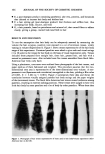
342 JOURNAL OF THE SOCIETY OF COSMETIC CHEMISTS different for different individuals because of hair type, and may differ between persons of different countries because of climate, customs, expectations, etc. An in-house survey (n = 150 men and women) showed only --15% of the respondents used stiff to describe hair body, but volume, bounce (springiness), and thickness de- scriptors were each used by -90% of the respondents. Volume and thickness were the most frequently cited hair body characteristics. The former can be evaluated visually, while the latter is inferred, and appears to require a textural examination of the hair to confirm the degree to which the attribute is present. Thickness can be considered a "volume q- texture" attribute. Our initial research with panelists suggests that both volume and texture contribute to hair body. We concluded that volume contributes most to the perception of hair body, especially when the judgement is solely visual (no tactile contribution). The visual impact of voluminous hair moving in a controlled manner is a universal description of hair with body. In the past year, volume has in many cases superseded body as a claim of hair care products and many "volumizing" products are now available in the US market. Texture should be more important for self evaluation than when the evaluation is made about someone else's hair. In the latter case evaluation is usually only visual. Products that impart body to hair can be divided into two main groups: ß Permanent treatments e.g., permanent waving solutions, hair bleaches ß Temporary effects e.g., shampoo, conditioner, or fixative type treatments The former are chemical treatments that affect the making and breaking of covalent bonds in the hair and, in the case of permanent waving, the amount or degree of curl of the hair. The hair appears to have more body due to the increased curl and the manner in which the fibers interact. Temporary treatments are used more often by consumers, but these also deliver smaller effects. For both types of treatments a textural change of the hair surface may, and in the permanent case will, occur. This textural change can affect the perception of hair body in either a positive or negative manner. This paper reports an instrumental means for measuring hair volume using image analysis, i.e., an instrumental hair body assessment. The results are compared with panelist assessments made using visual and visual-plus-tactile evaluations. For certain treatments, e.g., permanent waves where the hair volume change is relatively large, volume measurement alone will suffice. However, for a few surface treatments, e.g., where the hair volume change is relatively small and the texture change is relatively large, hair texture and hair volume may both need to be evaluated and the results combined to give the most meaningful measure of hair body. EXPERIMENTAL IMAGE ANALYZER EVALUATIONS A Zeiss Kontron Ibas 2000 image analyzer was used to obtain an instrumental measure of hair body. Hair tresses were measured by simply hanging the test tress next to a standard (control) body (hair tress), capturing the images on the analyzer screen, and determining and recording the tress areas. (The same control body--a 30 g tress of Oriental hair, sprayed with hair spray until rigid--was used for all experiments). The
Purchased for the exclusive use of nofirst nolast (unknown)
From: SCC Media Library & Resource Center (library.scconline.org)