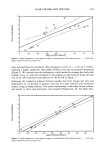
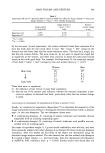
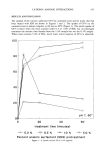
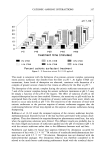
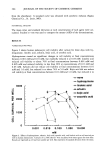
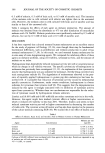
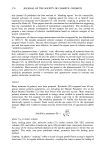
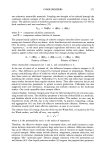
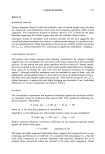
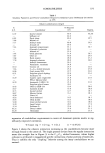
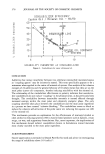
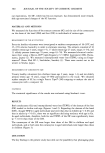
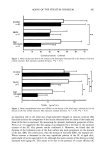
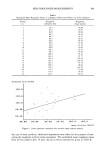
CATIONIC-ANIONIC INTERACTIONS 3 5 5 wool. Presumably an anionic-cationic complex is formed on the wool which, at neutral pH, will be positively charged if the cationic is in excess and negatively charged if the anionic is in excess. At pH 7 wool is negatively charged (isoionic point approximately pH 4-5) and the cationic complex will be taken up in much the same way as CTAB, whereas the anionic complex will be less strongly bound and can desorb into the treatment liquor. The same sorption/desorption phenomenon is observed for wools treated with the an- ionic surfactant P-6 at pH 3.5 following treatment with CTAB (Figures 3,4). Again the lOO • 80 60 40 20 Ol I I pH 3.5, 60 i 0 2o 40 60 treatment time (minutes) -0--0.0 % [] 0.5 % ,•, 1.0 % -0-2.0 % Percent cationic surfactant (CTAB) pretreatment Figure 3. % Uptake anionic P-6 (1.0% applied).

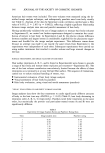
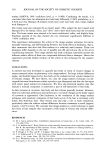
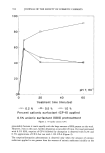
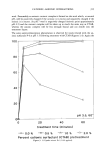
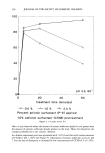
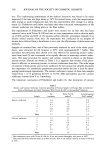
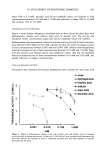
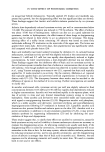
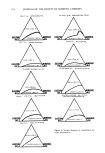
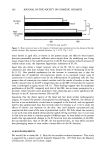
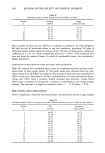
356 JOURNAL OF THE SOCIETY OF COSMETIC CHEMISTS lOO 80 60 40 20 0 I pH 3.5, 60ø I 0 2o 4o 6o treatment time (minutes) -•-0.5 % '•' 1.0 % •2.0 % Percent anionic surfactant (P-6) applied 1.0% cationic surfactant (CTAB) pretreatment Figure 4. % Uptake anionic P-6. effect is only observed where the amount of anionic surfactant applied is not greater than the amount of cationic surfactant already present on the wool. Hence for desorption the complex probably has a net cationic character. In a further experiment wool was pretreated with 1% P-6 and then with various amounts of CTAB at pH 7, 60øC (see Figure 5). Desorption of anionic surfactant occurs at pH 7, but the rate of desorption is increased by low concentrations of CTAB (0.5 or 1.0%).
Purchased for the exclusive use of nofirst nolast (unknown)
From: SCC Media Library & Resource Center (library.scconline.org)