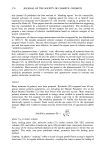
370 JOURNAL OF THE SOCIETY OF COSMETIC CHEMISTS this journal (4) published the first analysis of "blending agents" for the immiscible, mineral oil/castor oil system. Later, coupling agents for castor oil in lipstick were examined by Cadacamo and Cadacamo (5), and recently, coupling in general was ex- amined by Hertz (6). These papers describe a mechanism for cosolubilization suggesting that the cosolubilizer be a material of intermediate compatibility. The mechanics de- duced from our present investigation do not support the prior art, but instead we propose a new concept of solution cosolubilization based on cohesive energies of the system components. The importance of cohesive energy measurement was first recognized by Joel Hildebrand in 1950 (7). He initially measured cohesive energies of nonelectrolyte materials and assigned values in cal/cc. Because these energies correlated well with solubility proper- ties and the square roots were additive, he named the square roots of cohesive energies "solubility parameters." Solubility parameters form a "polarity" scale, effectively ranking all materials from oily (low cohesion) to waterlike (high cohesion). This system was readily adopted by the paint and coatings industry (8) and the plastics industry to provide rapid and accurate choices of plasticizers (9,10) and solvents, primarily due to the work of Burrell (11) and Hansen (12). In 1968 Burrell received the American Chemical Society's first award in the chemistry of plastics and coatings for his contribution to the practical understanding of solubility. More recently the system has spread to the pharmaceutical (13-15) cos- metics (16), adhesives (17), textile (18), and synthetic chemical (19) industries. In all, solubility parameters provide a convenient and quantitative means to evaluate and predict molecular interactions. THEORY Many measures of polarity have been proposed. Reichardt (20) compared over 40 em- pirical solvent polarity parameters, not including the Hansch Parameter (21) or the Kauri-Butanol Number (22) that have found wide practical success. Most empirical polarity measures cannot be expressed in energy values suitable to quantify molecular interactions. For this purpose one needs a polarity scale tied to the thermodynamic values of cohesive energy. The solubility parameter (7) fulfills this function and is historically quoted in calories. Some recent articles use joules (23) or the equivalent pressure (Mpa) (24). Cohesive energy was first derived from heat of vaporization (AHv) (25). Solubility parameter (8) = AHv where V M is molar volume. Later, boiling point (26), refractive index (27), surface tension (28), GLC retention volumes (29), and tables of molecular parts (30) provided more convenient derivations. Accuracy of the various methods depends on the specific applications to which they are applied. This study uses prior published values, primarily from the boiling point method. Coupling. In physics "coupling" refers to a pair of equal parallel forces acting in opposite directions (31). In regular solution chemistry, coupling has come to mean the linking of

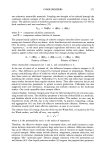
COSOLUBILIZERS 371 two otherwise immiscible materials. Coupling was thought to be induced through the combined cohesive energies of the solvent and cosolvent (cosolubilizer) acting on the solute. The additive nature of solubility parameters has been the explanation (32-34) for both cosolvency and non-cosolvency (35). 8123 where 8 = component solubility parameters, and cI) = component volume fraction of mixture The proportionally additive mixing of cohesive energies described above assumes "ori- enting and chemical effects are absent, while distributions and orientations are random (36). In reality, competition among cohesive energies results in non-polar separation by "squeeze-out," as the more polar (stronger) ingredients self-attract and coalesce. Par- tially miscible mixtures exhibit energetic competition within each phase. Additive polarity applies within each individual phase but changes during equilibrium. 8• = (ti)81) + (tI)82) + (tI)Sc)• 82 = (ti)82) + (tI)Sc) Polarity of Phase 1 Polarity of Phase 2 where immiscible components are 1 and 2, and cosolubilizer is C. In the case of castor oil vs mineral oil, the difference between cohesive energies is 30 cal/cc. That difference can be reduced by increased pressure or temperature. However, strong cosolubilizing effects of additives which maintain the polarity dif•rence indicate that there exists an additional important contributor to phase separation mechanics modifying the cohesive energy. Yalkowsky (37), Acree (38), and others have recognized many similar deviations from regular solution theory. They offer correction factors and empirical interaction parameters to permit accurate predictions. Yalkowsky has also suggested some new mechanics, recognizing non-uniform cohesion on the molecular surface. Our study quantifies these entropic effects. Cohesive blocking. Cohesive energies arise from the field produced by the electrons spin- ning around each atom. The solubility parameter is the sum of these fields in a molecule, and therefore related to the size of the molecular surface. This surface, in turn, may be described as sticky (39,40), due to the cohesive fields. In practice, branching, coiling, and aggregation (41) can limit the effective intermolecular cohesion. However, these deviations usually yield lower effective polarities, as seen in our results. The cohesive force (U), being a function of the van der Waals field, is situated at the Van der Waals surface, and falls off very, very rapidly. 2 --6 U=ar where a is the polarizability and r is the radius of separation. Therefore, the effective cohesive range is extremely short, and small increases in sepa- ration between molecules will produce large reductions in cohesion. Molecular distanc- ing can be effected most commonly through heat. Loss of viscosity on slight heating is a typical example. Other means include dilution, magnetism, pressure reduction, and solvation. In solvation, dissimilar molecules with similar cohesive energies will attract, wedging "like" molecules apart. Density changes consistent with this mechanism are well known (42). Gas-liquid partition studies (43) support the proposal that geometric
Purchased for the exclusive use of nofirst nolast (unknown)
From: SCC Media Library & Resource Center (library.scconline.org)