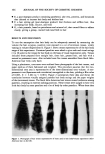
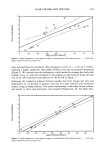
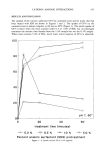
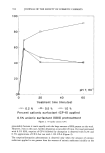
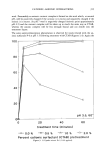
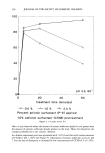
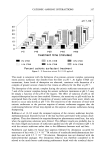
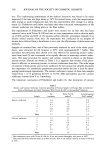
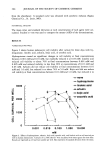
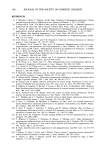
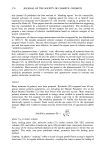
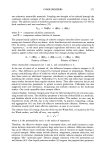
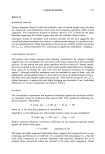
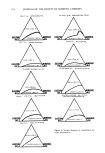
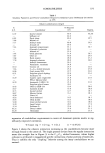
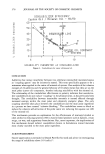
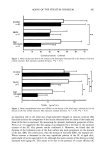
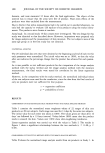
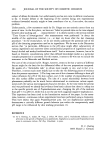
376 JOURNAL OF THE SOCIETY OF COSMETIC CHEMISTS C:OSO LLIB, I L I Z ERE F F I C I EHCV C.•stor Oil / Idiner.•l Oil - 50/513 61-] , • C,4 s TOIl \ [3..•,.... I•Ib/EI?AL OIL ..,& OIL' "' '•,,t.. E] REGRE::" S•,OIi LIHE i ' I " ..... ---' I ""J-•S[]:EM"S ' - I I I I o 'iEI SO LI_IB, I L IT'.? PARAhlET ER cd:' -"- ½'- -• ' I_:J._,l_l LLIB. I L I ..-ER Figure 3. Cosol•biIizcrs oeor c•stor oil/•incr•l oil. HAHT CONCLUSION Additives that induce miscibility between two otherwise immiscibile materials known as "coupling agents" may be incorrectly named. This term specifically appears to be a misnomer when applied to the castor oil/mineral oil system. Our analysis of the cohesive energies of 24 additives and the general behavior of 10 others shows that they act on the most polar (castor oil) component, thereby inducing miscibility with the mineral oil. The relationship of the cosolubilizer effectiveness to polarity indicates that nonelectro- lyte cosolubilizers do not induce "coupling" in the physical sense, as has previously been thought. The cosolubility between immiscible materials is instead effected through increased entropy within the most polar and cohesively energetic phase. The only coupling observed takes place between the cosolubilizer and the most polar ingredient in a process we have termed "cohesive blocking." The cosolubilizer serves to block or reduce the cohesive self-attraction of the polar castor oil, reducing the squeeze out (49) of the mineral oil. This mechanism provides an explanation for the effectiveness of isostearyl alcohol or oleyl alcohol in reducing syneresis (50) in wax/oil based products such as lipstick, cream rouge, car wax, and suppository formulations. But, more important, the implications of this mechanism should redirect cosolubilizer choices in formulation toward materials most closely matched to the most polar ingredient. ACKNOWLEDGMENT Sincere appreciation is extended to Dinesh Patel for his work and advice in investigating the range of solubilities above 9.0 (cal/cc) v2.

COSOLUBILIZE RS 3 7 7 REFERENCES (1) (2) (3) (4) (5) (6) (7) (8) (9) (10) (11) (12) (13) (14) (15) (16) (17) (18) (19) (20) (21) (22) (23) (24) (25) (26) (27) (28) (29) (30) (31) (32) M. M. Rieger, Solubilization, Cosmet. Toiletr., 97(10), 49-52 (1982). D. Langevin, Microemulsions, Accts. Chem. Res., 21(7), 255-260 (1988). H. L. Rosano, J. L. Cavallo, D. L. Chang, and J. H. Whittam, Microemulsions: A commentary on their preparation, J. Soc. Cosmet. Chem., 39(3), 201-209 (1988). E. Chadwick and G. Pears, Solvents, humectants, and blending agents in cosmetics, J. Soc. Cosmet. Chem., 2, 105-121 (1950). P. A. Cadacamo and J. J. Cadacamo, Strategy for lipstick formulation, Cosmet. Toiletr., 96(4), 55-60 (1981). D. L. Hertz, Jr., Will it dissolve?, Chemtech, 20(9), 574 (1990). J. H. Hildebrand and R. L. Scott, The Solubility of Nonelectrolytes (Dover Press, New York, 1950). A. J. Tortorello and M. A. Kinsella, Solubility parameter concept in the design of polymers for high performance coatings, J. Coatings Technol., 55(697), 29-38 (1983). R. F. Blanks and J. M. Prausnitz, Thermodynamics of polymer solubility in polar and nonpolar systems, I&EC Fund., 3(1), 1-8 (1964). G. C. Levy and D. Wang, Semiquantitative relationship between polymer side-chain dynamics and solvent solubility parameters, Macromol., 19(4), 1013 (1986). H. Burrell, The challenge of the solubility parameter, J. Paint Technol., 40(520), 197-208 (1968). C. Hansen and A. Beerbower, in Kirk-Othmer Encyclopedia of Chemical Technology, 2nd ed. A. Standen, Ed. (Wiley Interscience, New York, 1971), p. 899. S. Krause, "Partial Solubility Parameter Characterization of Interpenetrating Microphase Mem- branes," in Materials Science of Synthetic Membranes, Ch. 17, D. R. Lloyd, Ed. (American Chemical Society, 1982). K. B. Sloan, S. A. Koch, B. S. Siver, and F. P. Flowers, Use of solubility parameters of drug and vehicle to predict flux through skin, J. Invest. Dermatol., 87(2), 244-252 (1986). N. Yoshinobu, K. Yamamoto, T. Oguchi, and E. Yonemochi, Determination of solubility parameters for medicinals and excipients, Yakugaku Zasshi, 110(1), 34-39 (1990). C. D. Vaughan, Using solubility parameters in cosmetics formulation, J. Soc. Cosmet. Chem., 36(5), 319-333 (1985). J. L. Gardon, Critical review of concepts common to cohesive energy density, J. Coll. Interface Sci., 59(3), 582-596 (1977). S. A. Siddiqui, Studies in solvent dyeing, Textile Res. J., 51, 527 (1981). L. E. S. Brink and J. Tramper, Optimization of organic solvent in multiphase biocatalysis, Biotechnol. Bioeng., 27, 1258-1269 (1985). C. Reichardt, Solvents and solvent effects in organic chemistry (VCH Verlagsgesellschaft, Weinheim, Germany, 1988). C. Hansch and T. Fujita, A method for correlation of biological activity with chemical structure, J. Am. Chem. Soc., 86, 1616 (1964). American Society for Testing Materials, Philadelphia, ANSI/ASTM Method No. Dl133 (Am. Nat. Standards Inst., New York, 1977). C. H. Fisher, Equations for calculating homolog solubility parameters, J. Coat. Technol., 54(68) 67-71 (1982). A. F. M. Barton, Handbook of Solubility Parameters and Other Cohesive Parameters (CRC Press, Boca Raton, FL, 1983). J. H. Hildebrand, Solubility, J. Am. Chem. Soc., 38, 1442-1473 (1916). G. Scatchard, Equilibria in non-electrolyte solutions, J. Am. Chem. Soc., 38, 321 (1916). D. D. Lawson and J. D. Ingham, Method for estimating solubility parameter, NASA Tech. Brief, TSP73-10022 (1973). H. Lee, Relation between solubility parameter and surface tension, J. Paint Technol., 42, 365-370 (1970). G. J. Price, J. E. Guillet, and J. H. Purnell, Measurement of solubility parameters by gas-liquid chromatography, J. Chromatogr., 369, 273-280 (1986). R. F. Fedors, A method for estimating both the solubility parameters and molar volumes of liquids, Polym. Eng. Sci., 14, 147-154 (1974). R. K. Barnhart, Ed, The American Heritage Dictionary of Science (Houghton-Mifflin, Boston, 1986). L. Mandik, Additivity of the critical solution temperatures of hydrocarbons with aniline, Coll. Czech. Chem. Commun., 31, 3869 (1966).
Purchased for the exclusive use of nofirst nolast (unknown)
From: SCC Media Library & Resource Center (library.scconline.org)