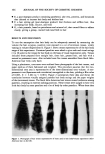
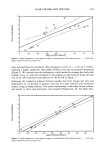
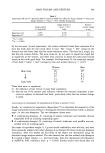
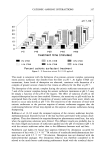
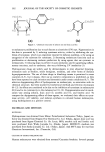
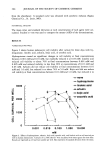
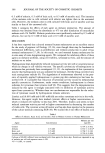
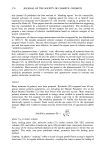
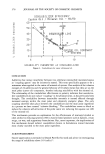
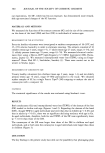
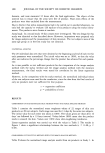
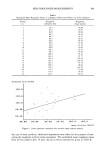
372 JOURNAL OF THE SOCIETY OF COSMETIC CHEMISTS dissimilarity relates to reduced interaction. Mechanistically viewed, as less contact is possible, entropy rises and is evidenced in reduced cohesion. This is what we believe is happening in the cosolubilizer systems we studied and possibly in all systems that use true molecular cosolubilizers and not microemulsifiers. EXPERIMENTAL For a model system we chose mineral oil/castor oil. This system is immiscible, with components separated and differing by about 30 cal/cc (two solubility parameter units). Mineral oil/castor oil is a good model system for lipstick development, and was origi- nally investigated by Chadwick and Pears (4). The mineral oil/castor oil system exhibits two-phase immiscibility throughout the temperature range shown in Figure 1. The limited solubility of mineral oil makes this system sensitive to effects of additives. The steric dissimilarity between mineral oil and castor oil exaggerate this effect. Turbidity titration (44) was performed in a carefully temperature controlled (+/- 0. IøC) insulated beaker. Various cosolubilizers were added to magnetically stirred mixtures of castor oil and mineral oil by weight. Clarity was determined by the visibility of lines in a standard ruled strip of notebook paper placed under the beaker. T P . o 70 •o 4o 3o 20 -to CASTOR OIL MINERAL OIL Figure 1. The mineral oil/castor oil system exhibits two-phase immiscibility throughout the temperature range.

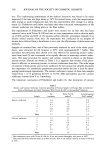
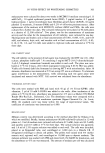
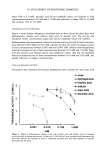
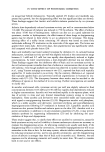
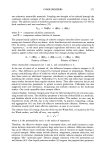
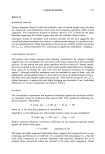
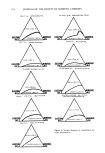
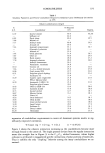
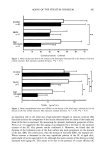
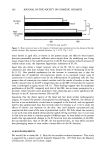
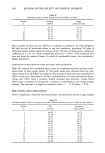
COSOLUBILIZERS 373 RESULTS MONOPHASE DOMAINS Ternary diagrams (Figure 2) show the solubility state of various weight ratios of castor oil, mineral oil, and cosolubilizer. Each corner of the diagrams represents 100% of each ingredient. The combination required to produce clarity at 25øC is shown by the phase boundary separating the soluble (upper) area and the insoluble (lower) region. Systematic studies of emulsifiers with cosolvent alcohols (45,46) have suggested that nonuniform phase boundaries are related to conformational changes in interfacial struc- ture and amphiphilicity. Phase boundaries in this study are uniform with few exceptions (see C12-C15 alcohol benzoates) (47), indicating no significant amphiphilic "bridging." COSOLUBILIZING EFFICIENCY The pattern that clearly emerges from ordering cosolubilizers by cohesive energies suggests that the cosolubilizer acts selectively on the polar component of the immiscible mixture. In this system the most polar ingredient would be castor oil. Several emulsi- fiers were included in the study to see if they would exhibit added efficacy by "bridging" from castor oil to mineral oil, since such were the historical mechanics of "coupling agents." Although solubility parameters were not available for some of them, only the amphiphiles and emulsifiers closest to the polarity of castor oil exhibited high solvency, and these were only slightly higher than projected. Thus with the exception of C12-C15 alcohol benzoates, it appears that only slight bridging was detectable, if any. Individual efficiencies of 34 test cosolubilizers are listed in Table I. STATISTICS The cosolubilizer requirement was regressed nonlinearly against the solubilizer solubil- ity parameter using the method of least squares (48). This yielded the following em- pirical quadratic relationship: % Cosol. req. = 4.455 Spc 2 - 81 Spc + 387 where Spc is the solubility parameter of cosolubilizer. Simplified, to the following root relationship between castor oil and cosolubilizer: % Cosol. req. = 9(0.5 Spc 2 - 9 Spc + 43) Product moments (Pearson's correlation coefficient) for the nonlinear regressed results against the actual values gave: r = 0.9289 (goodness of fit) The easily factorable regressed relationship above suggests that separate factors or par- ticipating contributors are at work here. It is consistent with our proposal (i.e., that the most polar component of a mixture dominates that mixture's dynamics) for us to examine those interactions where one material is the most polar component. Linear
Purchased for the exclusive use of nofirst nolast (unknown)
From: SCC Media Library & Resource Center (library.scconline.org)