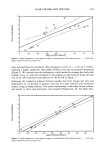
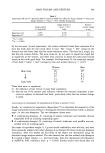
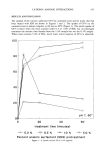
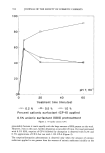
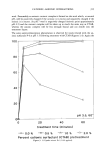
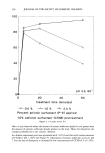
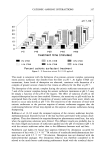
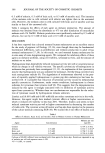
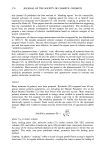
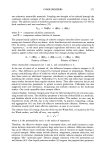
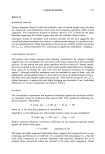
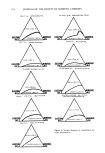
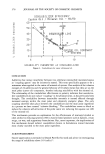
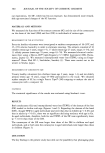
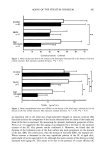
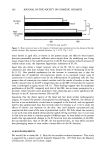
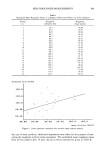
CATIONIC-ANIONIC INTERACTIONS 357 3O 25 2O 15 10 5 O I I I pH 7, 60 ø t=5 t--10 t=20 t=40 t=60 treatment time (minutes) 0%o CTAB • 0.5% CTAB • 1.0% CTAB 1.5% CTAB • 2.0% CTAB • 5.0%o CTAB Percent cationic surfactant treatment Figure 5. % Extraction anionic P-6 (1.0% applied). This result is consistent with the formation of an anionic-cationic complex containing excess anionic surfactant that desorbs from the fiber at pH 7. At higher CTAB con- centrations, lower levels of desorption are observed, consistent with formation of a complex of greater cationic character that retains an affinity for the fiber at pH 7. The desorption of the anionic complex during the cationic surfactant treatments at pH 7 and of the cationic complex during the anionic surfactant treatments at pH 3.5 may be simply a function of the pH of the liquors. The effect of variation of pH on the sorption/desorption has not been studied. However, the sensitivity to pH would not be anticipated from the study of desorption of anionic surfactants from wool, which was shown to occur only slowly at pH 7 (9). The sensitivity of the treatment of wool with cationic surfactants to the previous sorption of anionic surfactants suggests that the conditioning behavior of hair may depend on the sorption of anionic surfactants during shampooing. Robbins et al. (4, 12) noted the increased sorption of the cationic surfactant decyltri- methylammonium bromide by hair if the hair had been pretreated with sodium decyl- sulphate. They also observed the sorption/desorption phenomenon noted here, but only when the application solutions were diluted. The different results are probably due to the chain length and amount of surfactants applied and the pH of treatment (pH 3.6) with the cationic surfactant rather than to the differences between wool and hair. Finkelstein and Laden (3) found that sorption followed by desorption occurred for treatments of hair with 2.5 X 10⁻⁴ M solution of octadecyltrimethylammonium bro- mide but not with 2.5 x 10⁻³ M solution. Desorption was not observed with the dodecyltrimethyl analogue. The desorption behavior was therefore considered to be related to the much better conditioning performance found with the octadecyl deriva-

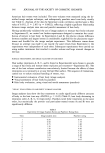
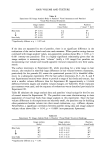
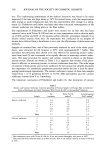
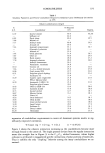
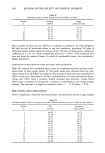
358 JOURNAL OF THE SOCIETY OF COSMETIC CHEMISTS tive. The conditioning performance of the dodecyl derivative was found to be much improved if the hair was kept damp at 56øC for several hours, with less improvement after storage at room temperature and even less improvement after storage in a refrig- erator (3). Finkelstein and Laden concluded that some structural rearrangement of the cationic surfactant was taking place at the fiber surface. The experiments of Finkelstein and Laden were carried out on hair that had been extracted twice with Triton X-100 and once at room temperature with a solution made up of 60% acetone and 40% of 1% aqueous sodium chloride, procedures claimed (3) to remove sorbed anionics from hair. An experiment was conducted on six samples of human hair collected from a hairdresser so as to test the effectiveness of these extraction methods. Samples of untreated hair, and of hair previously extracted by each of the above proce- dures, were extracted for 60 minutes at 60øC with isopropanol/pH 7 buffer. This procedure has previously been shown to be very effective for extracting anionic surfac- tants from wool (9) and is assumed to be equally effective in removing cationic surfac- tants. The assay procedure for anionic and cationic contents is shown in the Experi- mental section. Results are shown in Table I. It is apparent that neither of the proce- dures is effective in removing anionic or cationic surfactants from hair. The wide range of contents of both anionic and cationic surfactant for the various hair samples illustrates the importance of a satisfactory preparation procedure before the hair is used for sham- pooing/conditioning experiments. The anionic surfactant content of these hair samples varied from 1 to 8 •moles/g (0.03% to 0.25% SDS equivalents) and the cationic surfactant content from 0 to 3 •moles/g. The important conclusions of Finkelstein and Laden (3), that desorption of cationic Table I Anionic and Cationic Surfactant Contents (p•mole/g) of Various Samples of Human Hair as Collected From a Hairdresser and After Treatment With Triton X-100 a or Acetone/Salt b Solutions No Triton X- 100 Acetone/aqueous Sample treatment washed a NaC1 washed b Anionic surfactant 1 2.4 2.9 2.9 2 3.4 2.4 3.O 3 8.3 7.9 7.1 4 1.! 2.4 1.9 5 0.8 0.9 0.5 6 6.3 6.7 5.2 Mean 3.7 3.9 3.4 Cationic surfactant 1 1.4 1.7 1.6 2 1.6 1.5 1.2 3 0 0.4 0.3 4 0.9 1.4 1.0 5 0 0 0 6 2.O 3.7 2.8 Mean 1.0 1.4 1.1 Hair shampooed twice with Triton X-100 for 30 sec and rinsed thoroughly with water at 40øC. Hair extracted with a solution made up of 60% acetone, 40% of 1% sodium chloride in water for 60 min at 25øC.
Purchased for the exclusive use of nofirst nolast (unknown)
From: SCC Media Library & Resource Center (library.scconline.org)