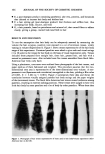
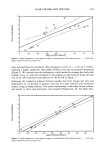
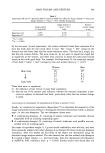
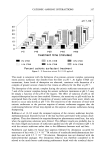
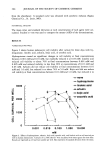
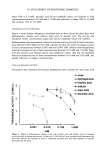
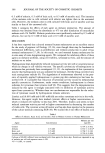
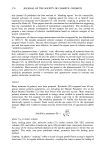
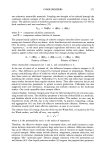
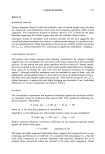
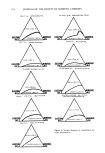
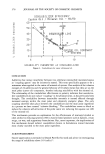
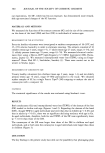
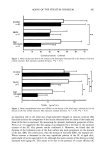
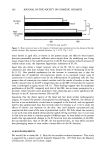
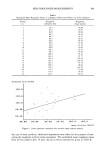
HAIR VOLUME AND TEXTURE 345 8 i i i i ! i • I i I i i i i i • 6 0 • 5 "' 4, ,a• , CI 3. O 2 1 O ß i i i I I ' I , i . i 0 .02 .04 .06 .08 .1 .1 2 .1 4 .1 6 Figure 2. Body assignment vs area (paper weight), including black Afro-American hair ..... 95 % Con- fidence bands for the true mean of ¾. were excluded from the correlation, Rho increased to 0.975, Z = 3.235 (p 0.001), implying a highly significant relationship between tress area and panelist assessment (Figure 3). We conclude that the technique is a valid method to estimate hair body with straight, wavy, or curly hair (see Figure 1) but perhaps not hair body for kinky hair like that of the Afro-American tress depicted on the far left of Figure 1. Following the correlation achieved between panelist hair body ratings and tress area (Experiment I), we decided to measure tress area in a more sensitive and convenient manner using an image analyzer. Ten tresses representing a wide range in hair volume, and similar to those used previously, were prepared (Experiment II). No black Afro- Figure fidenee 8 i i i I i i i I i i i i i i i •ll i •, d'•' 0 •, •, •.E •'• i .01 .02 .03 .04 .05 .06 .07 .08 .09 .1 AREA (PAPER WEIGHT) 3. Body assignment vs area (paper weight), excluding black Afro-American hair. ---- 95% Con- bands for the true mean of Y.

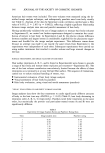
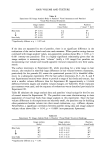
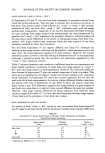
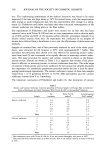
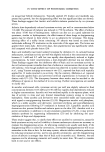
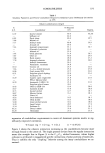
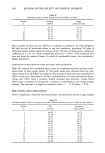
346 JOURNAL OF THE SOCIETY OF COSMETIC CHEMISTS American hair tresses were included. The tress volumes were measured using the de- scribed image analysis technique, and subsequently panelists rated tress body visually (see Table I). Analysis of the data by Spearman's rank correlation method gave a Rho value of 0.952, Z = 2.855 (p = 0.0022), reflecting a highly significant relationship between image analysis tress area and panelist assessment of hair body. Having satisfactorily validated the use of image analysis to measure hair body (volume) in Experiment II, we carried out further experiments designed to examine the contri- bution of texture to hair body. In Experiments I and II, the relative volume difference between smallest and largest tresses is considerable: eightfold for the planimeter exper- iment and fourfold for the image analysis experiment. This difference comes about because no attempt was made to use exactly the same tresses from Experiment I the experiments were independent of each other. Subsequent experiments were carried out using surface treatments that resulted in smaller volume and large textural changes to the hair. SURFACE TREATMENTS AND IMAGE ANALYSIS OF HAIR BODY Hair surface treatments A, B, C, and G (listed in Experimental) were chosen to provide a range of hair body and texture (three replicates per treatment--Experiment III). The size of the hair volume contribution was relatively limited because the effects of these treatments occur primarily at or near the hair fiber surface. The sequence of evaluations, carried out to ensure minimal handling of tresses, was: ß Instrumental evaluation of hair body (image analysis) ß Visual assessment of hair body by panelists ß Hair body evaluation, using visual and tactile assessment (panelists) "VISUAL" EVALUATION OF HAIR BODY VS IMAGE ANALYSIS Image analyzer data show the four treatments to confer significantly different amounts of body to the hair (one-way ANOVA p = 0.05) (Table II hair body decreasing in treatment order A, B, C, G respectively). Panelists rated these treatments in the same order, but statistically the protein- and particulate-treated tresses (A and B) were not significantly different. Table I Experiment II: Image Analysis Ratios and Panelists' Rating Data Tress Image analysis ratio Panelists' rating 1 O.5O O.95 2 O.58 1.55 3 0.75 1.80 4 1.16 3.7O 5 1.30 4.9O 6 1.48 5.65 7 1.08 5.35 8 1.44 6.40 9 1.61 7.50 10 1.90 9.05
Purchased for the exclusive use of nofirst nolast (unknown)
From: SCC Media Library & Resource Center (library.scconline.org)