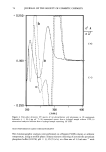
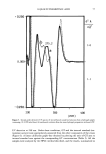
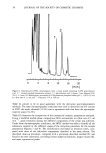
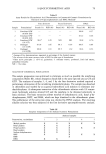
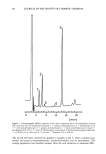
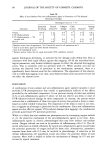
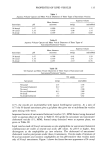
82 JOURNAL OF THE SOCIETY OF COSMETIC CHEMISTS Experiments carried out with hydrogels spiked with a known amount of GTP provided essentially quantitative recoveries by both the spectrophotometric and HPLC proce- dures. On the other hand, when cream 3 was analyzed, the recovery obtained by the spectrophotometric procedure was about 90%, owing to a minor percentage of the analyte remaining in the chloroformic solution. This recovery value, however, can be considered adequate to the purpose. Concerning samples 4 and 5, both the first and second derivative methods were applied, but the second derivative method proved to be more suitable because the blank presents a zero over a wider range of wavelengths. To obtain information about the determination limit for GT in the examined formu- lations by the described spectrophotometric method, laboratory-made cosmetic prepa- rations containing GT over the concentration range 0.015-1.5 % were analyzed. For the analysis of the formulations examined in this work, the results show the spectrophoto- metric method to be suitable with content of GT •0.3% for lower concentrations, the interference from the excipients made the method inaccurate. However, it is likely that for different formulations with lower excipient-to-GT ratios, a higher sensitivity for GT can be achieved. CONCLUSION Derivative UV spectrophotometry and liquid chromatography (HPLC) proved to be effective techniques suitable for the determination of GT and GTP in cosmetic formu- lations. The described derivative UV method showed good reproducibility and accuracy for GT contents •0.3% in the examined formulations. This technique can be consid- ered a useful alternative approach when HPLC instrumentation is not available, its application field being dependent on the formula of the GT preparation. HPLC was confirmed to be a versatile analytical tool useful as a reference method and able to selectively determine small amounts of GT in complex cosmetic matrices. ACKNOWLEDGMENTS We would like to thank Piana Cosmetici SPA (Bologna, Italy) for having kindly supplied some cosmetic samples for the purpose of this analysis. REFERENCES (1) G. Proserpio and S. Ferraris, Phytosomes: Cosmetic application, Cosmet. Toiletr. (Ital. Ed.), 9, 6-14 (1988). (2) CTFA Cosmetic Ingredient Dictionary, 3rd ed. (The Cosmetic, Toiletry and Fragrance Association, Inc., 1982). (3) Martindale, The Extra Pharmacopoeia, 29th ed. (The Pharmaceutical Press, London, 1989). (4) K. Norifumi, H. Itaru, S. Yoshihide, M. Yasuhiro, K. Kenzo, K. Hiroko, M. Seji, M. Takeyuki, and Y. Sukeo, Effect of glygyrrhizin and glycyrrhetinic acid on arachidonic acid metabolism in peritoneal exudate cells of rat, Ensho, 9(1), 29-32 (1989) Chem. Abst., 112, 36 (1990). (5) D. Xingying, W. Qihao, P. Yaqun, and L. Rongchun, Colorimetric determination of glycyrrhizic acid in licorice and its preparations with methylene blue, Yiyao Gongye 18(10), 451-455 (1987) Chem. Abst., 108, 408 (1988).

18 I3-GLYCYRRHETINIC ACID 83 (6) N. Sadlej-Sosnowska, Determination of glycyrrhizinic and glycyrrhetinic acids in pharmaceuticals by high performance liquid chromatography, J. Pharm. Biomed. Anal., 5, 289-293 (1987). (7) G. De Groot, R. Koops, E. A. Hogendoorn, C. E. Goewie, T. J. F. Savelkoul, and P. Van Vloten, Improvement of selectivity and sensitivity by column switching in the determination of glycyrrhizin and glycyrrhetinic acid in human plasma by high performance liquid chromatography, J. Chromatogr., 456, 71-81 (1988). (8) Z. Xinyi, W. Rujin, C. Jian, and A. Denkui, Determination of glycyrrhizin and its metabolite glycyrrhetinic acid in rabbit plasma by high performance liquid chromatography after oral adminis- tration of licorzin, J. Chromatogr., 495, 343-348 (1989). (9) S. Yamamoto, M. Kanda, M. Yokouchi, and S. Tahara, Simultaneous determination of multiple additives in cosmetics by high performance liquid chromatography, J. Chromatogr., 396, 404-409 (1987). (10) G. Talsky, L. Mayring, and H. Kreuzer, High-resolution, higher-order UV/VIS derivative spectro- photometry, Angew. Chem. Int. (Engl. Ed.), 17, 785-799 (1978). (! 1) A. F. Fell, Analysis of pharmaceutical dosage forms by second derivative ultraviolet-visible spectro- photometry, Proc. Anal. Div. Chem. Soc., 15, 260-267 (!978). (12) P. Levillain and D. Fompeydie, Spectrophotometrie deriv•e: Interet, limites et applications, Analusis, 14, !-20 (1986). (13) Clarke's Isolation and Identification of Drugs, 2nd ed. (The Pharmaceutical Press, London, 1986), pp. 603, 762, 938. (!4) Irving Sunshine, CRC Handbook of Spectrophotometric Data of Drugs (CRC Press, Inc., Boca Raton, Florida, 1981).
Purchased for the exclusive use of nofirst nolast (unknown)
From: SCC Media Library & Resource Center (library.scconline.org)