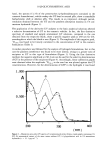
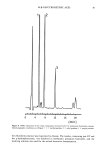
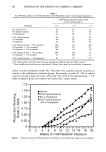
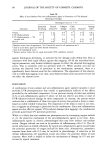
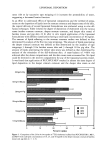
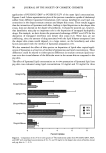
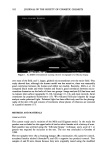
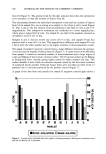
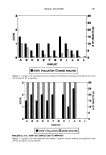
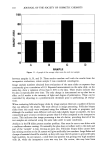
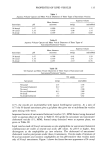
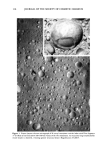
LIPOSOMAL DEPOSITION 97 ment (10) or by successive tape stripping (11) increases the permeability of water, suggesting a decreased barrier function. In an effort to understand effects of liposomal compositions and the method of prepa- ration on the deposition of lipids into the stratum corneum and deeper strata of the skin, the topical delivery of several liposomal formulations was evaluated using in vitro dif- fusion techniques. Table I shows the degree of deposition of cholesterol into the various strata (surface stratum corneum, deeper stratum corneum, and deeper skin strata) of hairless mouse and pig skin 24 hr after in vitro topical application of the liposomal formulations with different lamellarities having a total lipid concentration of 10 mg/ml. The amount of lipids adhering to the stratum corneum surface was defined as that determined by analysis of the first two tape strippings. The amount of lipids penetrating the deeper stratum corneum was defined as that determined by the analysis of tape strippings 3 through 9 for hairless mouse skin and 3 through 18 for pig skin. The amount of lipids penetrating the deeper skin strata was defined as that determined by analysis of the remainder of the full-thickness skin. A mass balance of 96% was achieved after the donor compartment and the skin rinses were accounted for. No lipid could be detected in the receiver compartment for any of the liposomal systems tested. It was found that application of PC/CH/CS MLV resulted in almost the same degree of lipid deposition in the deeper stratum corneum and the deeper skin strata as did 50mg/m I-Pig 50mg/mI-Mouse 25mg/mI-Pig 25mg/mI-Mouse 10mg/mI-Pig 10mg/mI-Mouse .......................... , : [] REV : [] I I ' I ' I 0 10 20 30 40 50 Percent Uptake Figure 1. Comparison of the 24-hr in vitro uptake of Z4[C]-cholesteryl sulfate from PC/CH/CS DRV, MLV, and REV with total lipid concentrations of 10, 25, and 50 mg/ml in the deeper stratum corneum of hairless mouse and pig skin (n = 4-5).

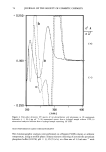
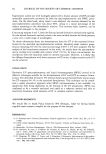
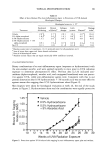
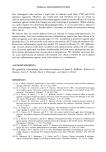
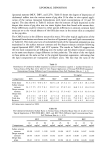
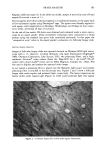
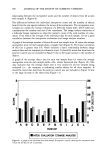
98 JOURNAL OF THE SOCIETY OF COSMETIC CHEMISTS application of PC/CH/CS DRV or PC/CH/CS LUV of the same lipid concentrations. Figures 1 and 2 show representative plots of the percent cumulative uptake of cholesteryl sulfate from different liposomal formulations with various lamellarities and lipid con- centrations in the deeper stratum corneum and deeper skin strata. These results suggest that the interaction of liposomes with skin, leading to lipid deposition in the deeper skin strata, does not depend on the degree of lamellarity. It should be pointed out, however, that lamellarity may play an important role in the deposition of entrapped hydrophilic drugs. For example, we have shown the pronounced advantage of DRV over LUV for the deposition of entrapped interferon into deeper skin strata (12). These data are not conflicting, since the amount of drug associated with the lipid bilayers transported into the deeper skin strata would depend, to a large extent, on the lamellarity and other factors associated with the method of liposomal preparation (13). We also examined the effect of skin species on deposition of lipids after topical appli- cation of liposomes as a function of method of preparation and lipid concentration. These differences could be related to either species differences in stratum corneum lipid struc- ture or to the virtual absence of the follicular route in the mouse skin as compared to the pig skin. The effect of liposomal lipid concentration on in vitro permeation of liposomal lipid into pig skin was evaluated using lipid concentrations 10 mg/ml and 50 mg/ml for three 50mg/mI-Pig 50mg/mI-Mouse 25mg/mI-Pig 25mg/mI-Mouse 10mg/mI-Pig 10mg/mI-Mouse [] REV [] DRV [] taLV ß o I ' I e I 2 4 6 Percent Uptake Figure 2. Comparison of the 24-hr in vitro uptake of •4[C]-cholesteryl sulfate from PC/CH/CS DRV, MLV, and REV with total lipid concentrations of 10, 25, and 50 mg/ml in the deeper skin strata of hairless mouse and pig skin (n = 4-5).
Purchased for the exclusive use of nofirst nolast (unknown)
From: SCC Media Library & Resource Center (library.scconline.org)