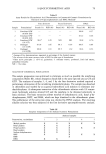
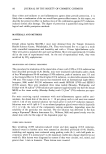
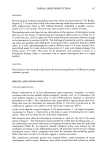
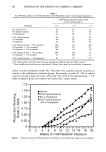
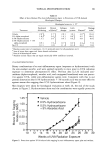
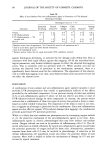
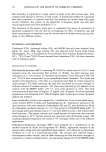
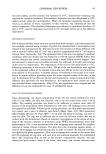
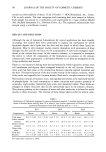
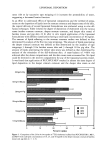
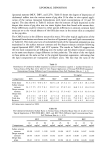
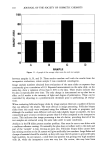
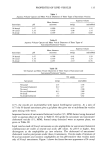
LIPOSOMAL DEPOSITION 99 liposomal systems (MLV, DRV, and LUV). Table II shows the degree of deposition of cholesteryl sulfate into the various strata of pig skin 24 hr after in vitro topical appli- cation of the various liposomal formulations with lipid concentrations of 10 and 50 mg/ml. The data shown in Table II indicate that the amount of lipid deposited in the deeper skin strata of pig skin was ten times higher than that found with mouse skin. These differences could be related to either species differences in stratum corneum lipid structure or to the virtual absence of the follicular route in the mouse skin as compared to the pig skin. The CH/CS ratios in the different mouse skin strata 24 hr after topical application of the liposomal formulations are shown as a function of liposomal type and lipid concentration in Table III. The molecular ratio of radiolabeled lipids of the liposomal preparations was maintained in the surface stratum corneum and the deeper stratum corneum following topical liposomal MLV, DRV, and LUV systems. The results in Table III suggest that the two lipid components are diffusing into the surface and the deeper stratum corneum at the same rate despite a large difference in their polarities. The ratios of the two lipids in these strata are the same as that in the original liposomal suspension, indicating that the lipid components are transported as bilayer units. The fact that the ratio of the Table II Distribution of Cholesteryl Sulfate (expressed as percent formulation applied -+ standard deviation) in Various Strata of Pig Skin 24 hr After In Vitro Topical Application of Various PC/CH/CS Liposomal Formulations Having Different Lipid Concentrations Onto Full-Thickness Skin (n = 4-5) 10 mg/ml 50 mg/ml Compartment REV DRV MLV REV DRV MLV Total donor 43.5 +-- 9.4 47.0 +-- 6.7 52.9 +-- 2.0 27.5 +-- 1.1 23.7 + 0.3 18.1 + 0.8 Surface stratum corneum 24.1 + 5.5 27.2 + 0.1 21.9 + 4.1 27.8 + 4.9 36.8 + 2.2 32.6 +-- 0.9 Deeper stratum corneum 26.2 + 5.4 23.7 + 5.3 20.1 -+ 1.2 37.5 +-- 8.5 34.3 +-- 3.9 41.4 --- 5,8 Deeper skin strata 4.9 +-- 0.3 3.9 +-- 0.8 4.7 +-- 1.6 6.9 +-- 0.0 4.8 + 2.4 7.4 -+ 0.6 Total skin 55.3 + 9.7 54.8 -+ 4.5 46.6 -+ 6.9 72.2 +-- 3.6 75.9 +-- 0.7 81.4 + 5.4 Receiver 1.3 + 0.2 0.6 + 0.06 0.5 +-- 0.1 0.4 + 0.03 4.1 + 0.5 0.6 + 0.1 All values were corrected to 100%. Table III The Cholesterol:Cholesteryl Sulfate Ratio in Various Strata of Hairless Mouse Skin 24 hr after In Vitro Topical Application of PC/CH/CS MLV, DRV, and REV With Different Lipid Concentrations Onto Full-Thickness Skin (n = 4-5) MLV DRV REV 10 25 50 10 25 50 10 25 50 Compartment mg/ml mg/ml mg/ml mg/ml mg/ml mg/ml mg/ml mg/ml mg/ml Surface stratum corneum 1:0.98 1:1.02 1:1.09 1:0.95 1:0.96 1:0.97 1:0.96 1:0.87 1:0.99 Deeper stratum corneum 1:0.95 1:0.83 1:0.50 1:0.92 1:0.97 1:0.94 1:0.88 1:1.44 1:0.94 Deeper skin strata 1:0.61 1:0.53 1:0.65 1:0.93 1:0.96 1:0.32 1:0.58 1:0.20 1:0.82

100 JOURNAL OF THE SOCIETY OF COSMETIC CHEMISTS radiolabeled lipids is not maintained in the deeper skin strata suggests that the lipo- somal components are diffusing independently in these regions. Cholesteryl sulfate is more polar than cholesterol, and the two molecules should diffuse at independent rates once they are no longer associated in a bilayer configuration. The combined results suggest that topically applied liposomal formulations could be an effective delivery system for the treatment of skin. Since these liposomal formulations provide sustained, enhanced levels of lipids in the skin, they may be of value to cosmetic products by encapsulating a variety of ingredients such as moisturizers and skin care agents. Furthermore, these formulations can be optimized, with respect to liposomal type and lipid concentration, to release material to the various layers of the skin at defined rates. ACKNOWLEDGMENTS J.D.P. was on sabbatical leave from the Department of Pharmaceutics, Potchefstroom University for C.H.E., Potchefstroom, South Africa. We thank the Foundation for Research Development, CSIR, Pretoria, and Eli Lilly (S.A.) Pty (Ltd.) for sabbatical grants. We also thank Hoffmann-LaRoche, Inc., and several other companies for partial support of this project. REFERENCES (1) A.D. Bangham, M. M. Standish, and J. C. Watkins, The action of steroids and streolysins on the permeability of phospholipid structures to cations, J. Mol. Biol., 13, 138-145 (1965). (2) M. M. Rieger, Skin lipids and their importance to cosmetic science, Cosmet. Toiletr., 102, 36-49 (1987). (3) C. Protrey, P. J. Hartop, and M. Press, Correction of the cutaneous manifestations of essential fatty acid deficiency in man by application of sunflower-seed oil to the skin, J. Invest. Dermatol., 64, 228-235 (1975). (4) G. Imokawa, S. Akasaki, Y. Minematsu, and M. Kawai, Importance of intercellular lipids in water- retention properties of the stratum corneum, Arch. Dern•tol. Res., 281, 45-51 (1989). (5) C. Artman, J. Roding, M. Ghyczy, and G. Pratzel, Influence of various liposome preparations on skin humidity, Parfumerie und Kosmetik, 5, 326-332 (1990). (6) W. S. Oleniacz, U.S. Patent, 3, 957, 971 (1976). (7) M. Tagawa, K. Shinozaki, Y. Kurata, K. Matsumoto, and Y. Tabata, Application of hydrogenated lecithin for cosmetics, 14th IFSCC, 1986, Vol. 1, p. 335. (8) F. Szoka and D. Papahadjopoulos, Procedure for preparation of liposomes with large internal aqueous space and high capture by reverse-phase evaporation, Biochem, 75, 4191-4198 (1978). (9) C. J. Kirby and G. Gregoriadis, "A Simple Procedure for Preparing Liposomes Capable of High Encapsulation Efficiency Under Mild Conditions," in Liposome Technology, G. Gregoriadis, Ed. (CRC Press, Boca Raton, FL, 1984), Vol. 1, pp. 19-28. (10) S. Grayson and P.M. Elias, Isolation and lipid biochemical characterization of stratum corneum membrane complexes: Implication for the cutaneous permeability barrier, J. Invest. Dermatol., 78, 128-135 (1982). (11) H. Schafer, G. Stuttgen, A. Zesch, W. Schalla, and J. Gazith, Quantitative determination of percutaneous absorption of radiolabeled drug, in vitro and in vivo by human skin, Curr. Probl. Dern•tol., 7, 80-94 (1979). (12) K. Egbaria, C. Ramachandran, D. Kittayonond, and N. Weiner, Topical delivery of liposomal interferon, Antimicrob. Agents Cheroother., 34, 107-110 (1990). (13) N. Weiner, F. Martin, and M. Riaz, Liposomes as a drug delivery system, Drug Devel. Ind. Pharm., 15, 1523-1554 (1989). (14) J. C. Tsai, M. J. Cappel, N. D. Weiner, G. L. Flynn, and J. Ferry, Solvent effects on the harvesting of stratum corneum from hairless mouse skin through adhesive tape stripping in vitro, Int. J. Pharm., 68, 127-133 (1991).
Purchased for the exclusive use of nofirst nolast (unknown)
From: SCC Media Library & Resource Center (library.scconline.org)