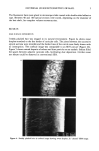
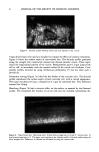
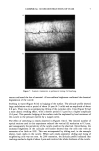
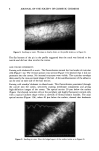
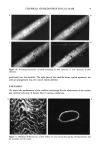
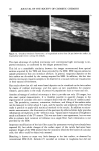
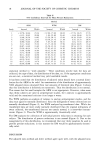
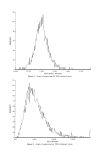
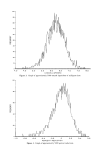
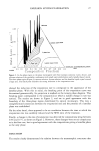
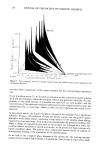
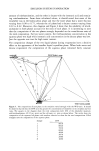
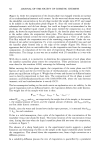
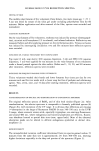
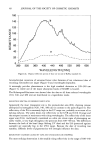
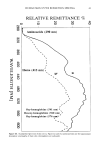
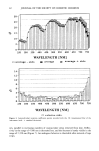
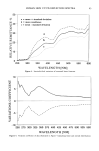
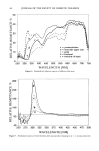
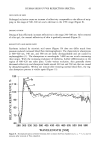
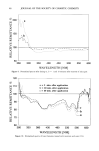
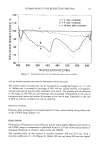
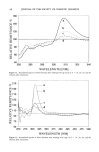
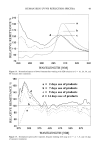
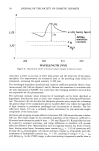
HUMAN SKIN UV/VIS REFLECTION SPECTRA 45 OCCLUSION OF SKIN Prolonged occlusion causes an increase of reflectivity comparable to the effects of strip- ping in the range of 300-340 nm and a decrease in the UVC range (Figure 8). DRYING OF SKIN Drying of skin efficiently increases reflectivity in the range 250-300 nm. After removal of silica gel, the normal reflectivity of skin is gradually restored (Figure 9). REFLECTIVITY AND BLOOD FLOW Erythema induced by nicotinic acid esters (Figure 10) does not differ much from pressure-induced increased blood flow (dermographism). The characteristic absorptions at 400-420 nm, 540 nm, and 580 nm are easily distinguishable and are caused by oxyhemoglobin (1). The absorptions at wavelengths 600 nm are occult concerning their origin. With the increasing endurance of erythema, further differentiation in the region of 400-420 nm takes place. Under venous occlusion, skin generally shows decreased reflectivity and absorption bands around 440 nm and 560 nm that are caused by desoxyhemoglobin. Within one minute after restoring normal blood flow, the reg- ular absorption pattern is visible again (Figure 11). 120 •11o •1oo [..T..1 90 80 70 60 280 305 330 355 380 405 430 455 480 505 530 555 580 WAVELENGTH [NM] Figure 8. Normalized spectra of lower forearms after occlusion by Finn chambers (a, b, c, = 3, 6, and 12 minutes after removal of Finn chamber).

46 JOURNAL OF THE SOCIETY OF COSMETIC CHEMISTS 200- [.. •- 15o 1oo 50 " . a ,b' i t 250 300 350 400 450 500 550 600 WAVELENGTH [NM] Figure 9. Normalized spectra after drying (a, b = 1 and 15 minutes after removal of silica gel). 120 L •110- r• •100 r..T-1 90- 80 • 70 60 ß ' a = 5 min. after application ß ' b = 20 min. after application f t• . c = 60 min. after application t ' ß E '•! " ,..'.t• oe c '" ".•J•-b 280 330 380 430 480 530 580 WAVELENGTH [NM] Figure 10. Normalized spectra of lower forearms treated with nicotinic acid ester (1%). 63O
Purchased for the exclusive use of nofirst nolast (unknown)
From: SCC Media Library & Resource Center (library.scconline.org)