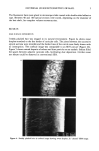
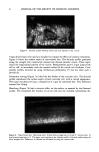
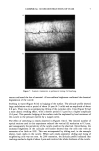
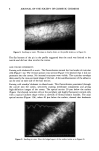
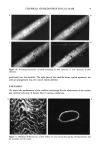
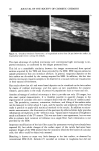
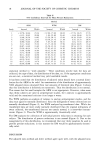
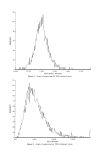
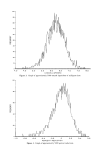
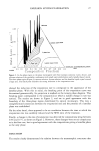
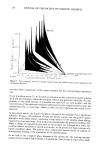
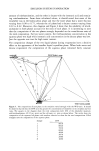
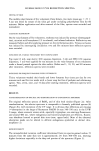
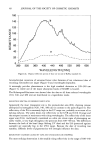
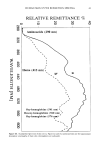
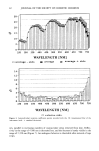
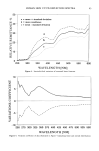
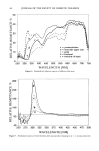
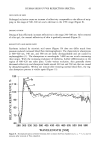
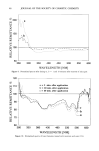
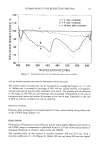
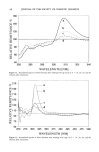
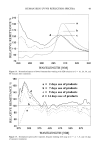
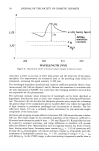
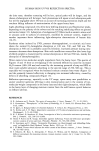
HUMAN SKIN UV/VIS REFLECTION SPECTRA 47 120 UJ110 •100- • 90 80- -I • 70 60 a = 2 min. occlusion b = 5 min. occlusion c = 10 min. after occlusion '• I.• ' ----"•' ''--' ----.,., '"' b """ . ß . . ß , . . . . 280 330 380 430 480 530 580 630 WAVELENGTH [NM] Figure 11. Normalized spectra of lower forearms after venous occlusion. LOSS OF WATER-SOLUBLE ENDOGENOUS ABSORBERS DURING BATHING The elutive power of surfactants can be estimated by considering Figures 12, 13, and 14. Reflectivity is increased in the range of 300-340 nm, falling steadily in an approx- imately exponential function after treatment with water. The primary loss of reflection in the range of 250-300 nm after bathing will be partially compensated in the case of treatment with water and within 40 minutes in the case of soap. Especially in the case of SDS an increase of reflectivity can be observed. FREQUENT WASHING Frequent daily washing for an extended period of time causes steadily rising reflectivity in the UVB/A-range (Figure 15). DISCUSSION Elimination of fluorescence from reflection spectra yields highly differentiated results in the UVB/C-range in comparison to published results (6, 10) and allows measurement of changing absorption of aromatic amino acids and NADH. The reproducibility of the method is excellent between 300 and 650 nm, with a variation coefficient of 1-3% (Figure 4). Below 300 nm and above 650 nm the signal/

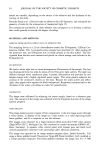
48 JOURNAL OF THE SOCIETY OF COSMETIC CHEMISTS 160 140- •120 •100 40 .)? '.x - - x!.' 7.. 250 265 280 295 310 325 340 WAVELENGTH [NM] Figure 12. Normalized spectra of lower forearms after washing with tap water (a•t = 10, 20, 30, and 40 minutes after treatment). 210 - 190- 170- 150 130- 110- 90- 70- 50 250 275 300 325 350 375 400 425 450 475 5( )0 WAVELENGTH [NM] Figure 13. Normalized spectra of lower forearms after washing with soap (a•t -- 10, 20, 40, and 80 minutes after treatment).
Purchased for the exclusive use of nofirst nolast (unknown)
From: SCC Media Library & Resource Center (library.scconline.org)