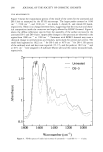
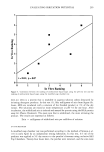
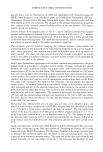
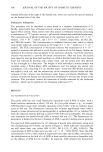
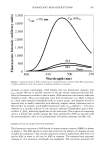
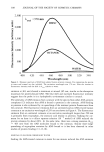
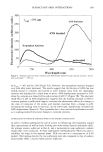
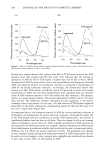
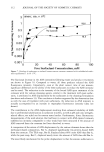
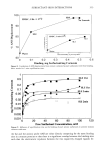
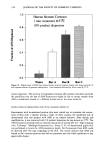
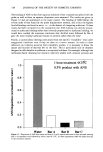
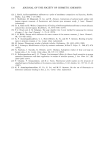
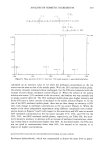
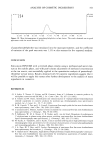
SURFACTANT-SKIN INTERACTIONS 309 300 25{) 15{) • 100 k =295 nm ext Tryptophan Emission ANS treated ß ß ß ANS Emission 350 400 450 5{)0 Wavelength (nm) Figure 4. Emission spectrum from untreated and ANS-treated isolated human stratum corneum. Excita- tion wavelength = 295 nm. (at }kma x : 463 nm) by 24% (Figure 5A). However, the tryptophan emission changed very little after water treatment. The results suggest that the fraction of ANS that was weakly bound to corneum and located at some distance away from the tryptophan moleties was displaced by a rapid rinse in water. ANS displacement increased to 34% when the corneum was rinsed with a soak solution of pH 9.5 (Figure 5B). The relatively small effect of pH on ANS displacement suggests that the binding strength of ANS to corneum proteins is sufficiently large to overcome the electrostatic effects of a change in the state of ionization of the amino acid residues resulting from a change in pH. Increasing the soaking time to one hour, on the other hand, significantly increased the ANS displacement (Figure 6). This is possibly due to the continued equilibration as well as to soaking-induced structural changes in corneum proteins. INTERACTION OF STRATUM CORNEUM WITH PURE ANIONIC SURFACTANTS In order to further understand the role of actives in influencing their harshness toward skin, spectroscopic as well as direct binding sites with sodium lauroyl isethionate (SLI), the primary anionic surfactant in Bar A, and a representative soap surfactant, sodium laurate (SL), were conducted. In these experiments triethanolamine (TEA) was used to solubilize the soaps in the aqueous phase. TEA was used at a concentration of 0.04 moles/1. The binding data for the two surfactants were also compared to that of sodium lauryl sulfate (SLS), a known harsh anionic surfactant.

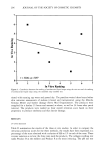
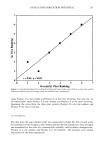
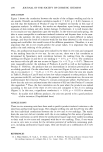
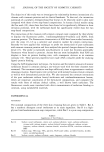
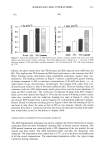
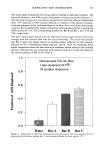
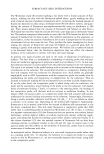
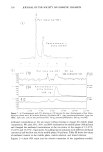
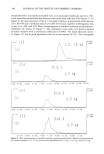
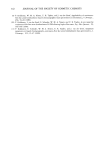
310 JOURNAL OF THE SOCIETY OF COSMETIC CHEMISTS (A) (B) ,•, 500 / "- ANS treated 4oo .,,• m 300 untreated ß p- 7.oX • 200 • 100 • o 310 360 410 460 310 360 410 460 Wavelength (nm) Wavelength (nm) • 500 '=• ANS tred 4OO 2• [ untreated • 300 • 200 ß • 100 Figure 5. Spectra of ANS-treated isolated human stratum corneum soaked in water. (A) Distilled water. (B) Distilled water buffered to pH 9.5 with TEA. Fluorescence studies showed that rinsing with SLS or TEA-laurate reduced the ANS emission more than rinsing with SLI and water. This indicates that the removal or desorption of ANS by SLS or TEA-laurate is higher than that by SLI or water. While the removal of ANS by water rinse is due to the reequilibrium and desorption of bound ANS, the enhanced removal of in-surfactant solutions is attributed to displacement of ANS by the bound surfactant molecules. Accordingly, the fluorescence results after rinsing with SLS, TEA-laurate, and SLI are given in Figure 6A in terms of fractional displacement of ANS. The fractional displacements were calculated from the intensity ratios of ANS emission maxima (=465 nm) before and after treatment. For example, relative to a water-treated control, TEA-laurate displaced the ANS by about 37% more than did SLI. The differences between treatments are also significant at the shorter treatment time of one minute. In this case, a 40 mM solution of TEA-laurate displaced about 86% of the ANS, whereas the corresponding figures for SLS and SLI were 51% and 41%, respectively (Figure 6B). As mentioned above, the enhanced removal of ANS by various surfactant solutions is attributed to its displacement by bound surfactant molecules. Although the higher pH of the TEA-laurate solution contributes to greater ANS displacement, the increase is significantly higher than that due to pH alone. Thus the change of pH as the primary removal mechanism can be ruled out. Other possible mechanisms of ANS removal are discounted for the following reasons: For example, enhanced desorption of ANS because of its solubilization in surfactant micelles can be ruled out because, as mentioned earlier, ANS has very low affinity for anionic surfactant micelies. The possibility that changes in ionic strength during rinsing with surfactants resulted in ANS displacement also can be ruled out since changes in ionic strength were negligible and neutral salts are known to have only a minor effect on the binding of ANS.
Purchased for the exclusive use of nofirst nolast (unknown)
From: SCC Media Library & Resource Center (library.scconline.org)