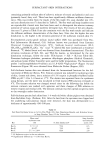
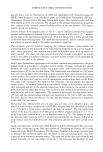
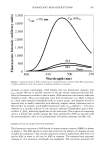
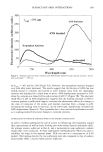
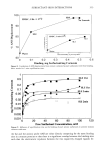
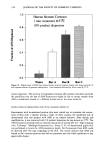
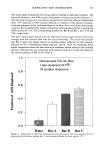
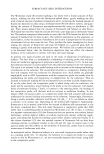
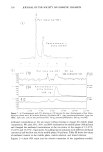
SURFACTANT-SKIN INTERACTIONS 307 3,500 ext = 3,000 2,500 2,000 1,500 ,ooo 0 400 450 500 550 Wavelength (rim) Figure 2. Emission spectra of ANS in water and in miceliar solutions of anionic (SLI, SLS) and nonionic (C12EO6) surfactants. Note the positions of maxima and relative intensities. intensity in water. Interestingly, ANS exhibits only low fluorescence intensity with X.m• x around 500 nm in micellar solutions of the two artionic surfactants SLI and SLS. Since its fluorescence is similar to that in water, ANS interaction with anionic surfactant micelles is small. This is not surprising, since from its structure, it is likely to behave as a short-chain branched hydrophobe with an anionic group, and therefore would be expected only to weakly comicellize with relatively compact artionic surfactants such as SLS and SLI. In contrast, much higher fluorescence with a Xm•x shifted to --470 nm is observed in a micellar solution of the nonionic surfactant hexaethylene glycol dode- cylether, C •2EO6, indicating significant micelle association. This is again not surprising since it is known that aromatic groups like those possessed by ANS can associate with the polyoxyethylene chain in the palisade layer of nonionic surfactant micelies (19). BINDING OF ANS TO HUMAN STRATUM CORNEUM The fluorescence spectrum of ANS bound to human stratum corneum (HMSC) is shown in Figure 3. The ANS spectra in water and octanol (in the absence of corneum) are also included for comparison. The emission maximum showed a marked blue shift from 515 nm for ANS in water to 463 nm for ANS in corneum. The emission from untreated comeurn at this excitation wavelength was negligible. The excitation spectrum (for

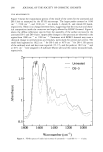
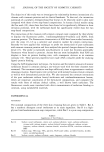
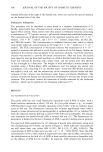
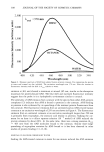
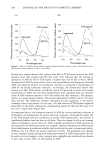
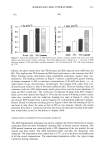
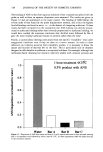
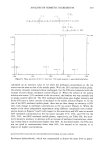
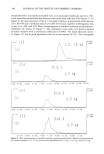
308 JOURNAL OF THE SOCIETY OF COSMETIC CHEMISTS 2,500 2,000 1,500 1,000 500 X. =370 nm ext HMSC OCTANOL WATER o 400 42o 440 460 480 500 52o 540 Wavelength (nm) Figure 3. Emission spectrum of ANS from isolated human stratum corneum. For comparison the spectra in water and octanol are also included. The excitation wavelength was 370 nm. Note the increase in fluorescence intensity and the shift in •'m•x relative to water. emission at 463 nm) showed a maximum at around 365 nm, similar to the absorption maximum for protein-bound ANS. The blue shift and increased fluorescence intensity suggest that the probe is in a hydrophobic environment similar to octanol. The similarity of ANS emission from corneum with the spectra from other ANS-protein complexes (12) indicates that ANS is bound to proteins in the corneum. ANS binding to proteins is also evidenced by its quenching of the intrinsic protein fluorescence from the.corneum. The fluorescence emissions from an untreated and an ANS-treated human corneum at an excitation wavelength of 295 nm are shown in Figure 4. The fluorescence emission from an untreated corneum at an excitation wavelength longer than 290 nm is primarily from tryptophan, the aromatic acid residue in proteins. Soaking the cor- neum for an hour in a dilute aqueous solution (10 -4 moles/l) of ANS reduced the protein emission by about 60%. At the same time, there was a strong emission (kma x = 465 rim) from the ANS molecules bound to the corneum. Similar short-range quenching of tryptophan emission by ANS bound to it has been observed in other studies of protein binding (11,13, 18). REMOVAL OF ANS FROM CORNEUM BY WATER Soaking the ANS-treated corneum in water for one minute reduced the ANS emission
Purchased for the exclusive use of nofirst nolast (unknown)
From: SCC Media Library & Resource Center (library.scconline.org)