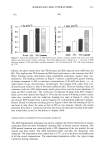
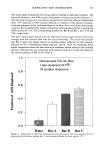
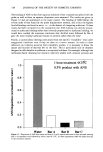
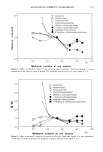
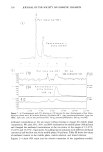
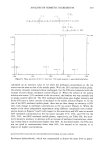
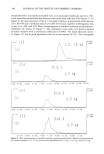
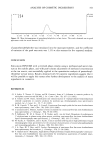
SURFACTANT-SKIN INTERACTIONS 315 The results again demonstrate the strong corneum binding of soap-based cleansers. The fractional decreases in the ANS emission after product treatment are shown in Figure 11. The data were averages of at least sixteen measurements with four different dermatomed skins. The reduction of ANS emission intensity is a measure of the amount of anionic surfactant adsorbed on the epidermal layers of the skin. As in our studies with human corneum, Bar A exhibited the weakest interactions with corneum proteins, lowering the ANS emission by 31%. The corresponding numbers for Bar B and Bar C were 47% and 54%, respectively. The above results again indicate that the soap-based compositions interact much more strongly with skin proteins than does the cocoyl isethionate. The results also indicate that Bar C leaves the largest amount of residual anionic surfactant on the corneum, followed by the triethanolamine-based soap bar, Bar B, while the isethionate-based syndet composition leaves the least amount of surfactant residue bound to the corneum proteins. The relatively low interaction with corneum proteins is in part the reason for the clinical mildness of Bar A (see Table I). 1.0 0.8 -- 0.6 -- 0.4 -- 0.2 -- 0.0 Dermatomed Porcine Skin I min. u-eatment @37øC 1% product dispersion Water Bar A Bar B Bar C Figure 11. Displacement of ANS from dermatomed porcine skin treated with water and with 10 wt% aqueous slurries of personal washing bars: 1-min treatment followed by 30-sec rinse @ 37øC.

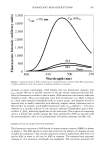
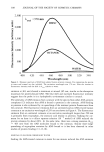
316 JOURNAL OF THE SOCIETY OF COSMETIC CHEMISTS DISCUSSION Fluorescence spectroscopic techniques have been used extensively in the biophysical literature to study protein-ligand interactions and are well suited for probing surfac- tant-corneum protein interactions. Studies with radiolabeled material, although useful for measuring deposition, do not provide any information on the location or molecular interactions. Infrared (IR) spectroscopy has been used to monitor deposition and ad- sorption of fatty acid soap residues on human stratum corneum (20). IR spectroscopy has the advantage of being non-perturbing. However, it is often not sufficiently sensitive to study interactions of a small amount of deposited material with the components of corneum. The ANS displacement method used here is similar to a probe extraction technique recently used by Paye eta/. (9), where the irritation potential of surfactants and cleansing products was correlated with their ability to extract the probe dansyl chloride from stratum corneum. The present method is also somewhat similar to the dye deposition technique developed by Imokawa eta/. (2). In that study, the decrease in the deposition of an acidic dye, indigo carmine, onto a surfactant-treated skin was used as the measure for in vivo deposition to a number of pure anionic surfactants. Presumably, the indigo carmine, like ANS, binds to the same sites in the corneum proteins as do anionic surfactants. However, for complex formulated products such as cleansing bars, tech- niques involving probe extraction might be more reliable, as these products often leave deposits on skin that might interfere with the staining of the dye. The advantages of using ANS are its well-characterized spectral properties and an extensive literature on its binding properties with proteins and lipids (12). Additionally, ANS does not impart any coloration to skin under visible light, making it potentially more suitable for in vivo studies over the other two dyes. Although steady-state fluorescence measurements are relatively easy to carry out, the proper interpretation of the results requires a knowledge of the location of the probe and how the changes in the probe environment may be reflected in different measurable spectroscopic properties such as quantum yield and shape of the emission spectrum. To gain such information, it is essential to use probes with well-understood binding and spectral properties. Without a proper understanding of the location of the probe, and its response to such parameters as pH and specific counter ion effects, conclusions drawn from changes in its spectral properties might be erroneous. This is particularly true for complex cleansing products such as soaps or detergents. The ANS displacement results as well as the direct surfactant binding results presented earlier clearly showed that the TEA-laurate-based soap left much more residue on the corneum than did the syndet bar based on SLI. Importantly, this ranking of residual surfactant bound to the corneum as measured by ANS probe displacement does not agree with the conclusions reported by Wortzman eta/. (8). In that study the amount of the fluorescent dye, fluorescein, that was deposited onto skin from surfactant solutions spiked with this dye was assumed to give a relative measure of the amount of surfactant bound to the skin. Since a TEA-based soap composition similar to bar B gave a lower level of bound fluorescence relative to an isethionate composition similar to Bar A, as measured by their procedure, Wortzman eta/. concluded that the TEA soap composition gave the least residue. This conclusion is opposite to what has been found in the present study and prompted us to consider the Wortzman eta/. study in some detail.
Purchased for the exclusive use of nofirst nolast (unknown)
From: SCC Media Library & Resource Center (library.scconline.org)