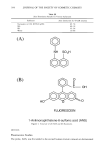
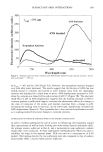
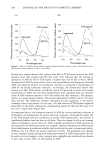
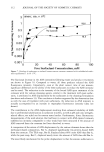
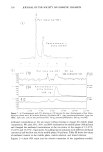
SURFACTANT-SKIN INTERACTIONS 317 The Wortzman study (8) involved spiking a bar slurry with a known amount of fluo- rescein, rubbing the skin with the fluorescein-spiked slurry, gently washing the skin with a limited amount of ambient-temperature water, extracting the residual amount of fluorescein deposited on skin using a methanol:water (80:20) solvent system, and quan- tifying the amount of fluorescein spectrophotometrically using its absorbance at 280 nm. Their results showed that the amount of fluorescein left behind on skin from a TEA-based bar was lower than the amount left from a pure soap and an isethionate-based bar. The authors interpreted these results to mean that the TEA-laurate bar left the least amount of residue from the bars on skin. The inherent assumption in this argument, as stated earlier, is that the amount of fluorescein left on skin is proportional to the amount of surfactant left on skin from the bar. They justified the latter assumption by deter- mining the amount of fluorescein and soap left behind on a grooved glass slide by washing it gently with ambient-temperature water. We believe, for a number of reasons to be discussed below, that the fluorescein deposition does not reflect the inherent tendency of the surfactant to interact with skin and cause damage. In general, two types of probes are used in the study of adsorption of surfactants to surfaces. The first kind is a hydrophobic coadsorbing or tracking probe that will par- tition into surfactant aggregates in solutions as well as at interfaces (21,22). In this case, the surfactant solution is usually spiked with the probe and exposed to the test substrate. The result is an increase in the probe binding with an increase in the adsorption/binding of surfactants to the substrate. The second kind of probe is a competitive binding probe that will compete with the surfactant for adsorption sites. Such probes are generally amphiphilic such as ANS. Experiments with the competitive probe are usually done by preadsorbing the probe and monitoring its displacement by the surfactant. Thus an increase in surfactant binding will be accompanied by an increase in probe displacement. If, on the other hand, the competitive probe is added along with the surfactant, the result will be essentially a lower binding of the probe to the test substrate, with higher levels of surfactant binding. Clearly, in contrast to the tracking probe, the binding of the competitive probe will decrease with an increase in surfactant binding. In this regard, ANS, the anionic probe, is a competitive probe that will compete with anionic surfactants for cationic binding sites present on the substrate. Interestingly, fluorescein, being a weakly ionizable carboxylic acid (Figure lB pK a = 6.5), can behave as either a nonionic or an anionic dye, depending on the solution pH employed. Importantly, fluorescein is in its anionic form below the neutral or alkaline pHs encountered in the bar slurry considered here. This will make fluorescein a competitive probe like ANS rather than a coadsorbing probe as assumed by Wortzman et al. (8). In fact, it is shown in a separate communication (23) that fluorescein does not partition into sodium lauroyl isethionate, sodium dodecyl sulfate, or sodium laurate-type anionic surfactant aggre- gates, indicating that fluorescein binding cannot reflect anionic surfactant binding. It is also shown elsewhere (23) that the residual amount of fluorescein left on skin from cleansing slurries is primarily related to the pH and the type of counter ions in the aqueous phase and their effects on the solubility of fluorescein, rather than to intrinsic interactions of surfactants with skin. As mentioned earlier, fluorescein behaves as a very weak competitive probe rather than as a tracking probe (23). To illustrate the behavior of a competitive probe in a study similar to that by Wortzman eta/., we have essentially repeated their study, using ANS as the competitive probe.

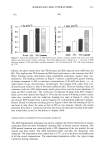
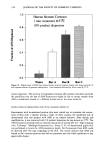
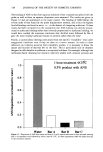
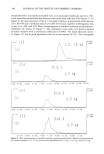
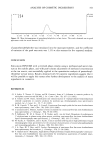
318 JOURNAL OF THE SOCIETY OF COSMETIC CHEMISTS The binding of ANS to skin from aqueous solutions of bar compositions spiked with the probe as well as from an aqueous dispersion were measured. The results are given in Figure 12 and are normalized to the water control. The binding of ANS follows the reverse order of that found by the probe displacement method, and in fact the highest level of binding was found in water, i.e., in the absence of competing surfactant. If these results had been interpreted on the assumption that ANS binding was directly propor- tional to surfactant binding rather than inversely proportional to surfactant binding, we would have reached the erroneous conclusion that distilled water followed by Bar A gave the most residual surfactant bound to proteins rather than the least! Finally, a caution about drawing conclusions from non-specific "rinsability" tests under exaggerated conditions even if they are done in a correct manner. In order to draw inferences on irritation potential from rinsability studies, it is necessary to know the nature and location of material left on the skin. This is particularly true of cleansers designed to offer benefits in addition to exceptional mildness. For example, although the isethionate-based cleansing bar interacts relatively weakly with corneum proteins and 0.8 -- 0.6 -- 0.4 -- 0.2 -- 0.0 I hour treatment @25øC 0.5% product with ANS 1 m , Water Bar A Bar B Bar C Figure 12. Deposition of ANS from water and from 0.5 wt% aqueous solutions of three personal washing bars: 1-hr treatment time followed by 30-sec rinse (•' 25øC. In these experiments ANS was added directly to the treatment solution.
Purchased for the exclusive use of nofirst nolast (unknown)
From: SCC Media Library & Resource Center (library.scconline.org)