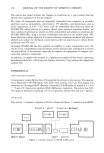
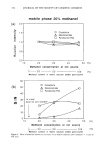
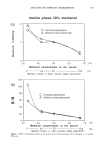
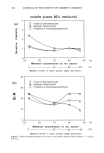
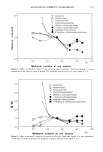
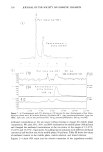
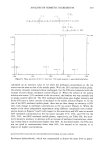
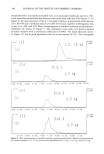
ANALYSIS OF COSMETIC INGREDIENTS 331 unit, a mixer, and a splitter connected to the Finnigan MAT CF-FAB probe by means of a 2.0-m ) 75-•m I.D. fused-silica capillary. The HPLC unit consisted of an LC-9A pump (Shimadzu, Kyoto, Japan), a Rheodyne 7125 injector (Rheodyne, CA) (20 •I), a CAPCELL PAK C18 SG120 reversed-phase column (250-mm) 1.5-mm I.D) (Shiseido, Tokyo, Japan), an SPD-6A UV detector (Shimadzu), and two LC-9A pumps for methanol and water, both containing 15% (v/v) glycerin to be added as a matrix solution post-column. The flow rates of the mobile phase and post-column matrix solution were 100 •l/min and 50 •I/min, respectively. The split ratio was l: 19, and so the flow rate to the ion source was ca. 7.5 •l/min and the concentration of glycerin was ca. 5% (v/v). MASS SPECTROMETRY The CF-FAB probe was fitted to a Finnigan MAT 90 double-focusing mass spectrom- eter, operating at 5 kV. The Finnigan MAT ICIS data system was used. The instrument was equipped with an FAB gun (Ion Tech, Teddington, U.K.) using xenon and pro- ducing a beam of neutral atoms with 7 kV energy. The FAB spectra were recorded in the positive-ion or negative-ion mode by scanning from m/z 70 to 2000 or from 100 to 800 with a scan speed of 5.0 per decade. The resolution was 1000 (10% valley defini- tion) during the measurement. A stainless-steel target with a gold-plated drain channel was used (10). An exchangeable ion volume with a wick was applied to reduce con- tamination problems. The wick, made from compressed paper, was placed at the bottom of the ion volume. Additional vacuum pumping at the ion source housing was obtained by using a liquid nitrogen trap. The temperature of the ion source was kept at 50øC to improve the evaporation of the mobile phase (11). REAGENTS Cosmetic ingredients to be formulated at the 0.01-1% level were purchased from Tokyo Kasei Kogyo (Tokyo, Japan) ingredients 22, 28, and 29 were purchased from Sigma (St. Louis, MO). Chemical names and molecular weights of these ingredients are sum- marized in Table I along with additive classification. Methanol was obtained from Merk (Darmstadt, Germany). Glycerin (99.5% pure) was purchased from Aldrich (Wiscon- sin). SAMPLE PREPARATION Applicability study of CF-FAB to cosmetic analysis. Solutions (1, 10, 100, 1000 ppm)were prepared in water (compounds 1-6, 20, 21, 23-25), 50% methanol (7-13, 22, 26, 28-30), and methanol (14-19, 27). An aliquot of 0.5 •1 was injected three times. The amounts injected were therefore 0.5, 5, 50, and 500 ng, respectively. Optimization study on methanol concentration at the ion source using the CF-FAB LC/MS. Solutions of 500 ppm of eight selected ingredients were prepared in 20% methanol (compounds 1, 3, 5), 50% methanol (8, 30), and 80% methanol (12, 13, 15), as used for the mobile phase of the HPLC system. The injection volume was 2 •1, and the amount actually introduced into the CF-FAB LC/MS was 50 ng, since the split ratio was set at 1:19.

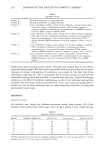
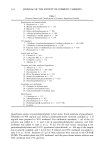
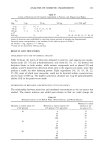
332 JOURNAL OF THE SOCIETY OF COSMETIC CHEMISTS Table I Chemical Names and Classifications of Cosmetic Ingredients Studied Preservatives and antimicrobials 6: Resorcinol m = 110 8: Methyl p-hydroxybenzoate m = 152 9: Phenol m = 94 10: Ethyl p-hydroxybenzoate m = 166 11: n-Propyl p-hydroxybenzoate m = 180 12: 4-Isopropyl 3-methyl phenol m = 150 13: n-Butyl p-hydroxybenzoate m = 194 UV absorbers 7: 2-Hydroxy-4-methoxybenzophenone-5-sodium sulfonate m = 330 (308) 15: 2-Hydroxy-4-methoxybenzophenone m = 228 16: Glyceryl mono-2-ethylhexanoate di-p-methoxycinnamate m = 538 17: Homosalate m = 262 Amino acid and base 23: L-Serine m = 105 24:L-Arginine-HC1 m = 210 (174) 25: L-Aspartic acid m = 133 4: Adenine m = 135 Vitamins and other medicinal ingredients 2: Arbutin m = 272 3:Pyridoxine-HC1 m = 205 (169) 5: Nicotinamide m = 122 18: DL-tx-Tocopheryl acetate m = 472 19: Stearyl glycyrrhetinate m = 722 26: Monoammonium glycyrrhizinate m = 822 30: Pantothenylethylether m = 233 Ceramides and cerebroside 22: Ceramide (o•-hydroxy-type) 28: Ceramide (non-hydroxy-type) 29: Galactocerebroside (o•-hydroxy type) Miscellaneous 1: Creatinine m = 113 14: Valerophenone m = 162 20: [3-Cyclodextrin m = 1134 21: Hydroxypropyl-lB-cyclodextrin m = 1134 + 58n 27: Lecithin Quantitative analysis of pantothenylethylether in hair lotion. Stock solutions of pantothenyl- ethylether (0. 100 mg/ml) and methyl p-hydroxybenzoate (internal standard ca. 1.0 mg/ml) were prepared in 50% methanol. For calibration standards, 1 ml of the I.S solution was added to 1, 2, and 4 ml of pantothenylethylether solution, and 50% methanol was added to raise it to ca. 10 ml. For the hair lotion containing 0.2% pantothenylethylether and 0.05% pyridoxine hydrochloride, ca. 100 mg of the sample was accurately weighed, and 1 ml of the I.S solution and 50% methanol was added to raise it to ca. 10 ml. Aliquots of 2 !xl of these solutions were injected to the CF-FAB LC/MS. The mobile phase was 50% methanol, and the post-column matrix solution was 50% methanol with 15% glycerin.
Purchased for the exclusive use of nofirst nolast (unknown)
From: SCC Media Library & Resource Center (library.scconline.org)