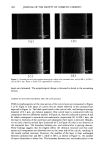
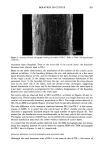
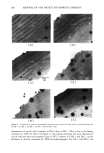
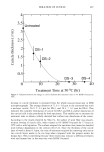
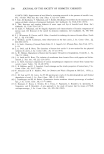
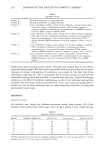
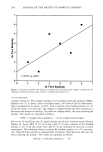
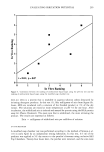
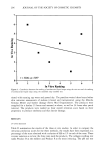
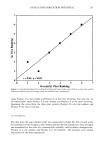
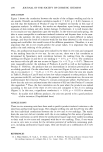
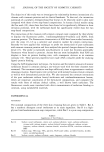
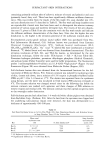
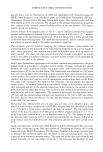
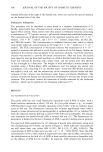
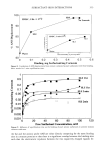
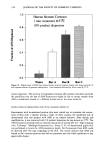
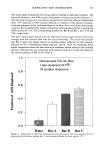
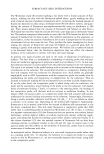
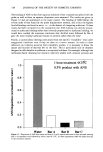
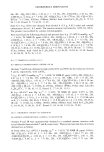
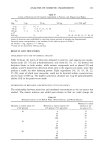
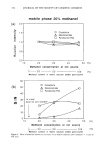
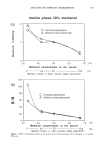
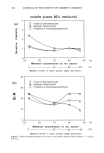
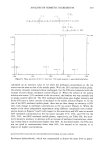
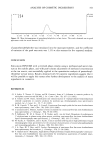
286 JOURNAL OF THE SOCIETY OF COSMETIC CHEMISTS (a) 1,OlJm (b) (c) 1.01•m (d) 1,Op• (e) (f) Figure 3. Transmission electron micrographs showing cross section of cuticle cells: (a) untreated hair and (b) DS-I, (c) DS-2, (d) DS-3, (e) DS-4, and (f) DS-2' hair. elimination of cuticle cells is greater in DS-2 than in DS-1. This is due to the longer treatment at 50øC for DS-2. In Figure 4, the relation between the total thickness of cuticle cells and the total treatment time at 50øC is shown. For DS-1 and DS-2, cuticle thickness is directly measured by TEM microphotographs. For DS-3 and DS-4, the

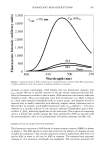
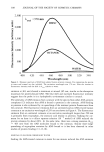
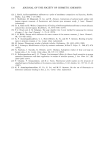
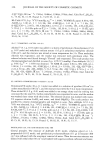
ISOLATION OF CUTICLE 287 i i 3.5tUntreate d 3 2.5 2 DS-1 1.5- 1- 0.5- DS-3 DS-4 I I • I •- 0 30 - 40 DS-2 10 20 Treatment Time at 50 øC (hr) Figure 4. Relation between the change in cuticle thickness and treatment time in 5% KOH/1-butanol at 50øC. decrease in cuticle thickness is estimated from the whole-cross-sectional area in SEM microphotographs. The average diameter of 72.6 ñ 5.0 pom in the untreated hair with a ten-layer cuticle, 56.9 - 4.4 pom for DS-3, and 50.4 -+- 4.1 pom for DS-4. This indicates the complete elimination of cuticle for DS-3 and DS-4 partial dissolution of the cortical cells is also postulated for both specimens. This enables one to estimate the treatment time to obtain a wholly descaled hair without any dissolution of the cortex. According to the results reported by Taki (3), the surface of wool fiber was smooth, without overlap of cuticle cells, when treated in 6% KOH/1-butanol for 17 hours at 50øC with a mild agitation. The authors assigned the specimen thus treated as descaled wool without degradation in the cortical cells (3,4). Since the thickness of the cuticle layer of wool is about 0.5 pom, the time of treatment required for removing only one or two cuticle layers seems to be too long when compared with the present results for human hair. This is interesting because these results may indicate a difference between wool and human hair in the reactivity with KOH/1-butanol.
Purchased for the exclusive use of nofirst nolast (unknown)
From: SCC Media Library & Resource Center (library.scconline.org)