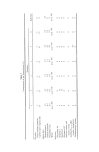
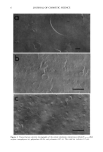
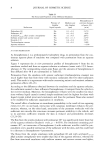
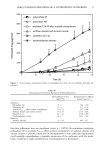
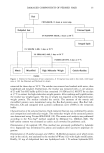
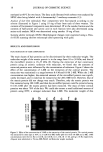
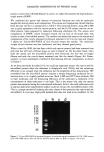
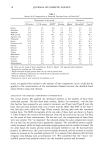
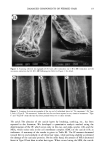
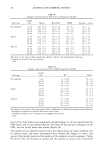
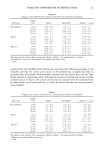
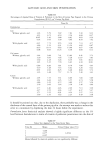
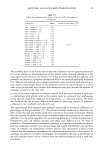
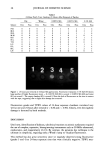
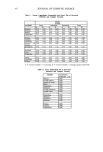
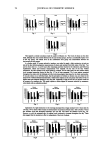
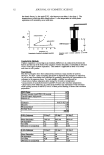
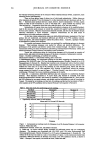
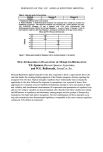
2 JOURNAL OF COSMETIC SCIENCE vehicle structure. Other studies have investigated the in vitro release of active compo- nents (12-15) and the cutaneous permeability (16-19) as a function of the various colloidal organizations for a given composition of the vehicle. However, in general, effects are demonstrated for one surfactant system. The aim of our study was to evaluate the impact of the presence of lamellar liquid crystals within emulsions on percutaneous permeability for a large variety of surfactants, by comparing six emulsions that only differed by the surfactant used and, as a result, by their structure. CHEMICALS AND FORMULATIONS CHEMICALS The permeant was benzophenone-4 (the sunscreen Uvinul©MS40). A series of six emul- sions containing different surfactants but with the same aqueous and oily phases was prepared. The oily phase was a caprilic/capric triglycerides (Miglyol©812)/octyl methoxycinna- mate (Parsol©MCX) mixture. The surfactants polysorbate 60 (Tween©60) steareth-2 (Brij©72) steareth-21 (Brij©721) poloxamer 407 (Synperonic©PE F/127) sorbitan stea- rate and sucrose cocoate (Ariatone©2121) and triethanolamine stearate were obtained from ICI Americas. The surfactant acrylates/C•o_3o alkyl acrylate crosspolymer (Pemulen©TR1) was obtained from Goodrich. The preservative, diazolidilyl urea (Germall©II), was obtained from Sutton. The sodium hydroxide required for aqueous phase and acrylates/C•o_3o alkyl acrylate crosspolymer neutralization was obtained from Fluka. FORMULATIONS Two hundred grams of each emulsion were prepared using a standardized procedure: surfactant, aqueous phase, and oily phase were weighed into a glass container, sealed, heated to 80øC, and stirred using Istral-type mixing equipment (1050 rpm). Agitation was maintained until the emulsion cooled to room temperature. Three passes through a microfluidizer (Rannie©), set at a pressure of 600 PSI, were necessary to produce stable emulsions with polysorbate 60 and poloxamer 407. The compositions of the formula- tions are listed in Table I. EMULSION STRUCTURE Freeze-fracture electron microscopy was used to study aggregate structures in emulsions with the six different surfactants. The samples were mixed with glycerol (30% of the water content) to prevent ice crystal formation and were rapidly frozen in liquid propane (-196øC). The frozen samples were fractured in a Baizers BAF400 freeze-etching device. Platinium and carbon replicas were made. These solids were evaporated by electron beaguns. Contrast was achieved by depositing the particles of platinium at an angle of 30 ø. The carbon layer was deposited vertically onto the replica. The replica was transferred from one cleaning solution to another. After being washed and dried on an electron microscope grid, the replica was

Purchased for the exclusive use of nofirst nolast (unknown)
From: SCC Media Library & Resource Center (library.scconline.org)