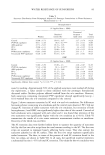
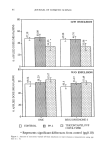
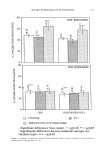
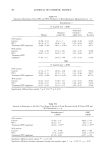
j. Cosmet. Sci., 50, 79-90 (March/April 1999) In vitro method for modeling water resistance of sunscreen formulations VINOD K. GUPTA and JOEL L. ZATZ, Organon Inc., 3 75 Mt. Pleasant Ave., West Orange, NJ 07052 (V.K.G.), and Department of Pharmaceutics, Rutgers University College of Pharmacy, 160 Frelinghuysen Road, Piscataway, NJ 08854 (J.L.Z.). Accepted for publication March 31, 1999. Synopsis Two of the most frequently used sunscreens, benzophenone-3 and octyl methoxycinnamate (OMC), were formulated into hydroalcoholic, diisopropyl adipate oil prototype formulations and o/w and w/o emulsions. Various polymers at a concentration of 5% w/w were included in these formulations. We developed an in vitro procedure for measuring the water resistance of sunscreens and assessing their ability to resist washoff. Results of our in vitro procedure were found comparable to in vivo findings reported in the literature. With tricontanyl PVP copolymer present in the o/w emulsion, a statistically significant increase in retention of benzophenone-3 by stratum corneum (SC) was observed. INTRODUCTION In order for sunscreens to provide prolonged photoprotection they should resist removal by sweat, immersion in water, or mechanical wipe off. The use of complex polymers and the selection of solvents that increase sunscreen substantivity are some of the means used to enhance water resistance of sunscreen products. Several tests have been recommended for evaluating the degree of sunscreen substan- tivity. These include both in vitro and in vivo measurements. In vitro methods usually involve measurements of the amounts of sunscreens that can be "leached out" following a water immersion procedure or some other standardized exposure to water (1). A more accurate method involves the use of excised animal skin such as hairless mouse epidermis that is treated with sunscreens and then exposed to water in a bath at controlled temperatures for a certain time interval. Residual photoprotection can then be measured by forward-scattering spectrophotometry (2). Although these in vitro procedures have not gained widespread use, they are often employed in pilot studies to provide rough estimates of substantivity prior to human testing. Address all correspondence to Joel L. Zatz. 79

80 JOURNAL OF COSMETIC SCIENCE In the final analysis, i, vivo human testing is the most definitive method. Several procedures have been tried, and these include the immersion of treated sites on the forearms in a water or whirlpool bath for a measured period of time followed by exposure to UV to determine the degree of residual photoprotection (3,4). However, the most commonly used test for measuring the washout resistance of sunscreens in the United States is one that has been proposed by the FDA (5). In this method the sunscreen is declared water-resistant if it retains substantial UV absorbance after two 20-minute periods of water activity. The main objective of the present study was to develop simple i, vitro methods for studying the water resistance of sunscreens using micro-Yucatan pig skin. Certain polymers were included in prototype sunscreen formulations to evaluate their effective- ness in enhancing water resistance. METHODS MATERIALS Freshly harvested excised micro-Yucatan pig skin was purchased from Charles River Laboratories, Wilmington, MA. Benzophenone-3, OMC, diisopropyl adipate, propylene glycol (and) diazolidinyl urea (and) methyl paraben (and) propyl paraben (Germaben © II), imidazolidinyl urea, isocetyl alcohol, polyquaternium-28, PVP/eicosene copolymer, PVP/VA copolymer, and tricontanyl PVP were obtained from ISP, Wayne, NJ. Radio- isotope labeling of sunscreens, [•4C] benzophenone-3 with a specific activity of 30.5 mCi/mmol and [3H] octyl methoxycinnamate (573 mCi/mmol), were obtained from Chemsyn Science Laboratories, Lenexa, KS. Adipic acid/diethylene glycol/glycerin (ADG) crosspolymer (Inolex Chemical Co., Philadelphia, PA), Carbomer 940 (BF Goodrich Specialty Chemicals, Brecksville, OH), DEA-cetyl phosphate (Hoffmann-La Roche Inc., Paramus, NJ), PEG-15 cocamine (Akzo Nobel Chemical Inc., Chicago, IL), Poloxamine 704 (BASF Corp, Parsippany, NJ), PPG-12 SMDI copolymer (polyolpre- polymer-2 or PP-2) and PPG-51 SMDI copolymer (polyolprepolymer-14 or PP-14) (Barnet Products Corp., Englewood Cliffs, NJ), polyquaternium-10 (Amerchol, Edison, NJ), polyquaternium-41 (Phoenix Chemical, Somerville, NJ), SD alcohol 40 (Eastman Chemical Co., Kingsport, TN), and PEG-20 oleyl ether (Croda Inc., Parsippany, NJ) were obtained as research samples. Oily Vegetol Marigold WL1072 ©, octyl dodecyl myristate, and polyglycerol-3-DI-IS were received as research samples from Gattefosse, Westwood, NJ. HPLC-grade acetonitrile, beeswax, glacial acetic acid, glycerin, mag- nesium sulfate, methyl paraben, mineral oil, reagent alcohol, scintillation fluid, sodium chloride, and triethanolamine were purchased from Fisher Scientific, Fair Lawn, NJ. Tissue-solubilizing fluid (Solvable TM) was purchased from Packard Instrument Co., Meriden, CT. Transparent tape #800 (Scotch TM) was purchased from 3M Packaging Systems Division, St. Paul, MN. All other materials were of high quality and purity and obtained from standard sources. SUNSCREEN FORMULATIONS The in vitro studies to develop a procedure for measuring water resistance were performed using hydroalcoholic and oil prototype formulations and o/w and w/o emulsions. Dii-
Purchased for the exclusive use of nofirst nolast (unknown)
From: SCC Media Library & Resource Center (library.scconline.org)