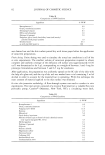
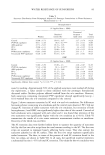
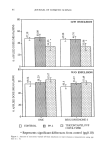
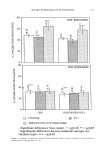
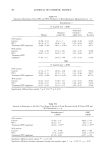
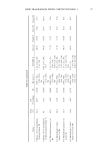
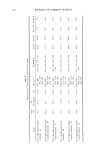
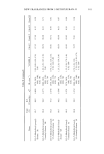
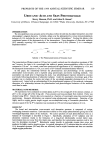
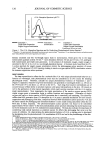
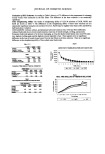
WATER RESISTANCE OF SUNSCREENS 85 Table V Sunscreen Distribution From Diisopropyl Adipate Oil Prototype Formulations in Water-Resistance Measurements (n -- 4) Benzophenone-3 (% Applied dose _+ SEM) Penetrated Retained (receptor + Total Washes (inside SC) viable skin) recovery Control 55.08 -+ 6.73 36.04 _+ 4.67 3.17 + 0.79 94.29 PVP/VA copolymer 58.31 _+ 2.29 18.8 + 0.17'** 1.73 _+ 0.11 78.84 ADG polymer 47.73 + 3.02 39.21 + 3.05 3.11 + 0.64 90.05 PP-2 45.98 _+ 4.11 41.78 + 1.65 3.4 + 0.25 91.16 PP-14 52.1 + 5.03 29.88 _+ 2.48 3.16 + 0.52 85.14 PVP/eicosene copolymer 64.64 + 6.09 22.04 + 4.76* 3.55 -+ 1.7 90.23 Tricontanyl PVP copolymer 55.28 _+ 2.49 41.65 + 5.24 2.31 + 0.61 99.24 OMC (% Applied dose + SEM) Control 53.89 + 6.59 35.88 + 4.3 2.18 + 0.67 91.95 PVP/VA copolymer 57.39 -+ 2.98 20.1 _+ 0.33*** 0.68 + 0.15' 78.17 ADG polymer 43.7 + 3.56 39.11 -+ 2.88 2.06 + 0.5 84.87 PP-2 43.51 + 4.08 43.27 + 1.3 2.41 _+ 0.18 89.19 PP-14 51.31 _+ 4.39 30.44 + 2.65 2.37 + 0.54 84.12 PVP/eicosene copolymer 65.01 + 6.68 22.81 + 4.67* 2.65 + 1.97 90.47 Tricontanyl PVP copolymer 55.28 + 2.35 42.53 + 5.01 1.25 + 0.54 99.06 Significantly different from control: * p -- 0.10 *** p -- 0.01. sions by washing. Approximately 50% of the applied sunscreens were washed off during the experiment, a value similar to those obtained with the prototype formulations discussed earlier. Neither polymer affected washoff from the w/o emulsion. However, both sunscreens containing tricontanyl PVP copolymer showed significantly less (p 0.10) washoff from the o/w emulsion compared to the control. Figure 2 shows sunscreen retention by SC with o/w and w/o emulsions. No differences between polymer-containing w/o emulsions and the control were observed. PP-2 did not change SC retention of either sunscreen with the o/w emulsion, but retention of both benzophenone-3 and OMC was significantly higher than that of the control. Controls of both emulsions were compared with each other and it was found that retention of the two sunscreens was significantly higher with the o/w emulsion (p • 0.01). Table VI summarizes the results of in vitro water resistance measurement studies on emulsions. Recovery of the labels was excellent. The SC retention data were further broken down to separate the quantity of sunscreen held by the first two skin strips from the total amount residing in the SC. The first two strips are assumed to represent loosely adhering horny tissue. They also contain the sunscreen adsorbed to the SC surface. Thus the first two strips represent superficially sorbed sunscreen. The data, in terms of the percent of total SC retention found in the first two strips, are shown in Table VII. In all cases, the superficial material represents a substantial fraction (45%) of total SC retention. The values for the w/o emulsion were

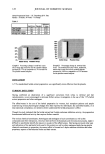
86 JOURNAL OF COSMETIC SCIENCE 80. 60- 40- 20- 0 8o o/w EMULSION t-- W/O EMULSION , , ,.., , , oo •--r •T / • ...... •T -,-,-,,,-,- 40- 20 OMC BENZOPHENONE-3 r-i CONTROL • PP-2 [•] TRICONTANYL PVP COPOLYMER * Represents significant differences from control (p0.10) Figure 1. Amount of sunscreens washed off from emulsions in water-resistance measurements using pig skin (n: 4).
Purchased for the exclusive use of nofirst nolast (unknown)
From: SCC Media Library & Resource Center (library.scconline.org)