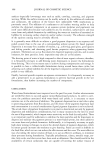
70 JOURNAL OF COSMETIC SCIENCE (5). Cracks and hair fracture are, certainly, two necessary steps during "split end" formation however, the occurrence of longitudinal cracks such as those observed in "split ends" rarely takes place in hair by the action of longitudinal stresses (6,7). In this paper it is shown that cyclical torsion stresses with strain levels beyond the elastic limit (8) produce long longitudinal cracks identical to those observed in hair fibers with split ends. The appearance of these cracks in the analyzed hair fibers was found to result from localized plastic deformation in the cuticles preceded by the formation of shear bands and crazing. Shear band and crazing are the main phenomena accompanying localized shear stresses in polymeric materials (9,10). Shear bands involve strain-localized softening of the material without changes in its density. Craze formation involves, on the other hand, a localized loss of cohesion with significant decreases in density examples of crazing are microvoid and microfracture formation in the material. In the following paragraphs it will be shown that all these types of plastic deformation also occur in human hair cuticles--in particular, at the hair tips and on cuticular regions undergoing split end formation. EXPERIMENTAL METHODOLOGY The hair fibers selected for these experiments were from a subject whose hair was washed only with a 10% aqueous solution of SLS for a period of one year the fibers had a diameter of approximately 82 + 11 !•m. Only portions of hair close to the root and with no damage at all in its cuticles were chosen. The selected hair fibers were then subjected to torsion cycling. Cyclical torsion was applied to the hair fibers by using a 2-V DC reversible motor whose speed and number of turns in each direction were regulated with an electronic controller. The shaft of the motor was attached to one end of the hair fiber while the other hair end was fixed to a bracket. Each torsion cycle consisted in applying to a single hair fiber between 4 and 40 turns/inch, first clockwise and then counter- clockwise. A total of 20 of these cycles was applied to each of at least five fibers. It should be pointed out here that, when the number of cycles was lower than ten, only traces of surface damage were observed. When the number of cycles was increased to 20, the cuticle damage patterns became fully developed in all cases. For this reason, unless otherwise stated, all torsion experiments were carried out using 20 cycles. Three dif- ferent relative humidities (30%, 65%, and 100%) were chosen to carry out the experi- ments. The torsion-fatigued fibers were analyzed by SEM, and their damage patterns were compared with those found in hair from a panel of 100 individuals. The panel consisted mostly of women with Caucasian brown hair that had never been treated chemically. At least ten fibers per each individual were analyzed by SEM. RESULTS EFFECTS OF HAIR TORSION AT LOW RELATIVE HUMIDITIES Low levels of fiber twisting, i.e., four to eight turns per inch applied to hair at 10% RH resulted in torsional deformations that were predominantly viscoelastic and reversible. For instance, a single cycle of six turns/inch applied to hair caused a delay in the

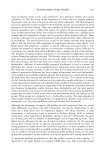
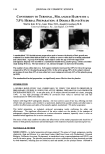
PLASTIC YIELDING IN HAIR CUTICLES 71 deformation recovery of the fiber upon stress release. SEM surface analysis of hair fibers subjected to a total of 20 of these cycles showed that their cuticles did not suffer any damage at all. As the number of turns per inch per cycle increased to 10-15, the deformation became partially irreversible and the first signs of cuticular damage ap- peared on the hair. Figure la shows patterns of cuticle damage fully developed after the application of 20 of these cycles. It can be seen in this figure that the hair damage effects appear as long helicoidal regions of damaged and undamaged cuticles around the lon- gitudinal axis of the hair fiber. Such a helicoidal pattern results from the damage occurring at the regions of maximum stress when the fiber is twisted. Figure lb shows a higher magnification of the damaged areas with abundant microcrack and microvoid formation. At higher levels of torsion, 20 cycles and 19-25 turns per inch per cycle, the microvoids and microcracks coalesced and gave rise to the formation of thin, shallow, longitudinal cracks that propagated along the cuticular envelope. Cracks frequently penetrated into the cortex but without splitting the fiber into two sections (see Figures 2a and 2b). At 25-30 turns/inch/cycle thin cracks developed into macroscopic longitudinal fractures that split the fiber into two portions (see Figure 3a). The appearance of such cracks is akin to those found in hair with "split ends." It is important to mention that the formation of longitudinal cracks and longitudinal fractures such as those depicted in Figures 2a, 2b, and 3a was found to be exclusively the result of torsion. The application of high tension or bending stresses to a hair fiber resulted in cracks perpendicular to its longitudinal axis. A more detailed description of hair fracture under high-tension stresses is given elsewhere (11,12). Analysis of hair from a panel of 100 individuals showed that plastic deformation of cuticles and long longitudinal cracks also occur commonly in panelists' hair. The analysis showed that approximately 80% of the panel population presented similar damage ..= Figure l. Helicoidal patterns of cuticle damage produced after the application of 20 torsion cycles, 15 turns/inch per cycle at 10% RH. (a) x0.42k (b) x2.6k.
Purchased for the exclusive use of nofirst nolast (unknown)
From: SCC Media Library & Resource Center (library.scconline.org)