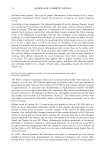
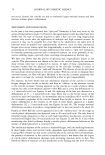
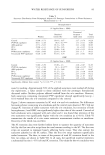
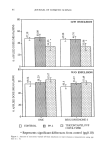
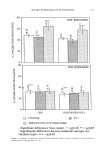
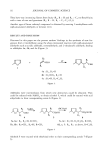
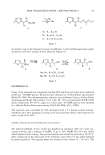
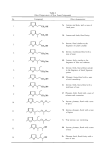
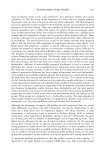
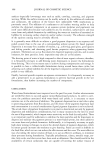
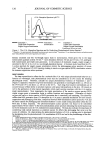
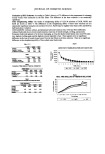
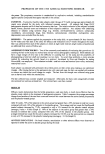
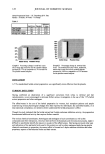
72 JOURNAL OF COSMETIC SCIENCE ß 2b Figure 2. Long, thin, longitudinal cracks produced after the application of 20 torsion cycles, 25 turns/inch per cycle at 10% RH. (a) x0.42k (b) xl.21k. patterns--in particular, at the tip sections of hair. For instance, a panelist hair fiber with a typical long longitudinal macrocrack is shown in Figure 3b. The micrograph shows that the crack has occurred in the middle of a wide and long surface zone partially devoid of cuticles. This damage characteristic is similar to that produced artificially by fiber twisting as displayed in Figure 3a. Microvoids, microcracks, and long cracks were also found to occur in hair fibers that had been abraded with a combing wheel, even at smaller deformations. Whether the cuticle damage patterns were found in panelists' or artificially damaged hair, the observed damaged regions were found to form helicoidal strips approximately 30 microns wide and 2 to 3 millimeters long. Figures 1, 2, and 3 show that their main feature is the lack of cuticles, suggesting that they may have been abraded before or during the fatigue experiments. This possibility was ruled out because the tested hair was collected from hair sections close to the roots and was characterized by undamaged cuticles. Also, cuticle wear experiments using a combing wheel revealed that the apparent lack of cuticles in fibers subjected to torsion is not due to wear. For instance, two hair surfaces are shown in Figures 3c and 3d, one of a hair fiber subjected to 120,000 combing strokes and another subjected to 20 cycles of torsion with 15 turns/inch/cycle. As illustrated by Figure 3c, in the case of the hair fiber subjected only to combing wear, a narrow region is fully worn up to the cortex. At the periphery of this region one can perceive about four or five cuticle layers overlapping each other in a stepwise descendant fashion, i.e., cuticles and regions without cuticles are not at the same topographic level. In contrast, the fiber subjected to torsion experienced no cuticle overlapping instead, the surface of the top cuticles is at the same topographic level and fused with the regions devoid of cuticles (see Figure 3d).

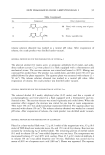
PLASTIC YIELDING IN HAIR CUTICLES 73 3b Figure 3. Macroscopic long longitudinal cracks found in hair fibers as follows: (3a) after the application of 20 cycles, 30 turns/inch per cycle at 10% RH (3b) typical crack found at the tip section of a hair fiber undergoing "split end." The hair was from a person in the panel of 100 individuals. 3c: Pattern of cuticle wear shown by a hair fiber after being subjected to 120,000 combing strokes with a combing wheel. 3d: Micrograph of a hair fiber after the application of 20 torsion cycles with 15 turns/inch/cycle at 10% RH. These observations indicate that the lack of cuticles in the torsioned fibers is not due to cuticle wearing. Rather, the cuticular material is still there and the apparent absence of cuticles is due to the prospect that they have lost their structure and boundaries due to extreme torsional forces. In Figure 1 b, for example, a portion of nondamaged cuticle can be seen extending continuously into a zone of damage and losing its structure. Surface damage with such characteristics is also commonly observed in polymers and is known as "crazing." Crazing is a form of plastic deformation, almost unique to polymers, and appears as a "whitening" of the material when subjected to intense and repetitive
Purchased for the exclusive use of nofirst nolast (unknown)
From: SCC Media Library & Resource Center (library.scconline.org)